Your cart is empty
Tax included and shipping calculated at checkout

Menú de cajones
Tax included and shipping calculated at checkout
A professional account gives you stylist pricing, priority support, early access to new releases, and education developed by working stylists.


The advice that a pain-free install is a safe install sets the bar too low. Weft hair extensions damage natural hair when attachment load, continuous wear and the client's hair condition don't match, so comfort checks must sit alongside density checks, conservative design and documented maintenance.
Fragile support hair creates the highest-risk install, regardless of the attachment name. The working assessment starts with the client's current condition, not the fullness shown in an inspiration photo.
Client conditions, risk levels and install adjustments
| Client condition | Relative risk | Install adjustment |
|---|---|---|
| Fine or low-density natural hair | Higher | Lighter weight, fewer high-load rows, wider spacing at the perimeter |
| Chemically relaxed or heavily processed hair | Higher | Lower tension, shorter wear interval, inspect shaft strength before every reinstall |
| Hair extending past shoulder length | Higher | Reduce extension length and weight, avoid concentrating mass on anchor hairs |
| Existing thinning or traction signs | Very high | Defer or modify the install and assess before any further tension |
| Healthy density, no chemical history, no prior traction | Lower, not zero | Standard protocol with tension checks at every visit |
These are qualitative planning categories, not a clinical scoring system. For the length row, the concern is the added extension length and its associated mass, not shoulder-length natural hair automatically making a client unsuitable.
A 2023 salon-based study in Yaoundé, Cameroon identified traction alopecia in 34.5% of 223 women, while 95.1% of the group used extensions regularly. The study doesn't establish that extensions caused every case, because braids, tight styling and chemical treatments can also contribute.
A dense-looking perimeter doesn't establish that the proposed row has adequate support. Separate the hair along the actual attachment path and inspect density, short broken hairs, chemical overlap and the condition of the shafts that will enter the beads.
The distinction between fine diameter and low density matters. A client can have fine strands with reasonable coverage, or coarse strands with sparse attachment zones; neither assessment should rely on ponytail circumference alone.
The practical considerations in extensions for thin hair belong in the consultation before the service is booked. Coverage requirements, concealment and support capacity must all work together.
Planning rule: A lighter install on compromised hair can still be a poorer choice than a fuller install on sound support hair.
Choose weight, length and row count only after that assessment. If the proposed result exceeds the available support, change the result rather than trying to engineer around inadequate anchor hair.
Choose the attachment after setting the client's load limits. A flatter profile, smaller bond or thinner seam doesn't establish how much natural hair will carry the finished design.
Conde Professional's methods differ in how each attachment distributes load across the supporting hair. The table pairs each option with the client profile it fits and the condition that rules it out.
Conde weft methods, qualitative fit and trade-offs
| Method | Load profile | Best-fit client | Wrong choice when |
|---|---|---|---|
| Volume Weft | Full-bodied panels distribute the selected mass along a supported row | Dense, healthy natural hair with no chemical history | Fine, relaxed or thinning hair, or heavy rows at the perimeter |
| Thin Weft | Slim seam keeps per-row weight low; row count is the load lever, and adding rows past what anchor density supports is the trigger to change methods | Lower-density installs where total weight must stay low | The requested full, heavy result exceeds available support |
| Tape Weft | Adhesive attachment near the root requires controlled placement and release | Healthy scalp, dense hair, planned removal schedule | Sensitive scalp, thinning zones or existing traction signs |
| K-Tip | Bonded attachments concentrate load at individual support sections | Clients needing bonded attachments on sound hair | Fragile hair lacks adequate anchor hair at attachment points |
| Tape-In | Adhesive tape near the root creates a flat attachment | Low-bulk installs on hair that tolerates adhesive removal | Relaxed or weakened shafts break during removal |
| Clip-In | Removable, non-permanent loading at clip locations | Clients needing frequent removal and occasional wear | Continuous wear with a fixed attachment is required |
| Bulk | Stylist determines attachment construction, weight and placement | Custom builds with a tested load plan | The stylist hasn't established a suitable load plan |
A hand-tied foundation or beaded row can conceal neatly while carrying too much hair. Switching from a row to fusion bonds or microlinks changes force distribution, and sound support sections remain a requirement either way.
Client comfort settles nothing here. A weft can sit pain-free for weeks while the follicles under its attachment points absorb more sustained load than the client's hair condition supports, which is why load, wear duration and the state of the anchor hair carry the decision.
The Johns Hopkins review of traction-related styling risks specifically identifies breakage concerns when adhesive is applied directly to the scalp, particularly during removal. Read that as a caution against scalp adhesion: adhesive systems require appropriate hair contact and a controlled removal plan.
The pictured panel illustrates the full-bodied construction under consideration.
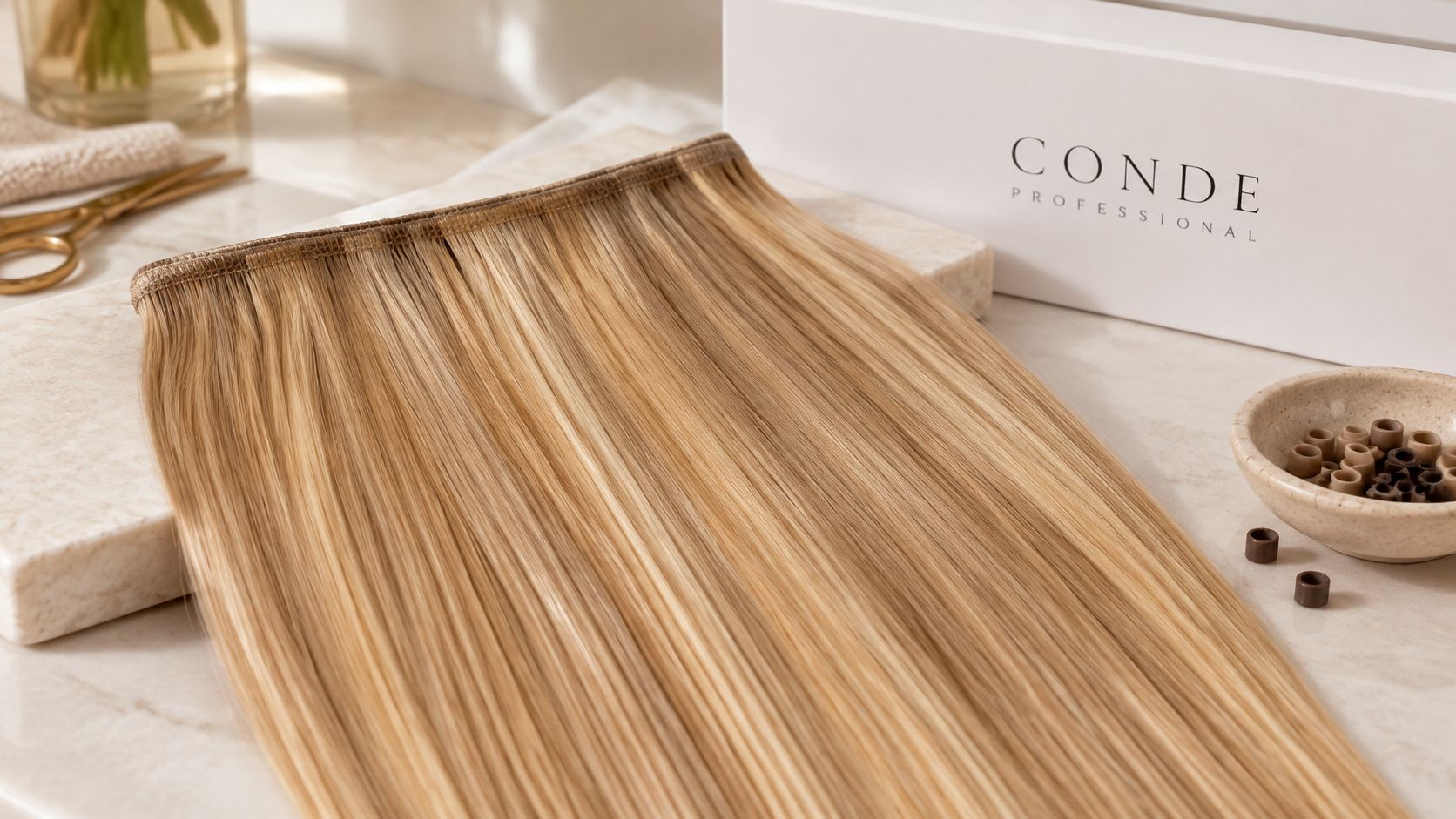
Volume Weft Flawless Blonde #7/8/11 Balayage uses dense, full-bodied machine weft panels for sew-in/bead-row application. Its color blend can solve a matching requirement while fragile support hair still rules it out.
Use the comparison of hair extension methods to narrow the attachment approach. Before recommending a method, request the actual weight and length details for the specific hair in the order from the account team.
A weft applies sustained force through its attachment points to the natural hair supporting it. A secure attachment can remain intact while the supporting hair or surrounding tissue shows damage.
A tent peg in soft ground works the same way. The peg can hold its shape and stay connected to the rope while the ground around it fails under the pull.
At the chair, that distinction separates attachment security from support capacity. A bead that doesn't slip demonstrates grip. Whether the load suits the hair underneath is a separate judgement.
A Practical Dermatology discussion of weft-related hair loss describes two patients with an unusual horseshoe-shaped traction pattern after wearing wefts and discusses four women with small, red, hairless patches at extension attachment sites, with dermoscopy identifying nonscarring alopecia rather than alopecia areata. Both findings trace the injury to the attachment site itself.
The publication describes tension pulling the shaft away from the follicular opening. It also distinguishes early nonscarring traction injury from continued exposure that can lead to scarring and permanent loss. Separating those stages is a clinical call.
For installation planning, the relevant chair-side checks are concrete:
Apply those checks across the full row, including the span between the endpoints.
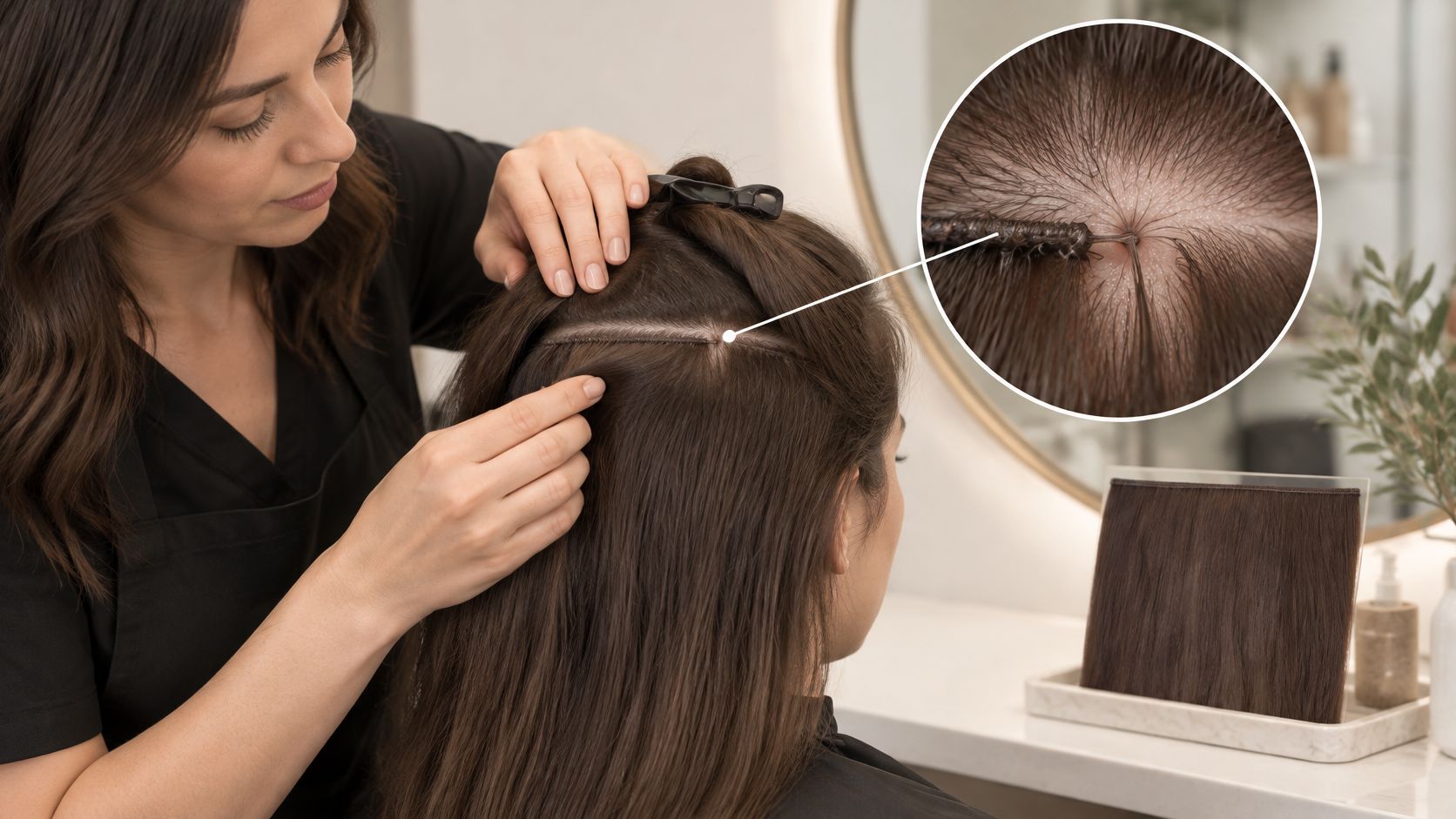
A review available through the National Library of Medicine identifies extension length, extension weight and wear duration as contributors to traction-related injury. Continuous wear means the supporting hair remains loaded outside the salon, including during sleep.
A row keeps loading the same anchors after the client stops noticing it. Sleep positioning, tight upstyles and brushing add directional pulling to the weight already present.
Chemical processing and repeated heat exposure also belong in the support assessment. An attachment map that suited a client before substantial processing needs a fresh look once the natural hair's condition changes.
A durable extension panel and a tolerable installation interval are different decisions.
The question of how long extensions last therefore needs separate answers for product condition and continuous attachment. Hair that remains cosmetically usable can still need removal, reassessment or a different placement plan.
Give clients the honest version of load management: greater length or weaker support hair calls for a lighter design or a different service plan, even when the attachment method stays the same.
No install can promise the absence of traction. The defensible objective is to minimize unnecessary pulling, distribute the selected load and stop treating removal as a routine detachment task.
For sew-in weft installation planning, use a repeatable protocol that records both the starting condition and the condition after removal.
The visual guide reinforces the main checkpoints within that service sequence.
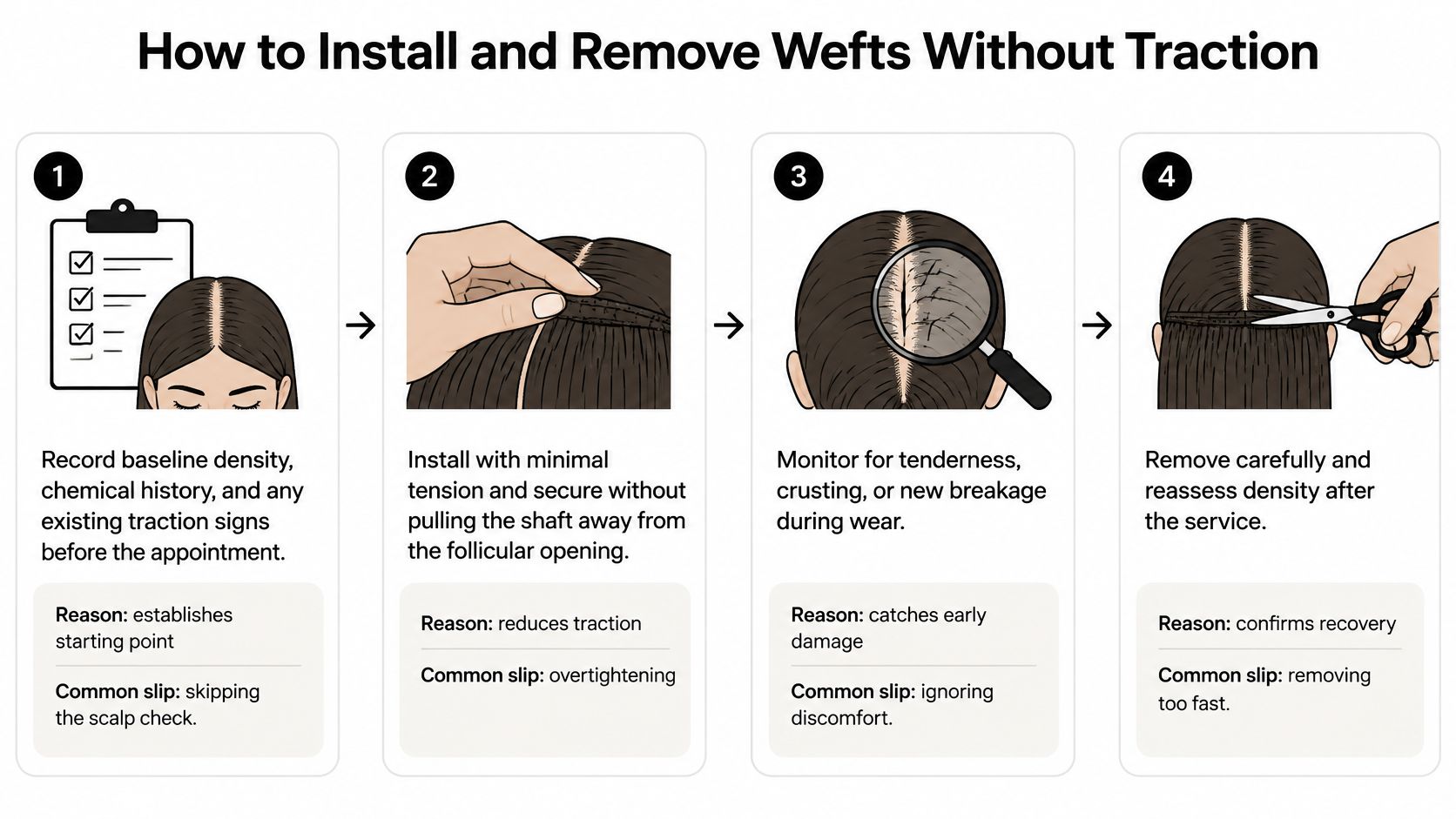
A satisfactory removal leaves intact support shafts, no crusting and no new tenderness at former attachment points. Retained shed hairs alone don't establish damage, but short broken hairs or a changed attachment-zone appearance require a different decision than a routine reinstall.
A client can leave the chair pain-free and still carry traction damage nobody has seen yet. A dermatology review reports that trichoscopic examination found broken hairs and signs of traction alopecia in all 12 women studied who wore extensions despite reporting no hair-loss complaints. The group is small; what it shows is that a comfortable install can hide stress that a client's symptoms and a quick glance at the roots will both miss.
Early warning signs, likely meaning and chair-side action
| Early sign | What it usually indicates | Chair-side action |
|---|---|---|
| Short broken hairs along a row | Mechanical breakage at the attachment | Lighten the row, loosen tension, recheck at the next visit |
| Reduced density along attachment zones | Possible traction affecting the follicle or shaft | Stop adding load, document the change, refer if it persists |
| Tenderness or pain at the base | Excessive loading on the follicle | Loosen or remove the affected section; don't treat pain as adaptation |
| Itching, scalp tenderness or headaches reported | Possible scalp irritation or excessive tension | Assess the scalp, shorten the wear interval, reassess before reinstalling |
| Changes at the hairline or temples | Possible tension concentrated at perimeter anchor points | Redistribute attachments away from the hairline and temples |
Read each sign as a trigger for a service decision. Pinpointing the cause sits outside the chair: itching and headaches can come from sources other than the installation, so symptoms that persist after you adjust the load deserve clinical assessment.
The American Academy of Dermatology's hairstyle guidance advises changing styles that cause pain or irritation. Stop the row when the base is tender. A pain report between visits means the plan needs adjusting before the scheduled move-up, because an attachment that hurts is already loading the follicle past what it tolerates.
Knowing the structure of hair helps you keep shaft observations separate from follicle-level questions when you document what you see. For clients who ask about home care between visits, ProMD Health's resource on scalp care for thinning hair supports that conversation.
Weight, length, attachment density, processing history and continuous wear all shape how much load a follicle is carrying at any given visit. Record the baseline at consultation, then repeat the same partings and scalp observations at every maintenance appointment. Subtle density shifts hide easily under a fresh style, and catching them early keeps your options open: lighten the row, widen the spacing, or shorten the wear interval before the follicle shows it in the mirror.
Pause the service when tenderness, crusting or new breakage appears. If the concern is confined to an attachment zone, remove its load and reassess before considering a lighter or relocated attachment; persistent inflammation, unresolved density changes or smooth, shiny areas require referral rather than another concealment strategy.
The distinction is between a cosmetic service problem and a question that needs clinical evaluation. Document broken shafts, compare photographs and change the attachment plan where the record supports it. Diagnosing the cause of thinning and promising regrowth belong to the clinician, so keep both out of the consultation.
Broken lengths require a plan that avoids further mechanical damage while the natural hair grows. Conditioning and a revised cut improve handling and appearance in the meantime. Neither one answers whether a former attachment site can carry weight again, so treat readiness as a separate question settled by scalp condition and support-hair strength at follow-up.
A dermatology review of traction alopecia discusses pulling over time and the distinctive horseshoe pattern associated with repetitive wefting. Follicle-level concerns need a different response from trimming damaged ends, particularly when the scalp's appearance has changed.
For clients seeking medical assessment, information about hair loss care at Luxe Aesthetic Surgery provides a starting point for discussing clinician-led options. A referral should include the service history, observed changes and photographs when the client consents.
Scalp inspection belongs before the next attachment decision.
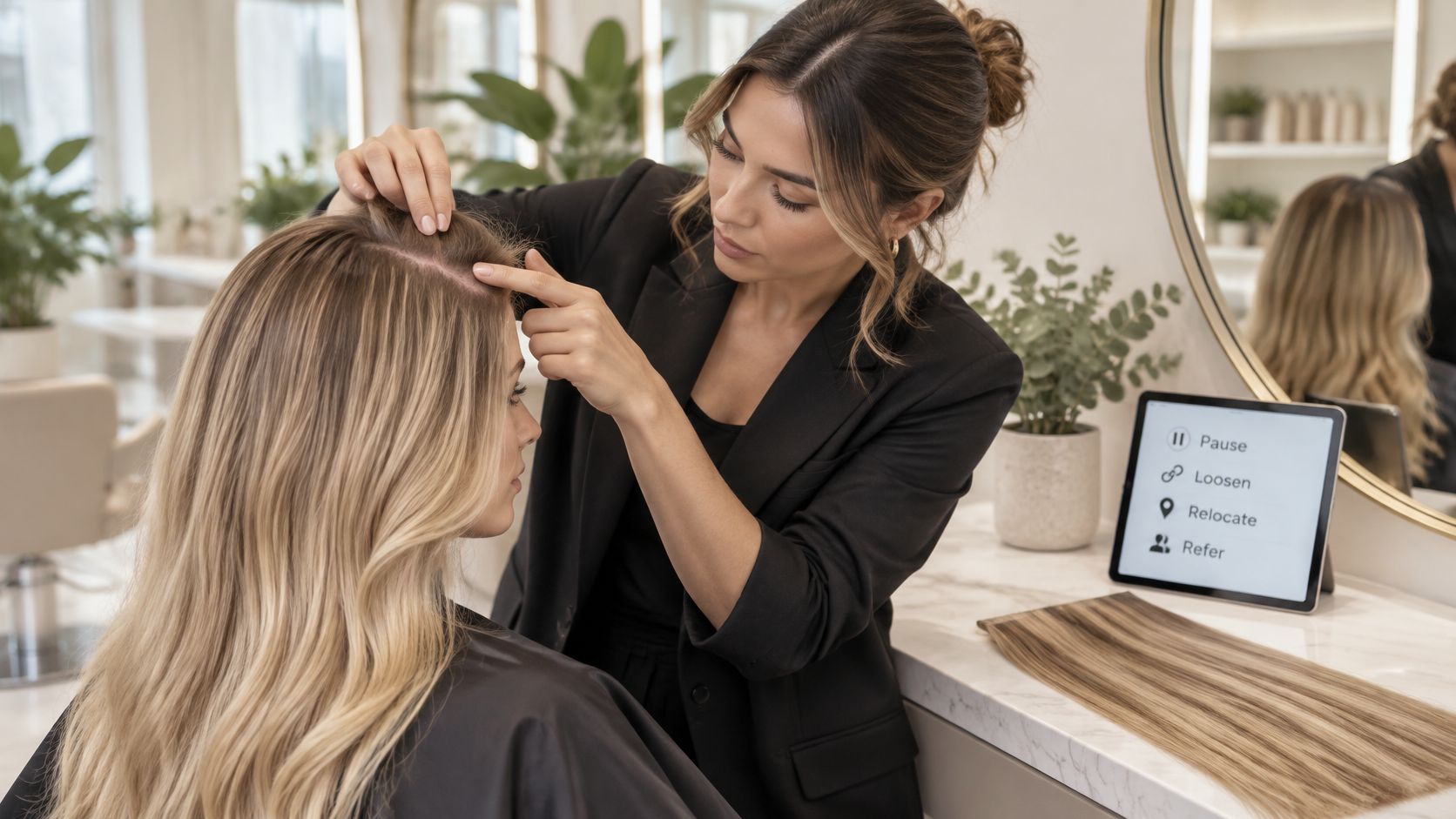
A Practical Dermatology report on traction-related styling cites removing weaves and extensions after six to eight weeks to avoid uninterrupted traction. Treat that interval as the outer limit for review. Plenty of clients need a closer look well before it.
A compromised attachment zone may need attention within days. A calendar break alone leaves the readiness question open; the next decision should use documented scalp condition, support-hair condition and any clinician guidance.
Reinstallation criterion: An available appointment says nothing about whether the support hair is ready.
The remaining work is administrative, and it directly shapes the next service decision:
Supplier consistency and appropriate installation remain separate responsibilities. Good extension hair can still be the wrong load for a particular client, and a precise shade match changes nothing about an unsuitable base.
Conde Professional sells professional hair extensions and offers education for stylists, including courses covering installation techniques, pricing and business development. This week, visit Conde Professional to open a professional account and request weight, length and method details for the installs the salon plans to offer.


