Your cart is empty
Tax included and shipping calculated at checkout

Menú de cajones
Tax included and shipping calculated at checkout
A professional account gives you stylist pricing, priority support, early access to new releases, and education developed by working stylists.


The most repeated advice about thick hair is that it carries more extension weight than any other client, so give her more. That advice is backwards. Density tells you how much hair sits on the head, not how much pull the follicles will tolerate, and the clients who leave with sore temples and thinned hairlines are almost always the ones who were told their thick hair could handle anything.
Two variables get skipped in that conversation. Strand diameter decides how much load a section carries before it dimples, and condition decides whether the fiber can take load at all. A dense head of fine, bleached strands is the most fragile client in the salon, and she is also the one most likely to be sold the heaviest method on the shelf.
Read density, caliber and condition as three separate measurements and the best extensions for thick hair stop being a product question. It becomes a load question. Method, section size, gram distribution and maintenance interval all fall out of those three readings in a fixed order.
Thick is a word that hides three measurements, and each one pushes the method in a different direction. Density is how many follicles sit per unit of scalp. Strand diameter is the caliber of each individual fiber. Condition covers elasticity, porosity, chemical history and how much the client is shedding this month.
Those three don't move together. The 2016 European Journal of Dermatology study examined 2,249 healthy adults aged 18 to 35 from 24 ethnic groups across five continents and found median strand diameter ranging from roughly 69 micrometers to 89 micrometers between groups (p < 0.001), while total density followed its own pattern: Caucasian hair carried relatively high density, Asian hair tended toward thicker strands and faster growth, and African hair showed lower density and slower growth. Density and caliber are independent readings, and every client is one sample of both.
Averages also flatten the head in front of you. Comparative scalp-hair analysis summarized in Penn State honors research measured East Asian hair averaging 92.67 micrometers, European hair at 78.04 and African hair at 79.41, yet still found African samples with a significantly larger maximum diameter than European samples. The mean describes a population. It says nothing about the nape fiber between your fingers.
Client one has high density with fine, healthy strands. She looks like a heavy-weft candidate and she isn't. She takes a lighter weft, smaller attachment zones, and more of them, because heavy panels on fine fiber concentrate stress fast.
Client two has moderate density, coarse strands and relaxed ends. Coverage is easy. The load comes down anyway and every attachment stays off the weakened lengths, because chemical straightening reduces tensile strength and leaves the fiber less able to tolerate pull.
Client three is dense and double-bleached. Density masks fragility, which is the worst combination in the book. The lowest-stress method wins even when the finish is a little less full than she pictured.
Assessment rule: diameter sets the weight ceiling, density sets how many attachments the head can carry, and condition sets the method. Never let the density number make the other two decisions.
Wet-stretch a shed strand to judge elasticity before you commit to a method. Note where the natural ends meet the planned extension hair, watch the brush for shedding, and ask about the last set. A client whose previous install thinned her temples has already given you the answer.
Density tells you how much coverage the client has. It does not tell you how much tension her strands can tolerate. Choose the method for strand condition and attachment load first, then use density to plan coverage and the finish to guide placement. Conde Professional offers Volume Weft, Thin Weft, Tape Weft, Tape-In, K-Tip, Bulk and Clip-In methods. Each can be the wrong choice when its load or wear demands exceed the client's limits.
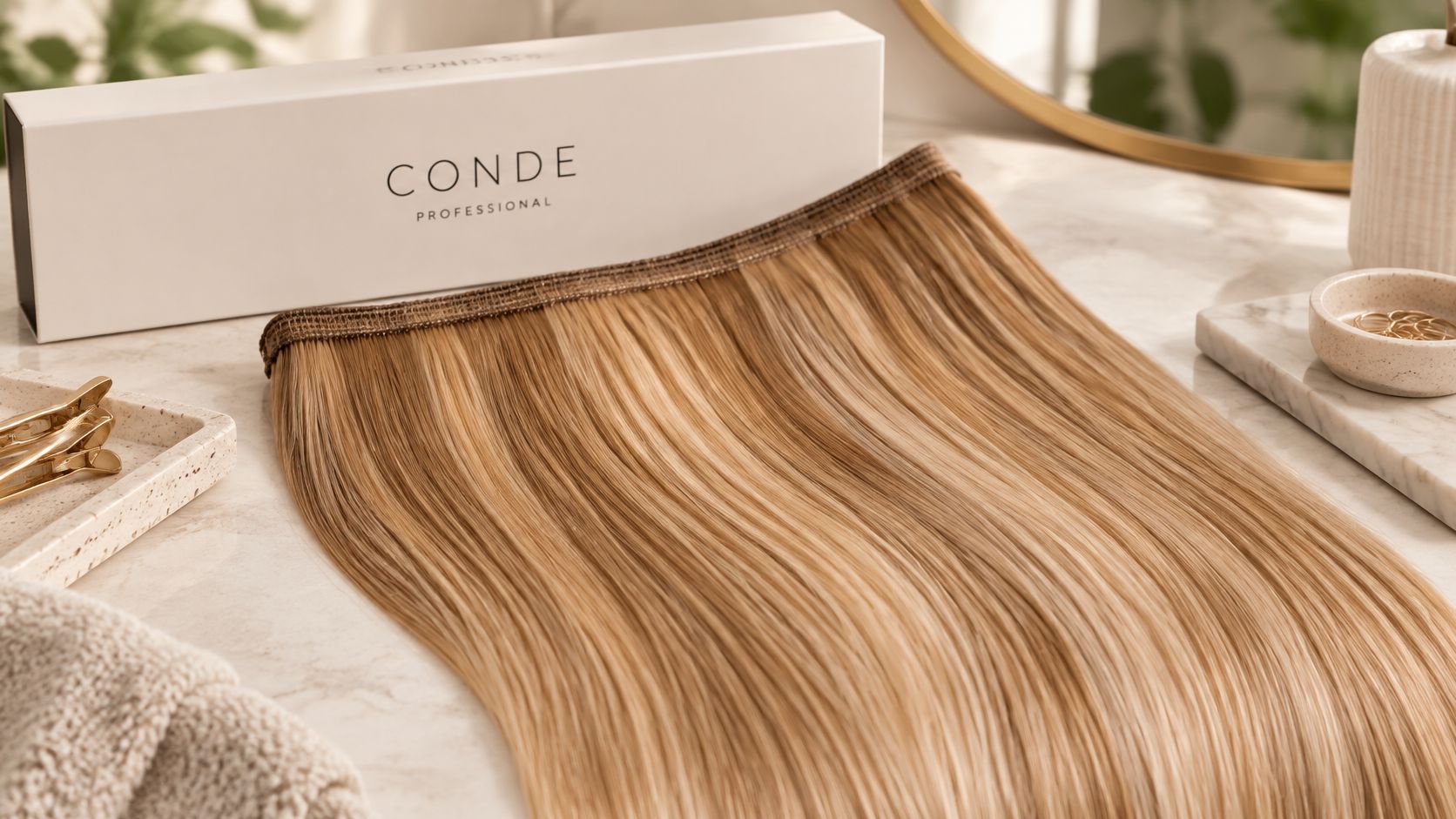
For dense, healthy, coarse strands and a full-coverage finish, consider Volume Weft Flawless Blonde #7/8/11 Balayage. Its shade blends #7, #8 and #11, but the color still needs to be matched against the client's hair. A weft places hair along a row, so the foundation and the natural hair supporting it must tolerate the combined load. Avoid a heavier row for a client with a compromised hairline, tender crown or history of temple thinning.
| Client profile | Starting method | Main trade-off |
|---|---|---|
| Dense, healthy, coarse strands; full coverage | Volume Weft | Row weight requires a foundation the natural hair can support |
| Dense hair, fine strands; lighter finish | Thin Weft | Lighter row load; check whether coverage is sufficient |
| Dense hair; flat, even row placement | Tape Weft | Adhesive load at each panel; avoid heavily compromised hair |
| Fine perimeter or sensitive hairline | Tape-In, placed away from hairline | Adhesive load per panel; check scalp tolerance before each wear |
| Dense hair; movement and precise blending | K-Tip | Longer installation; bonds are removed individually |
| Fragile, bleached or relaxed hair; temporary wear | Clip-In | No bonds remain in the hair; the client removes and reapplies it |
| Fullness added to existing braids | Bulk | Loose bundles depend on a secure braided foundation |
Tape-In can suit a fine perimeter or sensitive hairline when panels sit away from the hairline and placement accounts for scalp tolerance. Adhesive still creates a load at each panel. Moving attachments away from fragile tissue reduces direct stress there, but does not make weakened hair suitable for extensions.
K-Tip suits clients who need movement and precise blending through the mid-lengths, provided they can accommodate a longer installation and individual bond removal. It is a poor fit for a client who needs a quick appointment or fast removal. For fragile, bleached or relaxed hair, Clip-In avoids leaving bonds attached between wears, though repeated application still requires careful handling. Bulk means loose Remy human hair bundles. Because they rely on a braided foundation, they are not a shortcut around weak strands or an unstable base.
The methods differ in attachment and removal demands. Wefts are sewn into place, while K-Tip bonds are activated with heat. That distinction matters when the scalp is sensitive or the natural hair is compromised. Compare the available hair extension methods by attachment load, placement and removal, rather than choosing by hold alone.
A review of human-hair nanomechanics supports a practical distinction: coarse or dense natural hair can visually carry fuller coverage, but adding more fiber beyond the client's needs adds mass and traction at attachment points. Texture also affects blending. Wavy or textured extensions may sit more naturally with coarse hair than ultra-sleek fibers, which can require more heat or backcombing to blend. On lightened ends, reducing heat passes helps limit additional stress.
The weakened-hair scenario makes the choice clear: a client can have abundant hair and still lack the strand strength to support a heavy method. Reporting on extension safety notes that extension weight and texture should suit the natural hair, and that extensions on weakened or damaged hair raise the risk of breakage and hair loss. Damage may be present even when the wearer reports no symptoms. Let condition set the method, then use density to determine coverage. If the client cannot tolerate a long install or needs easy removal, choose a lighter-service option even when her density could accommodate more hair.
A grade label cannot tell you how a bundle will perform in a dense install. Grades such as 6A through 10A are supplier labels with no governing standard, so the same grade can describe hair with different cuticle condition, processing and durability. Judge the sample and batch, not the number on the listing.
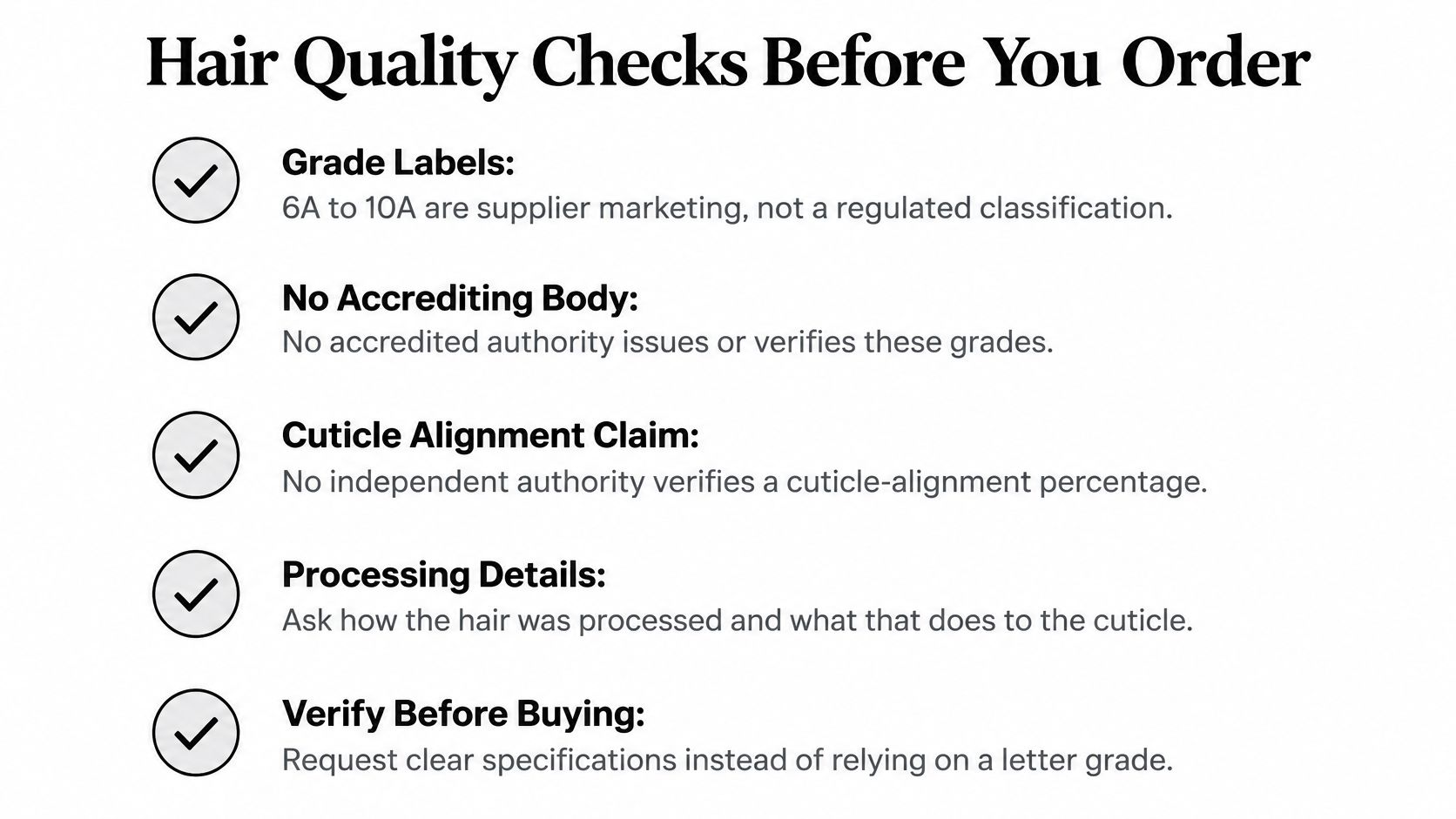
These checks matter in dense work because knots and tangles can make blending and move-ups more difficult. A thick head of hair does not make a fragile extension strand more durable, and extra combing can add stress to both the fiber and the install.
Conde Professional checks each batch for weight, color accuracy and strand strength, and hair that falls short of its standards stays at the facility. The company also checks cuticle integrity and color blending so the hair looks natural and wears well over time. Ask suppliers about batch checks, then assess the sample yourself before ordering for a client.
Human hair accounted for 55.8% of a North American extension market estimated at USD 1.527 billion in 2025, according to Ken Research. That market share does not establish the quality of a particular bundle, so check the product itself. Review what Remy human hair actually means to understand the term, then keep a record of the sample and batch that meet your standards.
Dense hair can hide an overloaded attachment, but it does not make the follicles beneath it more tolerant of tension. Placement determines the load on each follicle more than total grams do. Consider strand diameter and condition separately from density: coarse, resilient hair may support a different distribution than fine or fragile hair on an equally full head.
Dermatology literature identifies weaves, braids and extensions as high-risk styling practices because prolonged or repeated tension can injure follicles. Risk increases with the force and duration of the pull, while chemically relaxed hair can be more vulnerable because straighteners reduce tensile strength and increase brittleness (traction and follicle injury). Choose broad, lightweight attachment zones or several smaller points to spread the load, rather than concentrating a heavy bundle on a few strands.
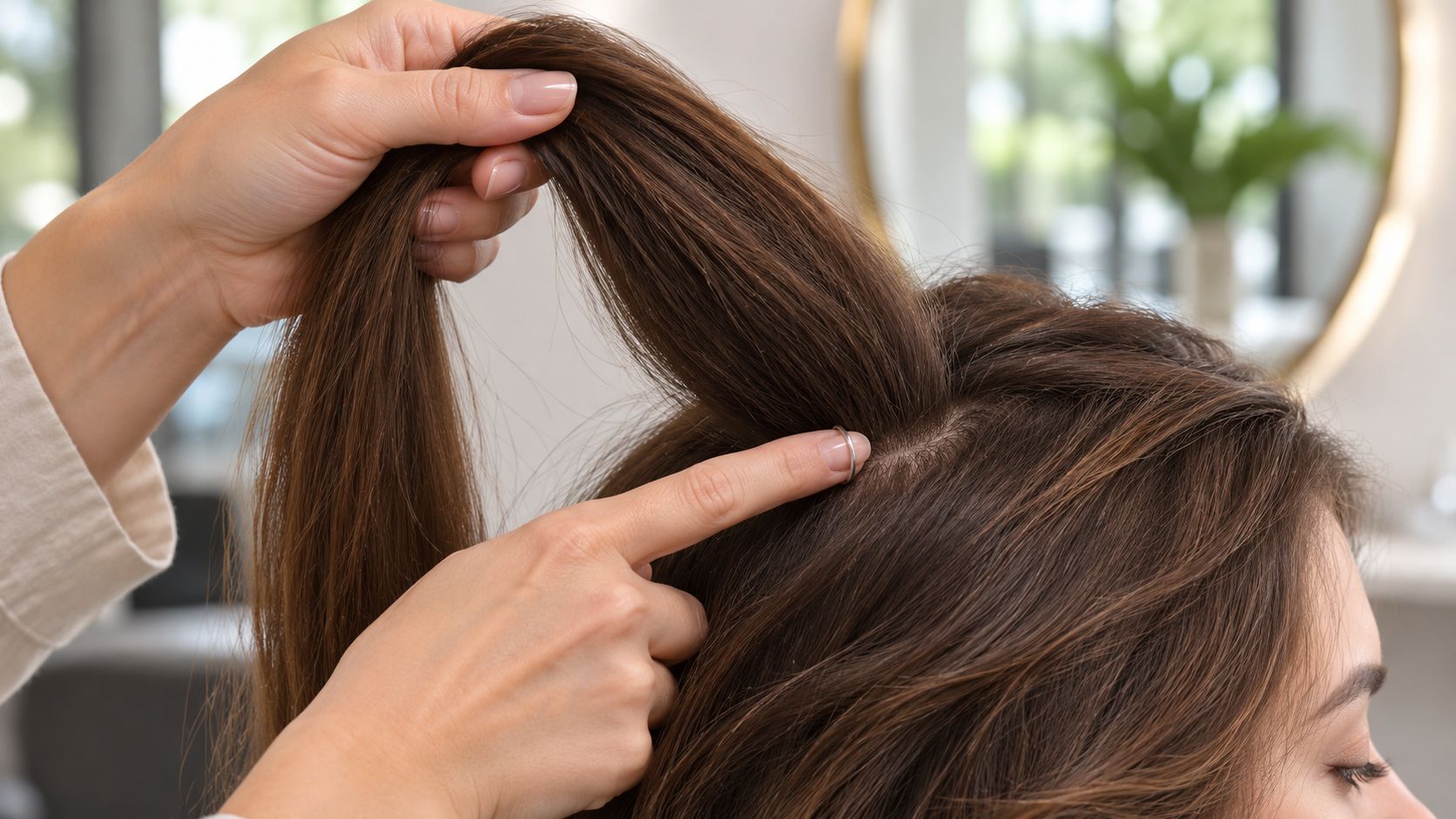
A medical review of extension wearers found broken hairs and signs of traction alopecia under magnification in women who had not reported hair loss. It also notes that added length increases weight and tension, and recommends limiting wear duration and avoiding excessive length (traction alopecia in extension wearers). For a long install on a client with dense but fine hair, evaluate the added length as part of the load, not as a styling detail. Density alone does not establish what the hair can safely carry.
Check the attachment base immediately after installation. Dense coverage can make pulling less obvious to the eye, so assess the scalp and ask the client about comfort.
If an attachment causes pain, remove or reposition it, then check the base again before the client leaves. Set the maintenance interval at installation. As natural hair grows, the stress point shifts, and a row that felt comfortable early in wear can begin pulling later. Review how weft installations can stress the hair when choosing a method, and avoid installing over an actively shedding, fragile or recently compromised area.
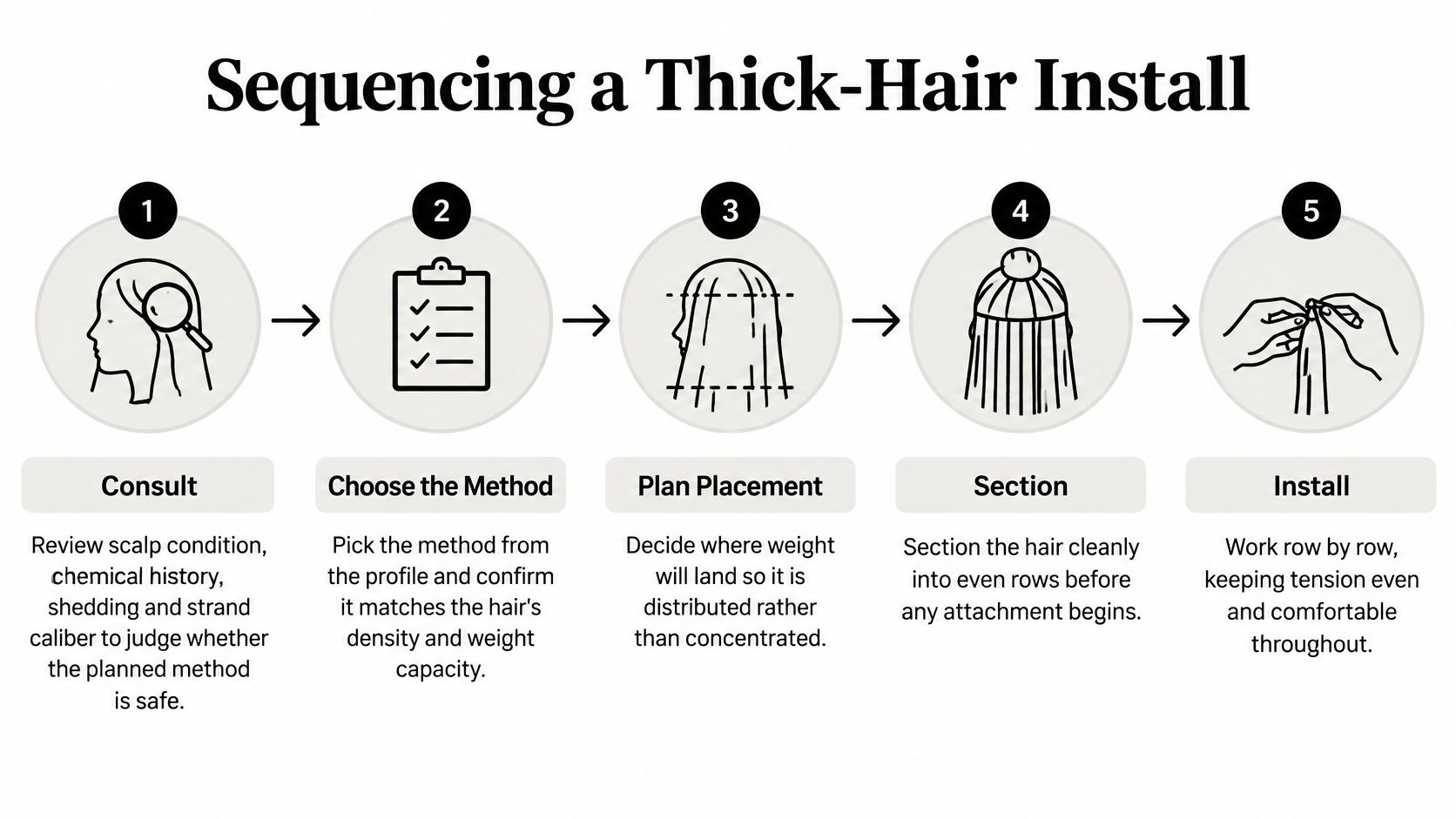
High density does not mean every strand can carry more weight. Sequence the install around strand diameter and condition first, then map attachment size and placement to the load each area can tolerate.
For I-Tip quantity planning, a typical thick-hair installation may use 100 to 150 strands, compared with 50 to 75 for fine, length-focused work and 75 to 100 at medium density. Strand loading may be around 0.7 to 1.0 grams, with a full head near 100 to 150 grams, application taking about two to three hours, and maintenance every six to eight weeks. Treat these as planning figures, not a specification. Length changes the load: an 18-inch install and a 28-inch install at the same strand count place different demands on the same follicles.
Use sectioning guidance for extension installs to keep partings controlled, then confirm that every attachment sits securely without forcing fine or fragile strands to carry more than their share.
Pulling at the temples is the complaint that fills the books, and it usually isn't the method's fault. It's panel weight or placement, and diagnosing it takes five minutes at the chair.
Extension education material ties traction to attachment weight, section size, preparation tension and wear pattern together, and names heavy or bulky attachments, tight installation, prolonged continuous wear and repeated high-tension styling as the contributors (professional extension education). Slippage belongs on that list from the other direction: an attachment that shifts under combing concentrates its load onto fewer strands every time it moves.
| Symptom | Likely cause | Fix |
|---|---|---|
| Pulling or tenderness at the temples | Panel too heavy or placed too tightly | Reduce panel size, re-section and move the attachment off the hairline |
| Slippage during wear | Too little natural hair under the attachment | Re-map density, add smaller attachments and check the foundation |
| Visible line at the root | Shade does not match the natural level | Move to a Rooted shade line or tone the root |
| Ends that look flat after balayage or highlights | Solid shade used on dimensional hair | Switch to a Balayage or Highlights shade family |
| Matting or tangling | Poor combability or skipped brushing | Start brushing at the ends and build up toward the root |
| Bumps, redness or broken hairs | Excessive tension or chemically fragile hair | Remove the affected section and refer if the reaction persists |
Some of these you close today. Re-sectioning, moving attachments off the hairline, starting the brushing routine at the ends and toning a root are all same-day work. A shade-family change that needs a fresh color match takes a return visit or two, and any section that has to come out and be rebuilt over more than one appointment belongs in the calendar, not squeezed into the last twenty minutes.
Color mismatch has its own logic. Solid shades run single-tone from Level 1 to Level 12, so the match starts with the client's natural level at the root and works outward, never from the finished photo. Rooted shades exist because most natural hair isn't one flat level: the line includes White Blonde #4/12, Dark Blonde Melt #6/11, Espresso to Platinum #6/11.1, Golden Brown #7/10, Iced Beige #7.1/10.13 and Platinum Glow #8.1/12.01 across Tape-In, K-Tip and Bulk. A client who sits at a Level 6 root with cool ends needs the Rooted family, not a solid Level 8. Work through how to color match hair extensions with the swatch ring in hand, and remember dense installs show a mismatch across more surface area than fine hair ever will.
Choose one client profile from the starting-method table and select a single method to evaluate. Request a sample, then run the five quality checks before placing a full order. Dense hair can make weaknesses in the extension hair more noticeable, so judge the sample against the client's strand condition and the planned load.
Plan the install around the client's load limits and section sequence. Schedule a base check at the first maintenance interval rather than waiting for the client to report a problem. Keep the tension findings in the installation map, giving the next move-up a documented baseline.
Avoid testing on a client who is actively shedding or has chemically compromised hair. Those conditions make it difficult to assess the method safely. Consults also depend on a clear booking process, so fixing broken booking form flows can help clients request the right appointment.
Conde Professional offers Volume Weft, Thin Weft, Tape Weft, Tape-In, K-Tip, Bulk and Clip-In methods, along with courses covering extension techniques and business skills. Order a sample of the method that fits the thick-hair profile you treat most, and assess it for that client's needs. Then open a professional account with Conde Professional to begin with one method and a documented plan.


