Your cart is empty
Tax included and shipping calculated at checkout

Menú de cajones
Tax included and shipping calculated at checkout
A professional account gives you stylist pricing, priority support, early access to new releases, and education developed by working stylists.


Cuticle-intact hair extensions retain overlapping scales oriented in one direction, root toward tip, within a cuticle typically described as 5–10 layers. That directional, preserved surface is the property a stylist can test, rather than accepting softness or a premium label as proof.
The usual advice to buy Remy and trust the grade skips the receiving inspection. A polished bundle can feel excellent before shampooing and still be the wrong material for a demanding install. Fiber condition, processing history, and attachment suitability require separate decisions.
Cuticle intact describes retained structure, not a surface finish. The cuticle consists of stacked, flat cells whose exposed edges overlap like roof shingles. Root-to-tip alignment keeps neighboring fibers traveling in the same direction; reversed strands place opposing scale margins against each other.
Individual human-hair scales measured about 0.33 micrometres thick and approximately 30 micrometres long, with only about one-sixth of each scale exposed, according to the Nature paper on hair-scale structure. Most of each scale sits beneath its neighbor, which explains why preservation means more than retaining a few visible edges.
The overlapping architecture is the important distinction.
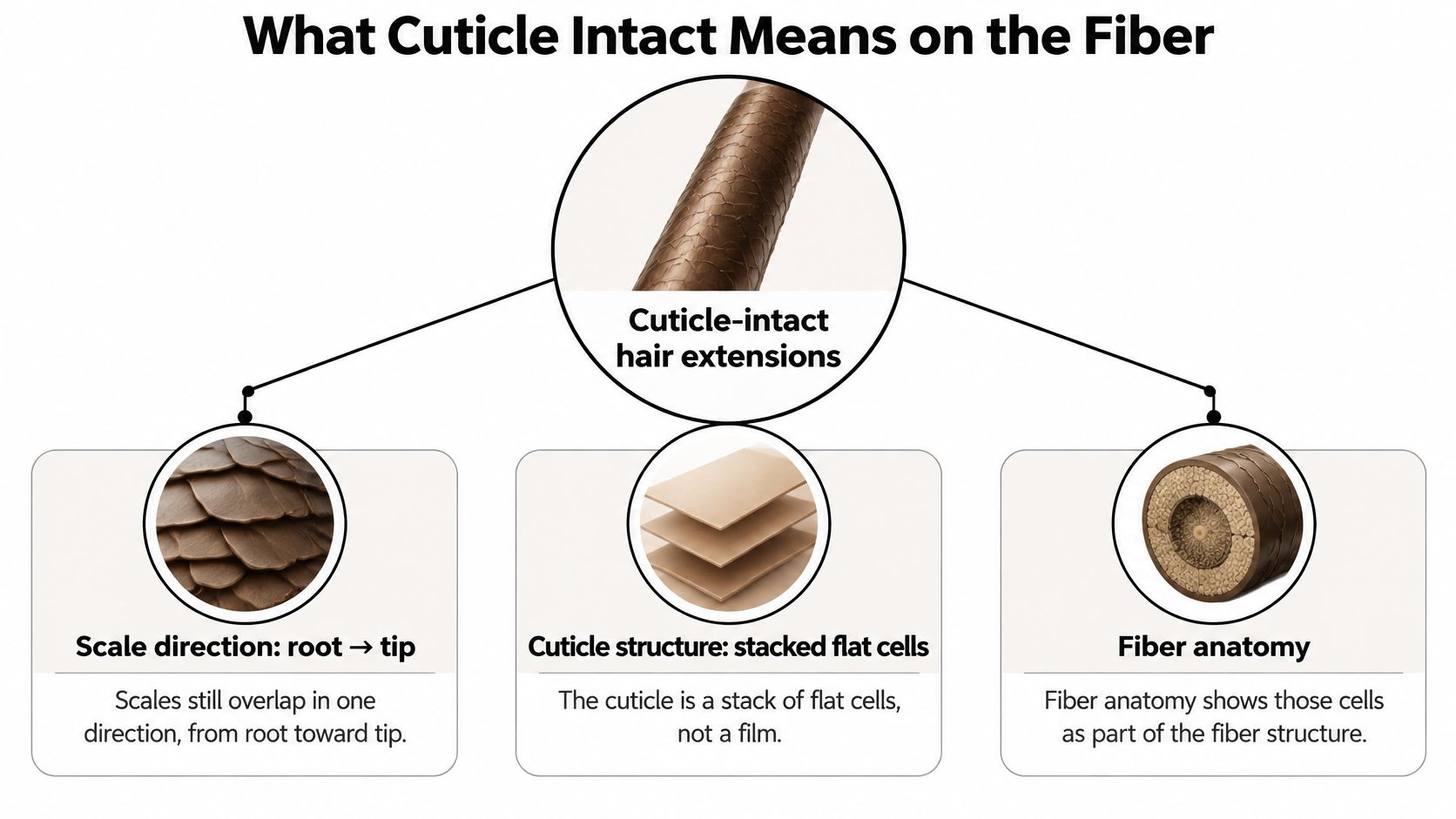
Alignment must remain consistent through sorting and attachment construction. A bundle can begin with directional hair and become troublesome if strands are reversed during sewing, tipping, or custom weft work. Preserved scales and consistent orientation are related, but they aren't interchangeable.
The shingle analogy helps explain the difference. Shingles can all point downhill while some edges remain cracked or lifted. Likewise, aligned hair can retain damaged scales, and a smooth finish can conceal roughness without rebuilding missing structure.
Conde Professional's guide to the structure of hair provides useful anatomical context for examining the surface separately from the underlying shaft.
Inspection principle: A directional surface must remain present and orderly. Shine alone doesn't establish either condition.
Cuticle-intact doesn't certify unbleached hair, an uncoated surface, or documented sourcing. Those require different evidence. Remy addresses alignment, while virgin terminology addresses processing history as the supplier defines it.
Salon owners also need to separate technical claims from promotional language before repeating them in consultations or social content. Jem Social's influencer marketing glossary is a useful vocabulary reference for assessing creator-led marketing, but marketing terminology isn't a fiber specification.
The practical payoff is a better purchasing question: What remains on this strand, and how consistently is it oriented? That question produces an inspection procedure rather than a debate over adjectives.
Receiving checks for cuticle-intact hair
| Check | Pass | Fail |
|---|---|---|
| Dry directional comb | Clear glide root to end and snag end to root | Snag or roughness in both directions |
| Damp directional comb | Direction still obvious despite higher drag | Matting, or no difference between directions |
| Macro or microscope | Closed, regular, overlapping scale edges | Lifted, detached, missing, or reversed scales |
| Wash then comb | Directional glide remains after shampoo and dry | Slip disappears and the hair then tangles |
| Shed comb-out | Few loose hairs | Short strands dump from the track, tip, or bond |
| Double-drawn look | Root and tip density stay close on one piece | Full root and a thin, wispy end |
| Supplier batch note | Notes on cuticle, color, weight, and strength | Only a 6A, 7A, 8A, 9A, or 10A label |
These are salon screening criteria, not laboratory certification. A directional difference is useful evidence, but comb feel alone can't establish microscopic integrity. Hair that feels similar in both directions should be held for closer assessment rather than automatically described as stripped.
A review of hair-fiber assessment connects cuticle alignment and integrity with combability, shine, softness, and frizz characteristics, and describes structural imaging alongside mechanical and cosmetic testing. That supports using several checks together rather than allowing a favorable hand-feel to overrule everything else.
Start with an unaltered sample from the batch intended for installation. Keep its attachment end identified, use the same clean comb throughout, and record the condition before adding conditioner, styling product, or color.
A wash test answers whether acceptable handling survives cleansing. It doesn't identify silicone chemically, prove that a coating was harmful, or establish that every change in slip came from a finish. Shampoo choice, conditioning, drying, and previous processing can all affect the result.
When slip disappears and tangling develops, hold the lot. There's no need to name the coating before recognizing an unacceptable performance change.
For double-drawn assessment, spread a single piece against a contrasting background without folding the ends together. Compare fullness through the length and note abrupt taper. This checks the density claim, not cuticle condition.
Likewise, a gentle strand assessment can reveal obvious fragility, but pulling a strand between fingers isn't a calibrated tensile test. Consistent resistance doesn't cancel visible surface damage. A tensile study using atomic-force microscopy examined different damage histories while observing cuticle behavior under loading, illustrating why structure and mechanical response deserve separate attention.
An industry explanation of human-hair grades notes that 6A, 7A, 8A, 9A, and 10A have no international governing body, and that Remy hair may still be processed or coated. Those labels aren't standardized specifications across suppliers.
Conde Professional's Remy versus non-Remy guide offers context for the alignment distinction. For purchasing, retain the actual results: direction, surface appearance, wash behavior, shedding, density, shade accuracy, and obvious weakness.
“Virgin” needs clarification too. The useful documentation identifies whether hair has been lightened, dyed, texture-treated, or finished, rather than relying on the word alone.
A grade belongs on a supplier description. A pass or fail belongs on the batch record.
Photograph the sample and attach observations to the invoice or lot reference. Approval applies to that delivery, not every future order carrying the same name.
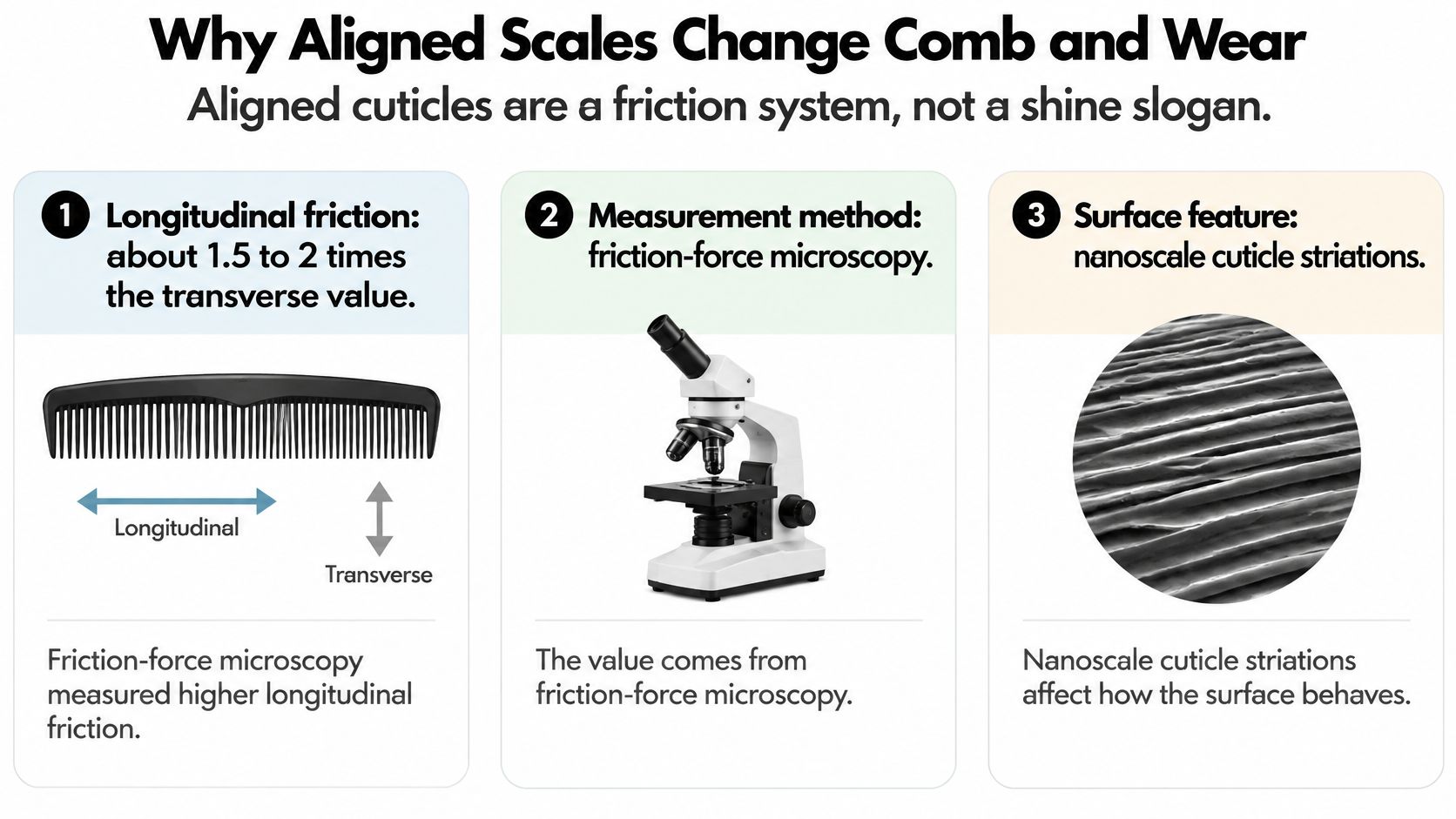
Aligned cuticles are a friction system, not a shine slogan. Friction-force microscopy research measured longitudinal friction at approximately 1.5–2 times the transverse value, with nanoscale cuticle striations about 6 nm deep. Those measurements describe directional surface behavior, not a promised reduction in salon brushing force.
Along-fiber versus across-fiber measurement also isn't the same comparison as root-to-tip versus tip-to-root combing. The salon takeaway is narrower: hair has a structured, direction-sensitive surface, so orientation and raised margins matter during repeated contact.
A beaded row, tape tab, stitch line, or fusion bond creates a working zone where fibers repeatedly contact adjacent hair and attachment material. A stylist who forces a brush through that zone adds pulling and rubbing exactly where access is already restricted.
Supporting the attachment during detangling reduces movement at the base. Clearing the ends before progressing upward avoids pushing a small snag into a larger compacted knot. The brush still travels down the strand; “ends upward” describes the order of sections, not reverse-direction brushing.
Repeated brushing can expose weaknesses that a polished initial finish conceals. In a laboratory comparison described by The Economic Times, untreated brown hair and bleached hair underwent 5,000 dry combing cycles, and the bleached fibers showed greater friction, fragility, and breakage.
That isn't a salon service-life forecast. A receiving test shouldn't attempt to translate laboratory cycles into appointments, washes, or move-ups.
Instead, brush the same retained sample with consistent handling and inspect for a developing halo of broken fibers, increasing drag, or persistent knotting. Compare like with like: the same brush, preparation, attachment support, and drying method.
Chair-side limit: Better fiber condition doesn't compensate for rough handling or an attachment that carries more hair than the section can reasonably support.
For an install planned around repeated maintenance, the useful question isn't whether the sample feels silky immediately. It's whether the stylist can handle it predictably without escalating force.
A passing delivery can become unsuitable during color preparation. Excessive bleaching can separate the cuticle from the cortex, break cuticle cells, and create cortical pores while reducing elasticity and tensile strength, according to the comparative study of bleaching-related fiber damage. The same study reported steady-state friction coefficients of approximately 0.13 ± 0.02 dry versus 0.25 ± 0.03 wet.
Those are measured conditions, not universal values for every extension bundle. They do explain why a damp sample that resists the comb shouldn't receive more pulling because wet hair appears easier to stretch.
The cortex carries most of the tensile load; the cuticle provides the protective outer architecture. Removing that protection isn't just a cosmetic change.
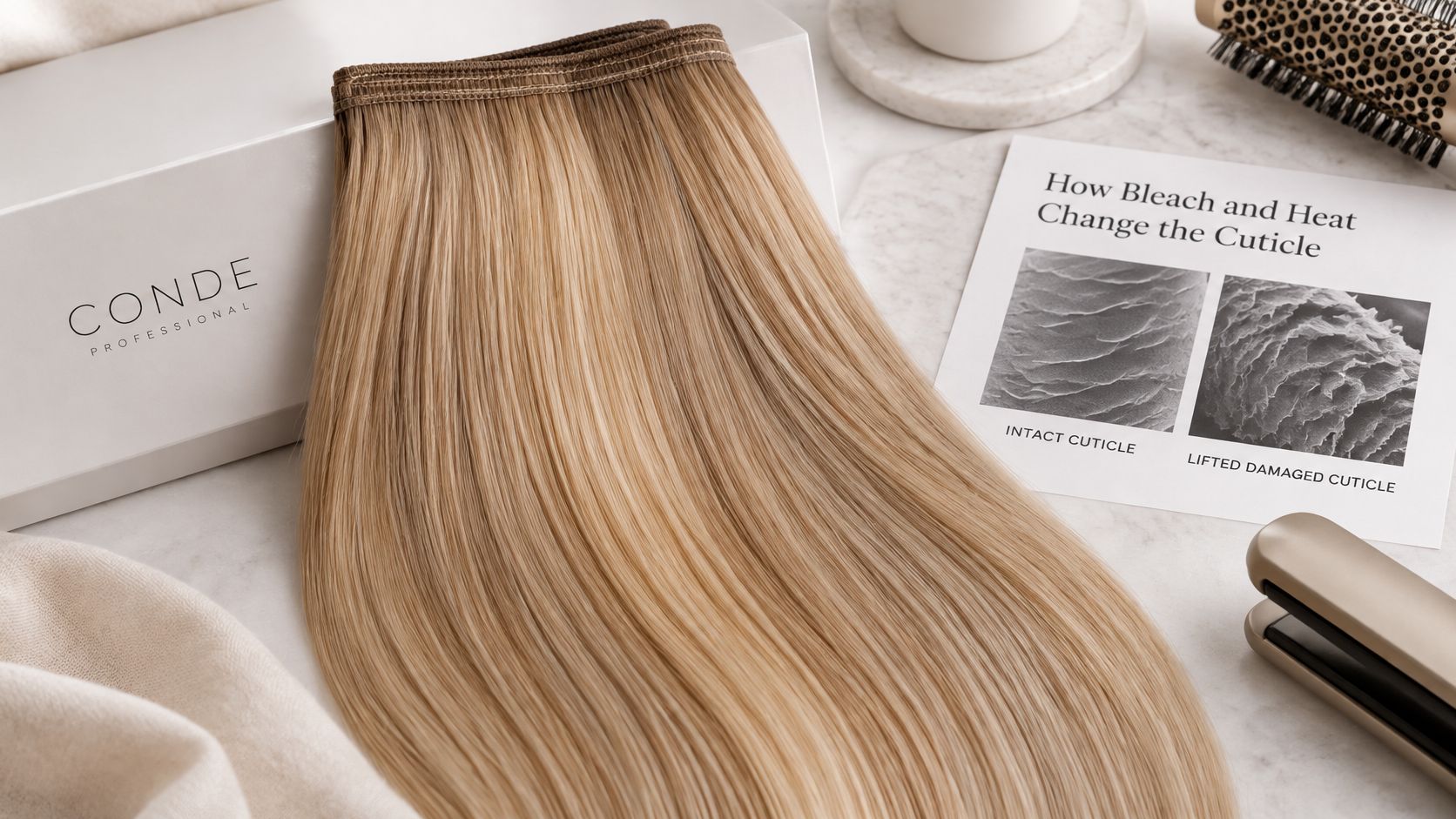
A microscopy and Raman spectroscopy study describes the normal cuticle as approximately 5–10 overlapping layers and observed closed, regular contours in untreated samples. Heat-treated samples showed longitudinal changes consistent with removed or broken layers; discoloration reduced cuticle definition, while relaxation and combined treatments produced detachment and irregular contours.
That distinction matters during consultation. A strand can look cosmetically acceptable while offering little margin for additional processing. Widespread lifted or missing scales, rapid knotting, or easy fragmentation are reasons to stop, not reasons to compensate with a stronger conditioning treatment afterward.
Conde Professional's guide to dyeing hair extensions is a useful preparation reference. The service still needs a test on hair from the actual batch before the full piece enters the bowl.
Conditioning improves handling; it doesn't reconstruct detached cuticle cells. A smoother finish after treatment shouldn't erase an unfavorable structural inspection.
For aftercare instruction, specify low-tension detangling, attachment support, thorough conditioning through the appropriate lengths, and complete drying before sleeping or securing the hair. These practices preserve handling quality without promising a fixed wear duration.
Passing the cuticle checks doesn't select the attachment. Natural-hair density, section strength, placement, desired length, and maintenance behavior still determine the method. Conde Professional offers straight and wavy textures across 18–28 inches, but length selection must remain subordinate to a workable installation plan.
A longer result isn't a reason to crowd more attachment weight into a limited support area. Straight and wavy are texture matches, not quality rankings.
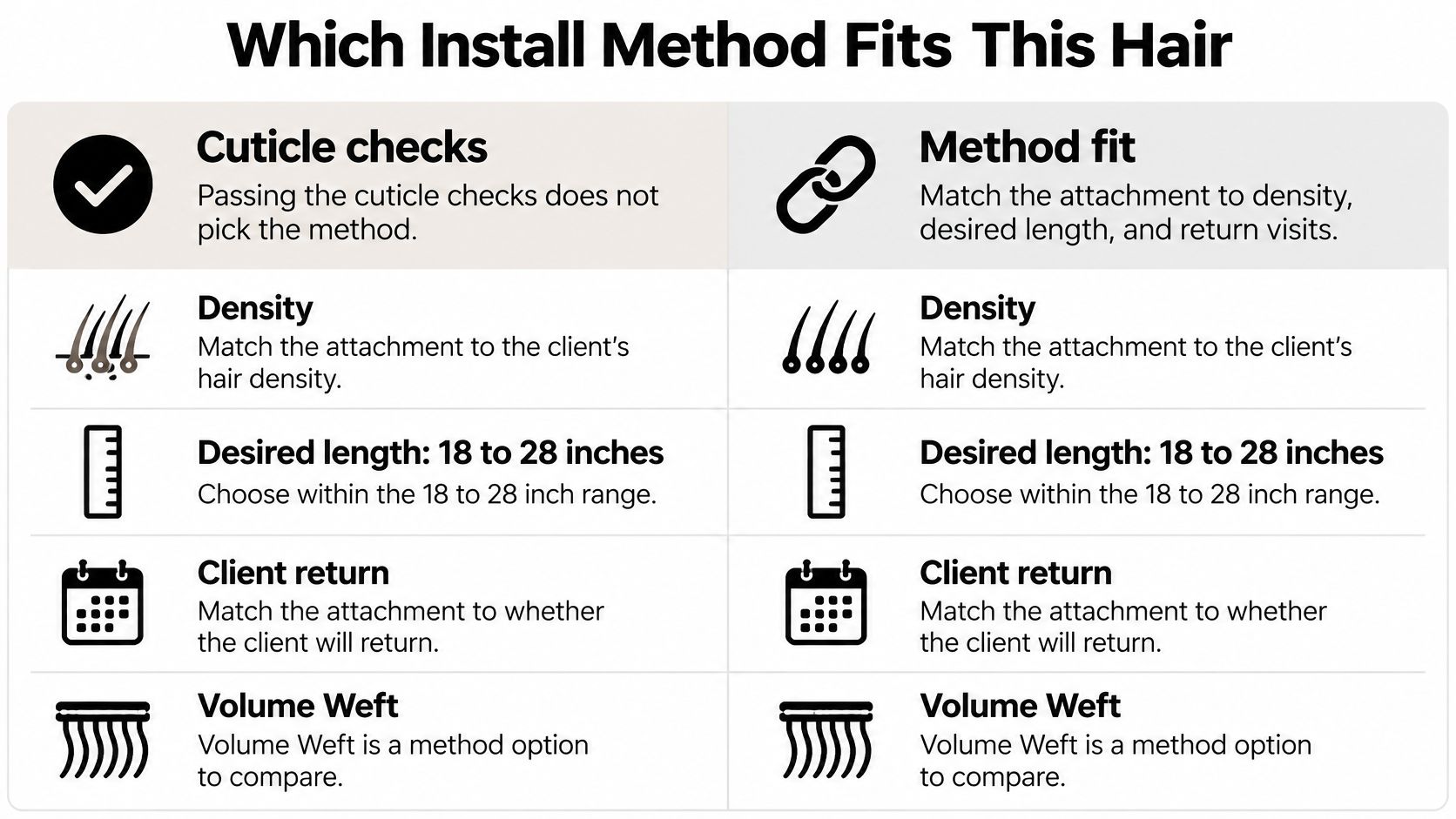
| Method | Fits when | Wrong when |
|---|---|---|
| Volume Weft | Coverage is the goal and density can carry a standard row | Fine density where a fuller track will show or overload |
| Thin Weft | Fine-to-medium hair needs a flatter row | The look needs maximum bulk from very few rows |
| Tape Weft | A flat custom row is built from tape-width hair | No one will keep that row light and directional |
| Tape-In | The client wants a fast flat install and will return for move-ups | Tabs are likely to be ripped out between visits |
| K-Tip | Placement is custom, partial, or face-framing | Hair is very fine or bonds will be scrubbed together |
| Bulk | The service is hand-tied, a beaded row, or custom color | There is no time to build and test the weft |
| Clip-In | The need is a trial, bridal set, or photoshoot | Daily wear is being sold in place of a maintained install |
These are selection boundaries, not automatic approvals based on density alone. Fine-to-medium hair still needs an individual placement assessment, and a flatter attachment doesn't authorize loading a weak section.
Conde Professional's hair-extension method guide supports comparing attachment approaches before committing the service time.
The Volume Weft Flawless Blonde #7/8/11 Balayage uses dense, full-bodied machine weft panels for sew-in/bead-row application. That construction belongs in a coverage decision, not a shade decision: an attractive blend doesn't make a dense panel appropriate for a fine-density perimeter.
Bulk consists of loose Remy human hair bundles and leaves more construction work with the professional. That flexibility is useful for custom services, but the appointment must include time to build, secure, and inspect the finished piece.
For microlinks, fusion bonds, or rows, assess how the client washes, brushes, and returns for service. A technically suitable method becomes a poor choice when the maintenance routine won't support it.
The wrong method should be declined even when the hair passes. Fiber quality and responsible load management are separate professional obligations.
The consultation should choose the method before the order is placed. Conde Professional supplies licensed professionals, so business purchasing belongs through a professional account rather than a client-facing retail checkout. The wholesale buying guide provides the appropriate starting route.
Conde Professional checks cuticle integrity and color blending so the hair looks natural and wears well over time. It works exclusively with ethical suppliers who meet its standards for cuticle integrity, natural texture, and consistent color.
Every batch is checked for weight, color accuracy, and strand strength. Hair that falls short of those standards stays at the facility; receiving inspection remains the salon's confirmation that the delivered material fits the planned service.
A failed sample shouldn't become an installed experiment. A disappearing finish, unacceptable tangling, or visibly compromised surface warrants holding that lot while the salon resolves the issue.
Retain the sheet for the move-up and reassess the actual hair before reinstalling. Previous approval doesn't authorize continued use after its condition changes.
Conde Professional offers professional hair extensions and stylist education alongside batch checks for cuticle integrity, color accuracy, weight, and strand strength. Visit Conde Professional to open a professional account, then approve the selected batch before confirming the client's install.


