Your cart is empty
Tax included and shipping calculated at checkout

Drawer menu
Tax included and shipping calculated at checkout
A professional account gives you stylist pricing, priority support, early access to new releases, and education developed by working stylists.


Search remy vs non remy hair and you'll get the same advice on every page: buy Remy, because Remy doesn't tangle. That's half right, and the half it gets wrong is the expensive half. Remy is a claim about cuticle direction and condition, not a quality tier, and on its own it tells you nothing about how a batch will behave after a bleach retouch, a toner, or four weeks of thermal styling.
The word describes how hair was collected and organized. The processing record describes what was done to it afterward. Two batches can both be legitimately Remy and behave nothing alike in the chair, because one arrived cuticle-intact and the other was lifted, toned and texturized before it was bundled. Here's how to separate those two cases before the install instead of after the first wash.
Remy is a manufacturing and quality classification, not a separate biological type of human hair. In professional use, the defining feature is that the cuticles remain present and run in the same direction from root to tip. That's the entire claim. Everything else people attach to the word, lifespan, color behavior, tensile strength, is inference stacked on top of it.
| Attribute | Remy hair | Non-Remy hair | Why it matters at the chair |
|---|---|---|---|
| Cuticle orientation | Consistent direction from root to tip | Mixed directions possible | Opposing scales create friction, ruffling and tangling |
| Cuticle condition | Intact when processing preserves it | May be removed, weakened or coated | Drives feel, friction and wash behavior |
| Initial feel | Natural texture, slight resistance tip to root | Can feel smoother from coatings | A first touch test can mislead |
| Chemical history | Can still be bleached, colored or texturized | Can be processed or coated | The label doesn't settle processing history |
| Combing after wash | More predictable when cuticles are intact | Varies by batch | Requires a per-batch check before install |
Each strand wears an outer layer of overlapping scales that point one way. When a batch is organized so every strand faces the same direction, adjacent shafts slide with less opposing scale friction, which is the mechanical reason aligned hair mats less, drags less and combs easier. Mix direction and the scales grip each other along the length, and the resulting ruffling shows up worst at the nape and around the attachment zone, where strands are pressed together all day.
Non-Remy hair generally contains mixed root-to-tip directions because strands are collected from multiple sources or combined after cutting. Manufacturers often remove or weaken the cuticle afterward so the fibers behave uniformly. That solves a handling problem in the factory and creates a wear problem on the client. The distinction is fiber organization and processing, not whether the material is human hair at all.
The cuticle is the fiber's outer protective layer, and the cortex supplies most of its mechanical strength. That split matters for how you read a Remy claim: alignment predicts friction and combing behavior, not tensile strength. Technical material on hair fiber properties describes the cuticle as a driver of torsional behavior while the cortex contributes most of the fiber's longitudinal tensile response, according to published Society of Cosmetic Chemists reference material.
Then processing enters the picture. A 2018 microscopy and proteomics study in the International Journal of Cosmetic Science reported that bleaching caused protein loss not only from the cuticle but also from cortical intermediate filaments and keratin-associated proteins, with damage increasing as bleaching severity increased (Wiley Online Library). The same body of work describes cosmetic oxidation breaking down surface lipids and creating acidic groups on cuticle cells, changes that shift feel, friction and conditioning behavior.
The distinction that matters on the bench: alignment tells you how the fibers will behave against each other. It says nothing about how much chemical punishment the fiber has already absorbed.
The layer-by-layer anatomy behind that is worth keeping straight, and a walkthrough of the structure of a hair fiber is the quickest refresher for anyone who hasn't thought about the cortex since school.
Coatings and acid treatment can make non-Remy hair feel smooth and glossy straight out of the pack. Conditioners do the same thing more subtly. A silky hand-feel is therefore a statement about the surface finish, not about cuticle direction or integrity, and that finish declines with washing, heat and chemical exposure.
So where does that leave the buying decision? A verified Remy batch is the safer starting point for methods that get handled constantly, because aligned cuticles tolerate repeated combing and move-up with less matting. Treat the label as a hypothesis to confirm on the bench, not a verdict. No universal certification standard sits behind the word, so two suppliers can mean two different things by it.
Remy gets confirmed on the bench, not on the label, and the whole protocol takes about as long as mixing color. Work through it in this order and write down what you see, because the notes matter more than the verdict on any single sample.
A sample protocol covers six checks, each targeting a different failure mode.
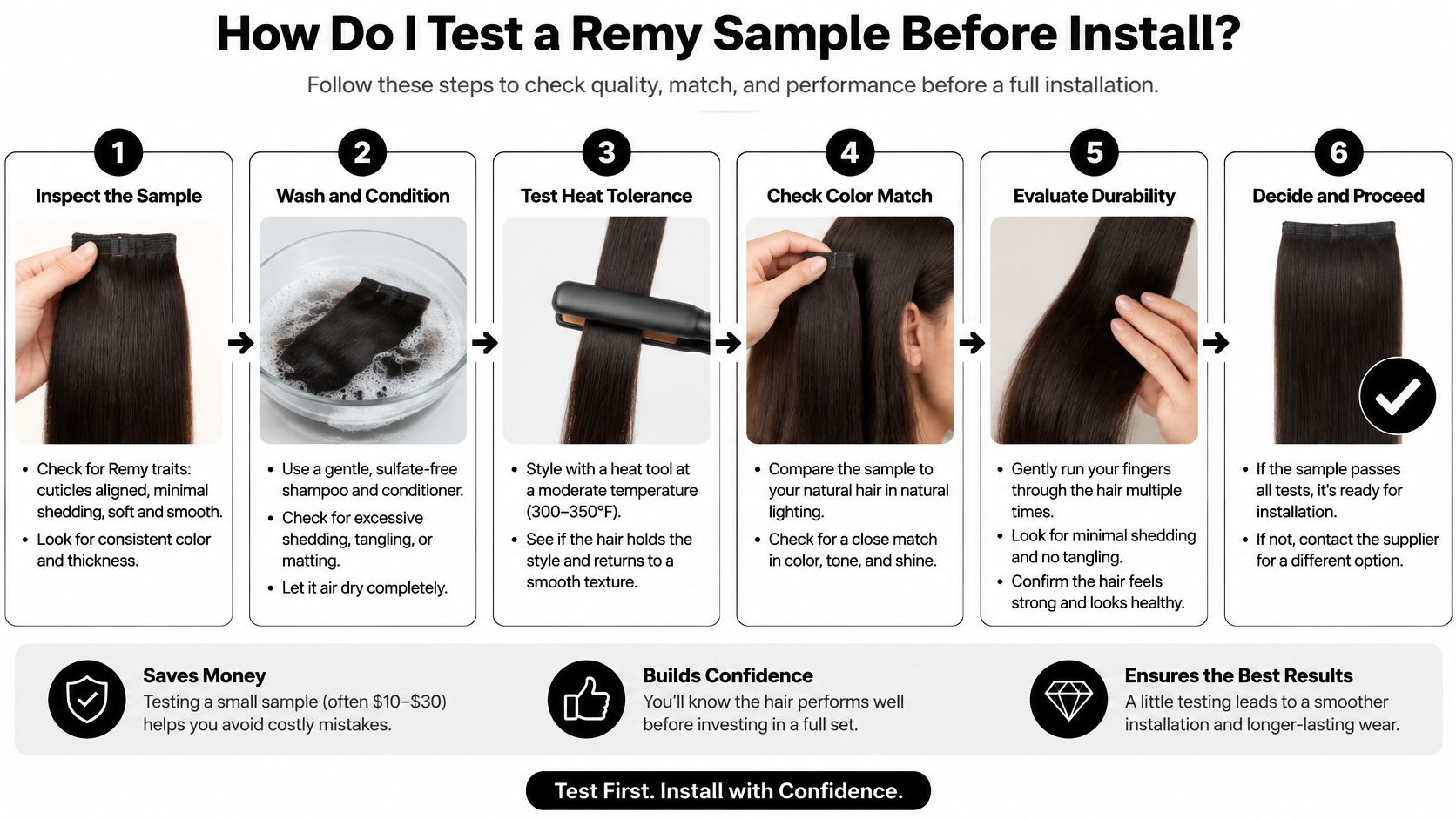
Microscopic examination gives a direct read on the structural claim. At approximately 3,500× magnification, overlapping cuticle scales are visible along the shaft, and damaged or stripped fibers show loss of normal cuticle structure with deeper fiber layers exposed, as described in an industry explainer on how manufacturers assess Remy claims. That's far more meaningful than how a sample looks right after a silicone coating or a finishing treatment.
What it doesn't do is predict combability, shedding or wash behavior on its own. Pair it with the practical checks every time.
Send the batch back when: scales lift across several strands, the palm test leaves a pile of loose fiber, or the post-wash comb shows tangling got worse rather than better. A passing sample shows consistent direction, minimal shedding and no degradation after washing.
Batch-level control is the only version of this that scales. Conde Professional checks every batch for weight, color accuracy and strand strength, and hair that falls short of those standards stays at the facility rather than shipping.
No label substitutes for batch evidence. Start with the grade problem, because it's the most common place stylists get sold something the paperwork can't support. Numeric grades from 6A through 10A have no governing international body or standardized certification system. Suppliers assign the same number to hair with materially different cuticle integrity, alignment, processing history, density and wash durability, as an explainer on human hair grades sets out plainly.
That means a grade can't establish a cuticle-alignment percentage, an expected wear period or a strand-strength threshold. Treat the number as supplier marketing terminology and nothing more.
| Claim | What it establishes | What to request |
|---|---|---|
| Remy | Root-to-tip cuticle direction and condition | Batch evidence of cuticle alignment plus the inspection criteria used |
| Virgin | No prior processing is claimed | Processing history for the specific batch, not the category |
| 100% human hair | Fiber composition | Documentation of fiber composition |
| Ethically sourced | No universal standard applies in major North American markets | Traceable origin and batch records |
| 6A, 7A, 8A, 9A, 10A | Supplier marketing terminology with no governing body | Measurable criteria: cuticle integrity, shedding, combability, wash durability |
| Non-Remy with smooth feel | Possible coating or acid treatment | Wet-combing and post-wash results |
Read the table as a translation guide. Remy answers a question about orientation and condition only. Virgin answers a question about prior processing, and a batch can be Remy and non-virgin, or virgin and non-Remy, without contradiction. "100% human hair" is a composition claim that both Remy and non-Remy products satisfy, so it separates almost nothing at the point of purchase.
Ethical sourcing is the row most often left vague. With no mandatory traceability system in major North American markets, the phrase means something only when origin and batch records exist behind it.
Cuticle orientation, cuticle integrity, chemical history and manufacturing consistency are the criteria that hold up. They're observable, comparable between batches and specific enough to argue about with a supplier. Shedding, combability, tangling resistance, color consistency and post-wash behavior round out the panel.
Before installing anything from a new supplier, request four things: processing history for the batch, fiber composition documentation, origin records, and the quality-control criteria applied to that specific lot. A supplier who can show inspection criteria per batch offers better evidence than one who offers a grade label. Comparing brands on those grounds is a more useful exercise than comparing numbers, and this breakdown of how to evaluate professional extension brands frames the questions.
The failure usually traces to chemical history, not to the Remy label. The main salon risk isn't tangling at install, it's performance after chemical and thermal services. A neutral review published by the American Hair Loss Association makes the point directly: Remy hair can still be heavily processed and therefore behave unpredictably during toning, bleaching, heat styling or repeated washing, while non-Remy hair may have misaligned cuticles and be chemically treated to reduce friction (American Hair Loss Association). Neither category predicts the outcome on its own.
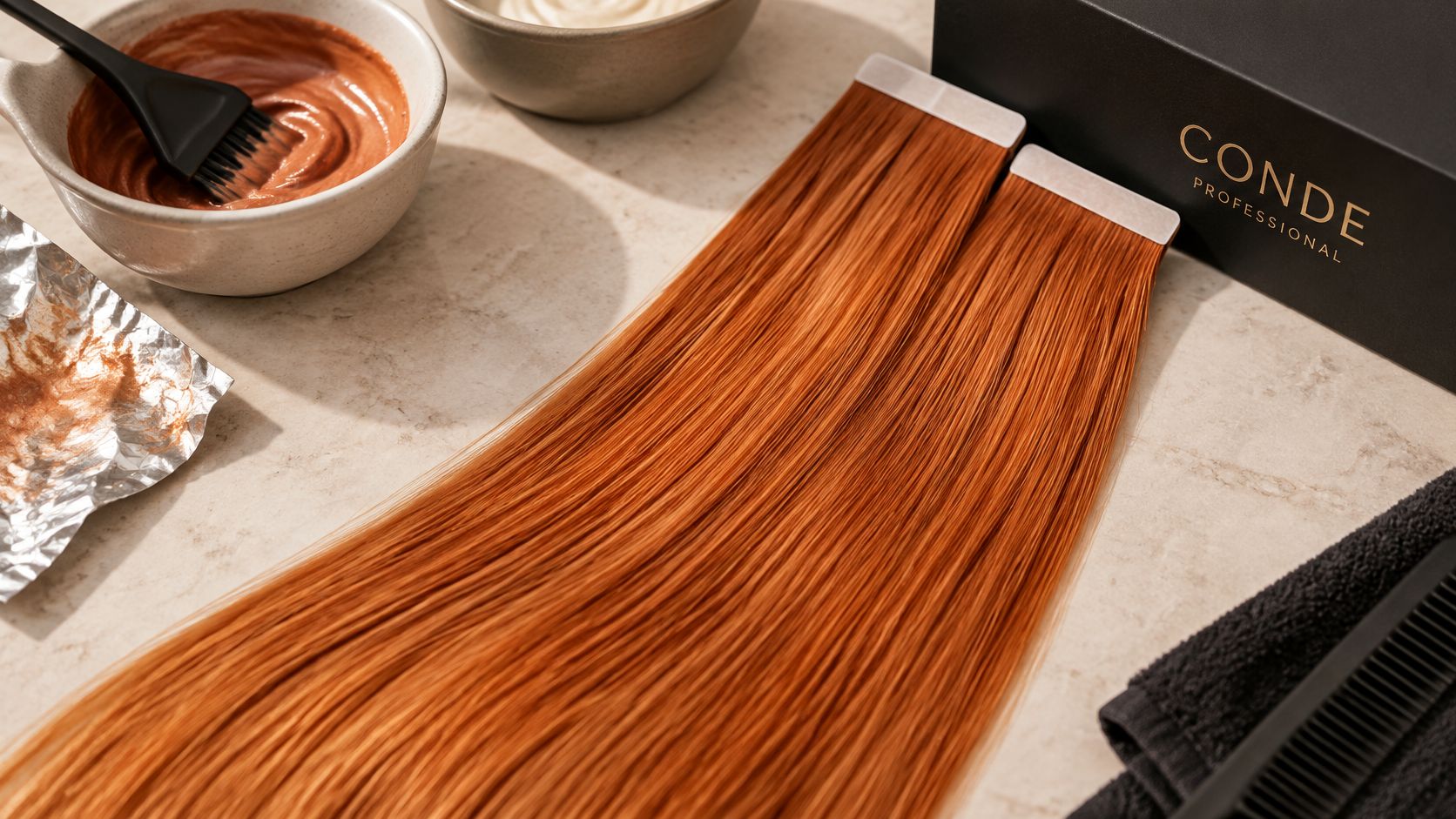
Say a client books a gloss and tone on a batch that's already been colored once, either at the factory or in your chair six weeks ago. The label says Remy. That's true and irrelevant. What predicts the result is whether the batch was lifted to get to its current level, how many oxidative passes it has already absorbed, and whether anything was applied afterward to mask the feel.
Run the same toner on two batches with different processing records and you'll get two different outcomes from identical technique. One comes out even and smooth. The other goes brassy at the mid-lengths, feels rougher coming off the bowl, and tangles at the tape tabs within a week. The technique didn't change. The fiber's history did.
Oxidation doesn't stop at the surface, which is the reason a smooth batch can turn overnight. Bleaching and toning change the fiber chemically, and the change reaches past the outer layer into the structures that give the strand its strength. A batch that has already been through that once has less tolerance left for a second pass.
The rule that prevents most of these calls: record the chemical history of every batch you bring in, match its tolerance to the service you're planning, and set processing limits before the appointment instead of discovering them mid-application.
Conde Professional checks cuticle integrity and color blending so the hair looks natural and wears well over time, which is the criterion that matters when a client's plan includes toning rather than a straight install. Where the plan involves actual color work, the technique matters as much as the batch, and the guide to dyeing hair extensions covers what to attempt and what to refuse.
The decision is situational. Method and client handling decide how much cuticle alignment is worth paying for, and the formats in play are Volume Weft, Thin Weft, Tape Weft, Tape-In, K-Tip, Bulk and Clip-In. Each one loads the fiber differently.
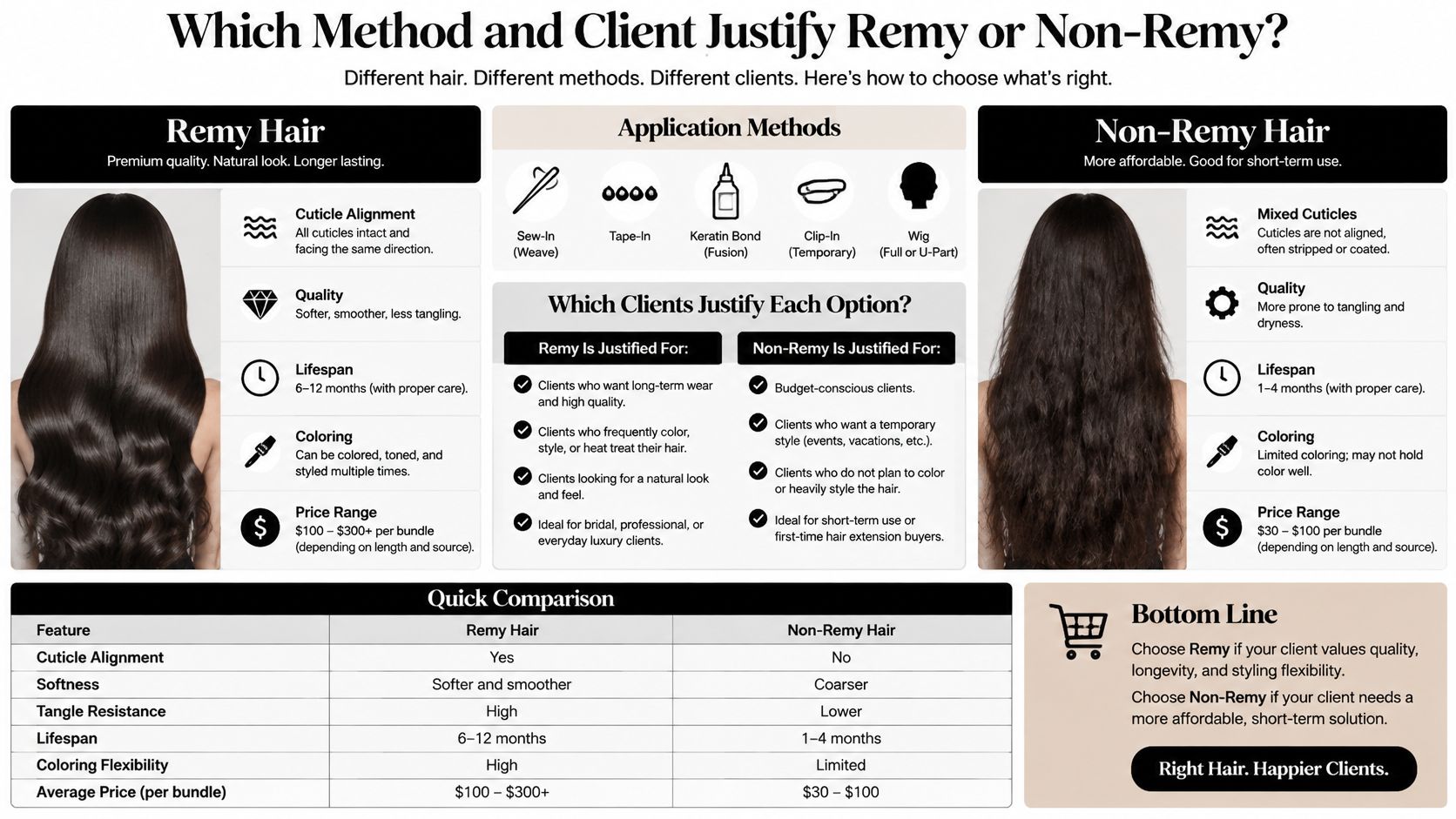
Remy status is a separate question from whether hair is virgin, double-drawn or suited to a particular install method, as this overview of extension types and how they're sold makes clear. Those are four independent questions. Conflating them is how stylists end up paying Remy prices for a batch that was never inspected.
| Situation | Lean toward | Reason |
|---|---|---|
| Weft and panel methods with frequent handling (Volume, Thin, Tape Weft, Tape-In, K-Tip) | Verified Remy with documented chemical history | Alignment matters most where brushing and styling repeat daily |
| Bulk for braiding or micro-installs | Verified Remy bundles checked individually | Each bundle needs its own check before handling |
| Client with frequent color correction | Batch with a known processing record | Processing history predicts tolerance better than the label |
| Fantasy or fashion shade on a fast turnaround | Remy batch with a documented chemical path | Fashion tones carry prior processing that limits what the fiber can still take |
| Short-term or low-handling install | Non-Remy acceptable after a sample test | Lower handling reduces the friction penalty if the sample passes |
| Client with repeated chemical services between installs | Remy only if the batch record supports the planned services | Some routines exceed what any batch can tolerate, so change the plan |
| Clip-In for a fast event install | Verified Remy with clean inspection | Repeated removal and reinstall rewards intact cuticles |
Non-Remy works in the right slot. A short-term install on a client who won't heat style, won't color and won't touch the hair between appointments can hold up, provided the sample passed the bench protocol. The friction penalty scales with handling, so a low-handling client carries less of it. The failure mode is assuming the label did the inspection for you.
Bulk is loose Remy human hair bundles, which changes the inspection rhythm. You check each bundle separately instead of letting one weft sample stand in for the whole lot.
Some plans can't be saved by a label. A client who wants frequent full color corrections, daily hot tools and a permanent install on hair the batch record says has already been lifted twice is a mismatch, not a shopping problem. Lower the processing level, switch to a removable method, or decline. Swapping suppliers for the same impossible service plan fixes nothing.
For a statement shade on a fast turnaround, Tape-In Copper #Copper Fantasy is a bold fashion copper available in multiple lengths, built on adhesive-backed weft panels applied by sandwiching a thin section of natural hair between two panels. It suits fine to medium hair and quick maintenance appointments, and it's the kind of shade where a verified processing record matters, since fashion tones get the most handling. The full spread of extension methods and their handling demands is worth reviewing before matching a batch to a client.
Open a professional account with Conde Professional, which sells to licensed pros and runs education for stylists, then request four things for the specific method being planned: processing history for the batch, fiber composition, origin records, and the inspection criteria applied to that lot, including cuticle integrity, directional alignment and combability.
Ask for those criteria in measurable terms. A supplier who answers with "our hair is 8A" has answered nothing. One who can describe how cuticle alignment and shedding are assessed per batch has given you something you can compare against the next shipment.
When the documentation arrives, run the six-step sample protocol on the batch before the install date, not on the day. Compare the results directly against the processing record you were given.
If the record and the bench results disagree, hold the batch. Don't install it, don't sample it on a friend, and don't talk yourself into it because the delivery took three weeks.
Conde hair is tested in the salon for natural blends, lasting comfort and consistent quality, and the batch paperwork should line up with what the wet comb tells you. When they match, install with confidence. When they don't, the sample just saved an appointment.
Conde Professional supplies professional hair extensions across Volume Weft, Thin Weft, Tape Weft, Tape-In, K-Tip, Bulk and Clip-In, with education built by working stylists and batch inspection covering cuticle integrity, color accuracy, weight and strand strength. If this changed how you plan to evaluate your next batch, open a professional account at Conde Professional and request the processing record alongside the sample before you book the install.


