Your cart is empty
Tax included and shipping calculated at checkout

Drawer menu
Tax included and shipping calculated at checkout
A professional account gives you stylist pricing, priority support, early access to new releases, and education developed by working stylists.


A stylist usually starts looking into wholesale after the first painful reorder. The sample looked clean, the install booked fast, then the landed invoice came in heavier than expected, the next batch shifted in color or texture, and client timing slipped because the supplier's “ready stock” wasn't ready.
That's the answer to how to buy hair extensions wholesale. It isn't a catalog exercise. It's a vetting workflow built around batch consistency, reorder control, landed cost, and a supplier who can still perform once the first nice order is out of the way.
A working extension specialist isn't buying hair for one pretty unboxing. The job is to protect installs, reorders, timing, and margin at the same time.
One week it's a full head of tape-ins. The next week it's a move-up on beaded rows, then a color match for a K-tip client who wants the same blend as last visit. Wholesale buying has to support all of that without forcing the salon to re-engineer every order.
Most supplier storefronts are built to sell confidence. Clean product shots. Soft language around “premium” and “luxury.” Broad shade families that look complete until a stylist has to match a live guest under salon lighting.
The operational reality is less glamorous. A salon owner has to think about:
A useful wholesale process also has to account for the fact that the category is still growing. One market estimate values the global hair extension market at US$8.6 billion in 2026 with projected growth to US$15.4 billion by 2033, while another estimates USD 3.43 billion in 2025 and USD 5.06 billion by 2032. The practical takeaway isn't the size. It's that growth is pushing wholesale buying away from casual trial orders and toward repeatable supply planning, especially around batch consistency and reorder risk.
Practical rule: If a supplier can sell a beautiful sample but can't explain batch identifiers, approved shade standards, reorder photos, or acceptable variance, that supplier isn't ready for a salon that depends on repeat guests.
For a stylist or salon owner, a wholesale system should answer a few blunt questions fast.
Method planning matters too. A salon may stock Volume Weft, Thin Weft, Tape Weft, K-Tip, Tape-In, Clip-In, or Bulk depending on client profile and service mix, but that only works if reorder behavior is stable enough to maintain the result the guest expects.
Start with business identity, not with swatches. A polished catalog proves almost nothing.
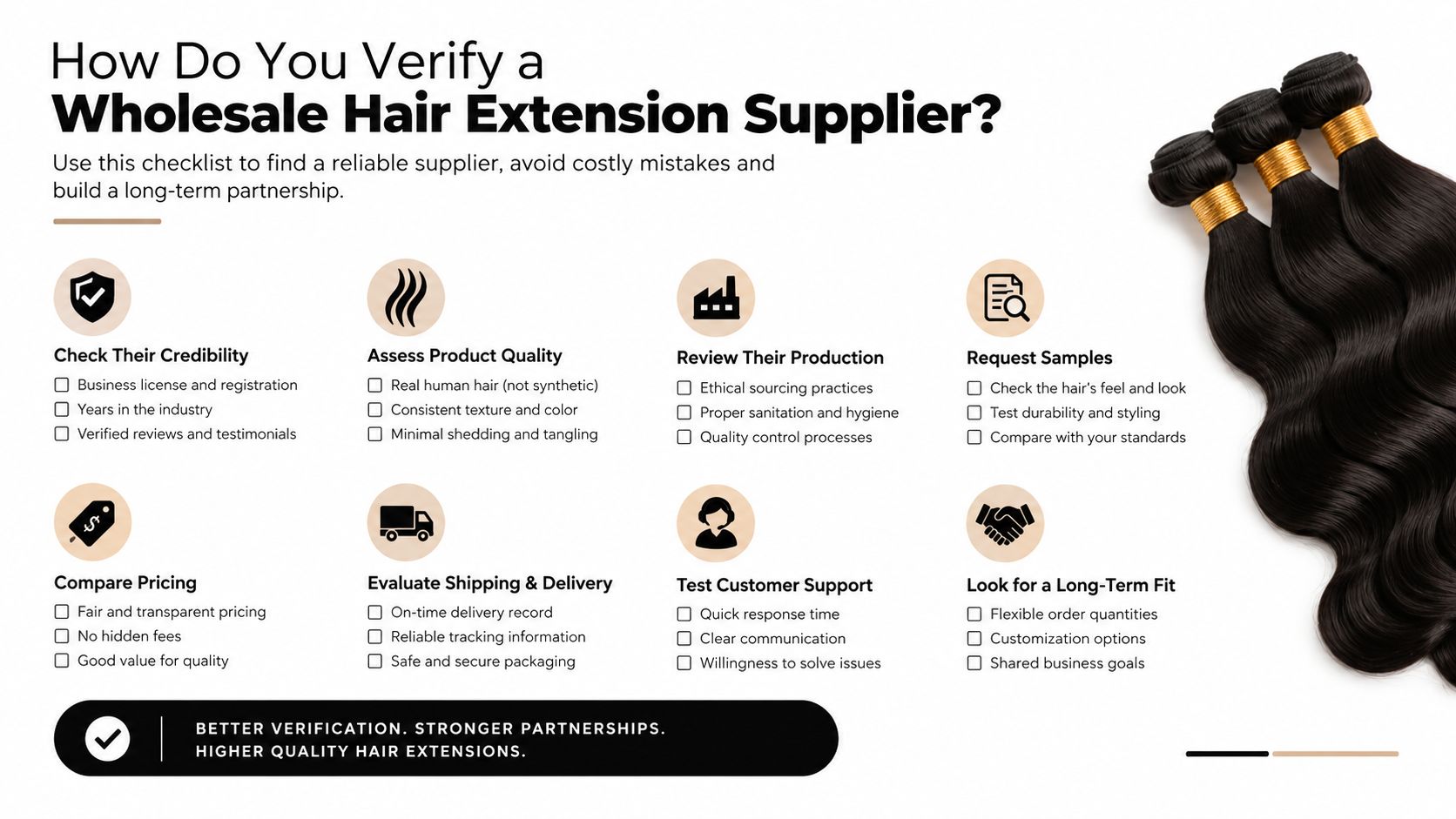
For wholesale hair-extension sourcing, one of the highest-risk mistakes is assuming business identity and product consistency from a polished catalog alone. A stronger buying process is to verify legal registration and export credentials, confirm that the factory address matches a real industrial site, request a production video walkthrough rather than stock images, and ask for third-party lab reports and client references before placing volume orders. The same guidance also stresses chain-of-custody documentation for raw materials and a willingness to accept in-person or live-video audits to reduce fraud, hidden resellers, and batch-quality drift.
That sequence matters because stylists often reverse it. They fall in love with the hair first, then try to verify the business after money is already in motion.
A clean verification pass usually includes:
For stylists who want a broader framework for supplier due diligence, not just in beauty but in marketplace-oriented wholesale workflows, the 2026 playbook for Amazon sourcing is useful because it sharpens the same discipline around proof, process, and supplier accountability.
The red flags aren't subtle once a stylist knows where to look.
A supplier that avoids direct questions about registration, facility access, documentation, or reorder controls is already answering the question.
A few issues should stop the process cold:
Ethics matter here too, especially for salons that are building a premium service menu around trust and traceability. The practical standard is transparency, documentation, and consistency, not marketing language about “good hair.” The same mindset shows up in ethical hair extension buying considerations, where the issue is what can be verified, not what sounds clean on a product page.
Before any negotiation, stylists should run two checks that don't depend on the supplier's own marketing.
If either of those breaks down, the order shouldn't move forward.
Grade letters don't protect installs. Cuticle integrity and alignment do.
The fastest way to clean up wholesale buying is to stop treating 6A, 7A, 8A, 9A, or 10A as technical standards. They aren't. There's no governing body behind those labels, so they function as supplier marketing, not a usable quality system.
Industry guidance treats Remy as a cuticle-direction and integrity issue. True Remy hair has cuticles consistently aligned root to tip, and buyers are advised to verify that with hands-on checks such as a reverse-direction feel test instead of trusting the claim on the package.
That matters because a bundle can feel smooth at first and still fail in service if the cuticle direction is mixed or the surface has been over-processed.
A stylist buying wholesale should test four things before taking any “Remy” label seriously:
| Test | Genuine Remy Behavior | Marketing-Only Claim |
|---|---|---|
| Reverse-direction feel | Consistent resistance because cuticles stay aligned | “Silky” feel only in first handling |
| Wash result | Maintains manageable texture without sudden collapse | Looks good dry, then tangles once coating lifts |
| Mid-length combability | Smooth pass with predictable drag | Snags in scattered zones through the bundle |
| Bundle consistency | Similar behavior from top to ends | Uneven sections that react differently to heat and moisture |
Stylists who need a refresher on what to evaluate in human hair quality can cross-check with Remy human hair extension fundamentals.
The best sampling questions are specific enough to become part of the buying record.
Hair that only performs while it still wears a fresh finish isn't a salon supply asset. It's a return waiting to happen.
A sample request shouldn't sound like a favor. It should read like a test protocol.
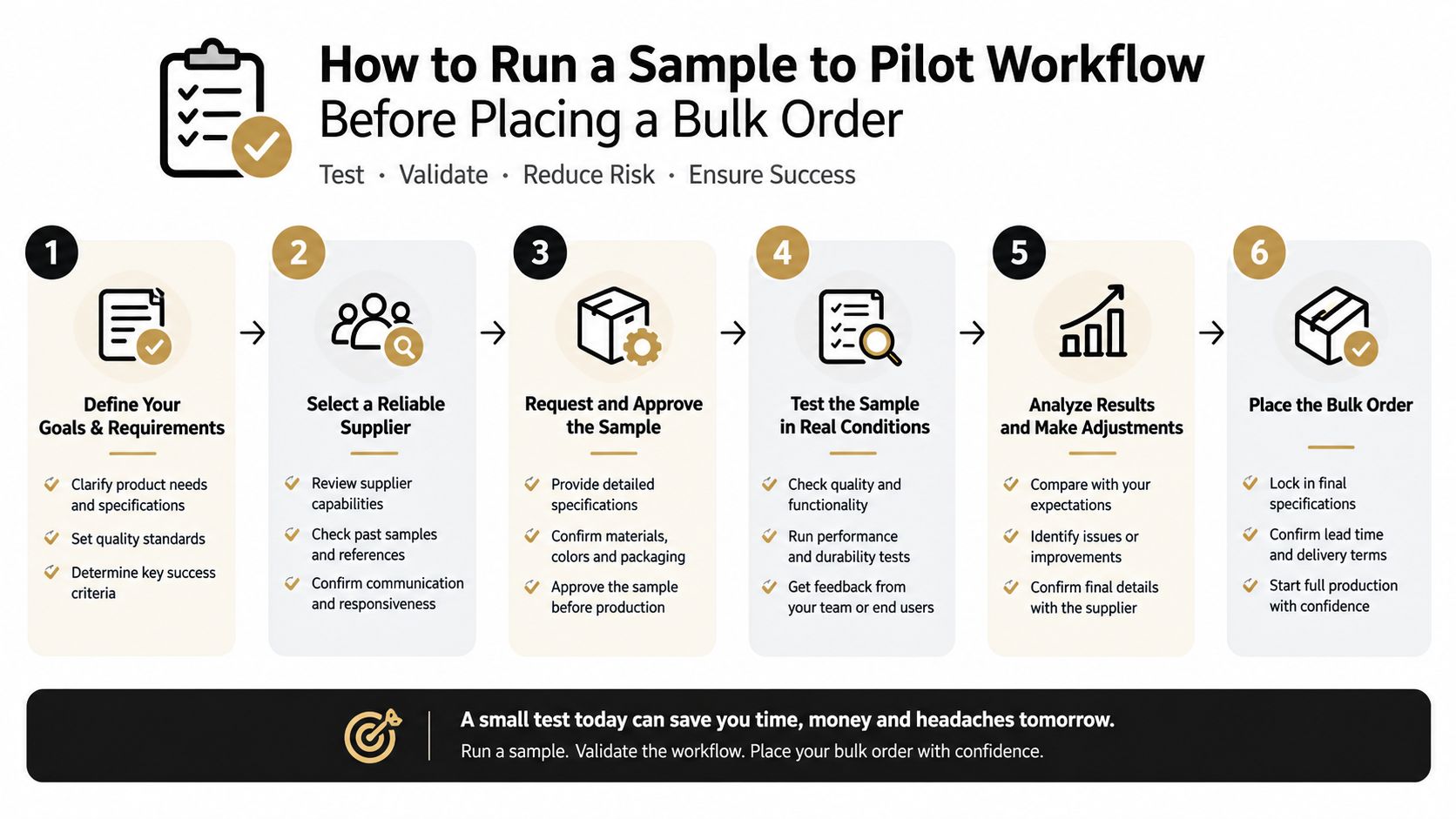
A practical wholesale workflow starts with supplier verification, then sample validation, then pilot-lot confirmation before any bulk order. One expert checklist recommends requesting a golden sample, verifying that the same operators and materials will be used for the pilot lot, and testing real-world performance after a wash-and-air-dry cycle on day three. It also advises confirming order cutoff times and checking a recent eight-week history of same-day first scans for orders received before cutoff to prove dispatch discipline. A final gate is to run a live-label test through the warehouse or fulfillment node to validate barcode readability, warning labels, and carton durability, because those are common chargeback triggers if mishandled.
That process applies cleanly to salon buying, even on a smaller scale.
A strong sample brief should ask for:
The salon-side test has to mimic service reality, not showroom handling.
A tight workflow looks like this:
A sample can be curated. A pilot lot reveals the system.
Bench test standard: Approve a sample only after it has been handled, washed, dried, and documented the same way a booked client's hair would be handled.
The pilot lot should answer three questions:
One optional operational tool in this stage is a dedicated extension stand that keeps multiple sample pieces separated during washing, drying, and comparison. A salon using several methods at once may find a professional stand useful for organizing sample pieces without tangling them. That's one place where Conde Professional's professional extension stand fits as a handling tool, not as a quality shortcut.
Catalog price is just the first number. It isn't the service cost.
For salons and distributors buying across borders, an overlooked issue is total landed cost and commercial risk. Market coverage notes that beauty supply stores and chains still function as a primary wholesale and retail hub for salon pros and DIY consumers in the U.S., and the outlook ties future growth to e-commerce and texture diversity. At the same time, market forecasts continue pointing upward through the coming years, which usually makes margin leakage from freight, duties, and delivery surprises more painful for wholesale buyers trying to protect service profitability.
A salon owner comparing two suppliers often treats unit price as the decision point. That's where margin gets lost.
Real landed cost usually includes:
| Cost Line Item | Catalog Assumption | Real Landed Cost Impact |
|---|---|---|
| Product price | “This is the hair cost” | It's only the base line item |
| Freight | “Shipping is minor” | Can reshape cost per install fast |
| Duties and customs handling | “That's part of shipping” | Often separate and easy to miss |
| Payment fees and currency conversion | “The invoice total is the total” | Payment method changes actual spend |
| Defect allowance | “Bad pieces are rare” | Every salon needs a reserve assumption |
| Packaging and relabeling | “Ready to use as delivered” | Time and handling have cost too |
Stylists don't need to become freight specialists, but they do need to know what the quote includes.
The clean way to compare options is to build a salon-side formula:
Landed batch cost = product cost + freight + import-related charges + payment costs + receiving losses + defect reserve
Then divide that by the usable hair in the batch and map it against service pricing. A salon that skips this step usually underprices installs or overestimates margin. Stylists working through service economics can line that up with salon extension pricing structure to keep product buying connected to real appointment math.
Method choice shouldn't start with trend pressure. It should start with hair health and the likelihood that the salon can repeat the result cleanly on the next visit.
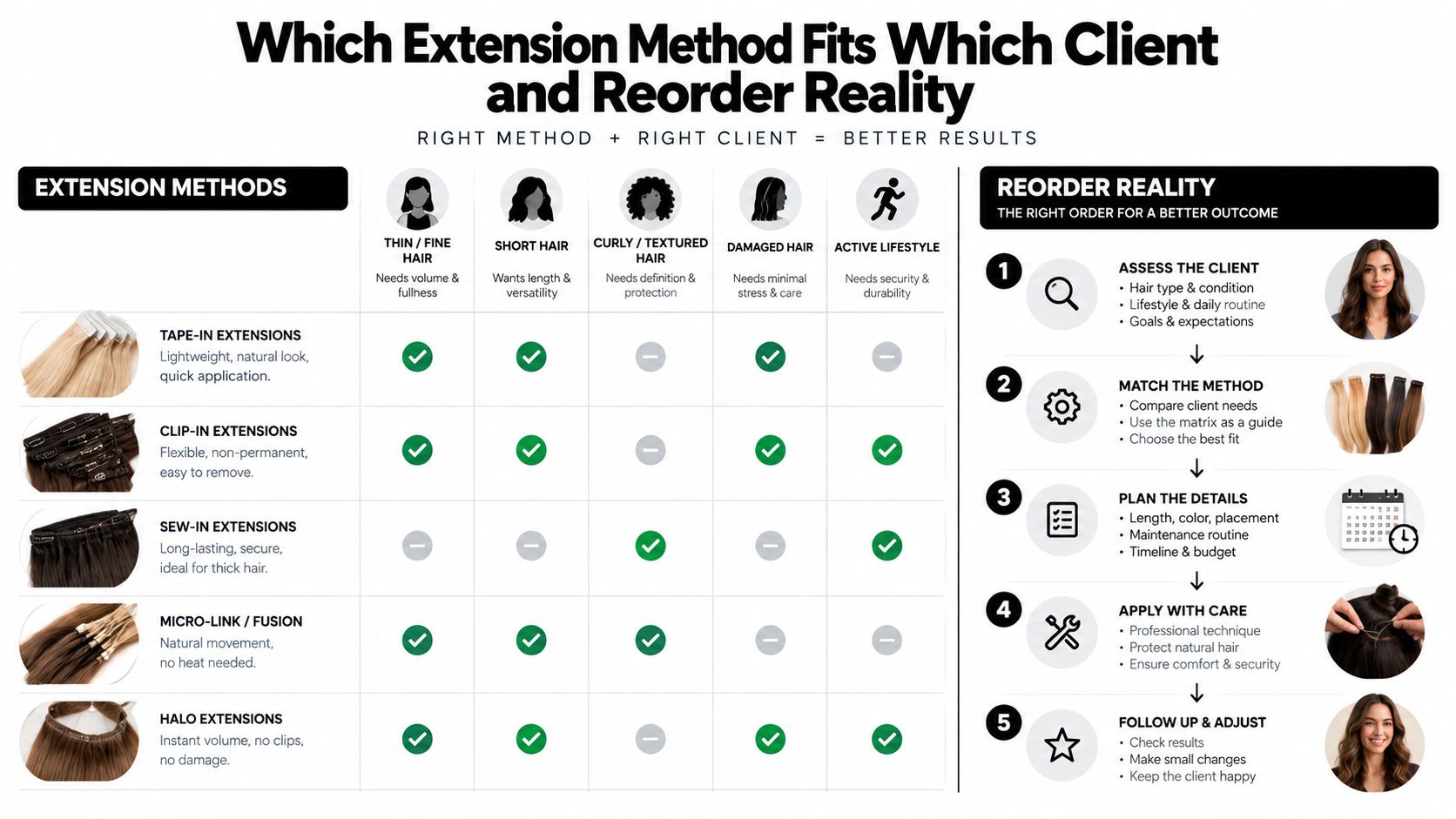
A lot of bad wholesale decisions begin as method decisions. The salon buys too heavily into one system because the sample looked good, then tries to force that system onto clients whose density, maintenance habits, or color cadence don't support it.
A stronger framework is simple:
That order prevents the salon from buying inventory that only works on ideal clients.
Tape systems can be efficient and low profile, but only when the client's hair and maintenance behavior suit them. A professional tape-in guide instructs stylists to place the weft about 1/2 inch below the parting, use a very thin veil of natural hair so some tape remains visible, and press the second tape piece firmly to form the bond (professional tape-in placement guide). That kind of precision is exactly why method-specific buying matters. A salon ordering tape hair wholesale needs construction consistency, not just a nice color card.
Some practical method pairings:
For a broader review of system options, types of hair extension methods is a useful reference point.
The best-looking install on day one can still be the wrong wholesale method if the salon can't reorder it cleanly for maintenance appointments.
A salon should ask two things before committing to method inventory:
If the answer is shaky, the method isn't wrong in theory. It's wrong for that buying plan.
At some point, ad-hoc ordering stops working. A salon needs account structure, not random checkout behavior.
Professional wholesale hair-extension programs commonly restrict access to licensed stylists, salon owners, and registered beauty businesses, and they often require credential verification before wholesale pricing is activated. One example states that wholesale access is granted only after payment and verification, after which wholesale pricing appears automatically on the shop page (wholesale membership verification example). Another professional account model says members receive wholesale pricing only after application review and that the account is designed for licensed salon professionals (professional account application example).
A serious supplier shouldn't feel like a DM thread with inventory attached. The onboarding should show that the business knows how to support licensed pros.
A stylist should expect to provide:
The supplier side should answer with structure:
A huge catalog doesn't help if the salon can't reorder the same blend cleanly, get support on a mismatch, or confirm what line fits the client's install plan.
That's why opening a professional account is the right next move for stylists who are done guessing. It shifts the relationship from one-off buying to a repeatable supply process built around service reality. If the salon is evaluating a wholesale partner, the useful question isn't “How many SKUs are there?” It's “Can this account support accurate reorders, method-specific buying, and fast problem resolution without burning chair time?”
Conde Professional is built for licensed pros who need method-specific options like Volume Weft, Thin Weft, Tape Weft, Tape-In, K-Tip, Clip-In, and Bulk inside a real professional buying structure. Stylists who want a cleaner path from sampling to repeatable reorders can visit Conde Professional and open a professional account built around salon use, not consumer checkout.


