Your cart is empty
Tax included and shipping calculated at checkout

Drawer menu
Tax included and shipping calculated at checkout
A professional account gives you stylist pricing, priority support, early access to new releases, and education developed by working stylists.


Most advice on a Bellami hair dupe is wrong because it starts with price. Stylists don't need a cheaper name match. They need a supply relationship that still holds up at install, at move-up, and when a reorder has to match what walked out of the salon the first time.
The broader category is large enough to explain why this search keeps showing up. Independent market summaries place the global hair extensions market at about $4.6 billion in 2023, with North America at roughly 38% of revenue and the U.S. market at about $2.1 billion that same year, while other forecasts place the category in the $3.0 billion to $5.1 billion range with projected annual growth around 6% to 8% through the 2030s (hair extensions market summaries). That matters behind the chair because extensions are a repeat-purchase service category, not a novelty add-on. A bad supplier choice keeps showing up in remake time, support tickets, and hair that looks acceptable on day one but collapses by the first maintenance visit.
Stylists usually start looking for a Bellami hair dupe after the same pattern shows up a few times. The reorder doesn't feel as predictable. The shade mapping takes more effort on a new client. Support gets thinner than the margin on the install.
That search isn't really about finding “cheaper Bellami.” It's about reducing operational drag. Bellami has strong brand equity because it's been in the market since 2012 and was later acquired in May 2025 by Beauty Industry Group, which shows how established the name became in the extension category. A recognizable brand creates the dupe search, but it doesn't solve the salon's actual problem.
A lower invoice can still cost more if the hair tangles at nape tension points, sheds during the first brush-out, or comes back matte at move-up. Stylists don't make extension profit on the first order alone. They make it on retention, reinstall efficiency, and how confidently they can book the next guest without wondering what the reorder will look like.
Practical rule: Judge any Bellami hair dupe by total cost across the life of the install, not by what the cart total looks like on order day.
Three filters matter more than “dupe” language:
Stylists who are actively comparing options usually benefit more from reviewing professional hair extension brand criteria than from scrolling lists of “cheaper alternatives.”
A true Bellami hair dupe preserves the result profile that matters to the client. Density. Movement. Finish. Predictable maintenance. The wrong replacement usually wins only on upfront cost and loses on wear behavior.
That's why method-by-method comparison is more useful than brand-name swapping. A salon-grade alternative has to survive the actual service cycle. If it doesn't, it isn't a dupe. It's just cheaper hair.
A real dupe can be checked with hands, comb, brush, tension, and water. Marketing copy won't tell a stylist much. The hair itself will.
Independent quality guidance consistently points back to cuticle integrity, directional alignment, and weft construction as the biggest performance markers, because intact unidirectional cuticles reduce friction, tangling, and matting, while weak construction raises shedding risk. That is the part worth testing first.
Take a small section and run it root to tip between thumb and forefinger. Then reverse it and go tip to root. Hair with aligned cuticle should feel smooth in the natural direction and slightly resistant in reverse. If the reverse pass catches hard, ruffles fast, or feels coated rather than directional, that bundle needs more scrutiny.
That quick test isn't glamorous, but it saves hours later. Hair that fails the reverse pass tends to tell on itself after washing, especially in friction zones around the collar and nape.
If the strand feels polished only because it's coated, the truth usually shows up after the first shampoo.
Supplier “grades” like 6A, 7A, 8A, 9A, 10A aren't an official standard. There's no governing body that defines them, so those labels matter less than measurable behavior like combability, shedding, cuticle alignment, and wash durability (why hair grades are marketing terms).
A same-day quality check should include:
Stylists who are screening a new line can also review Conde's quality overview as one example of what a supplier should explain clearly before a larger order.
Before switching inventory, run a strand test. If the salon tones, custom-colors, or softens texture regularly, the replacement hair has to tolerate normal pro handling without turning hollow, rough, or mushy.
The core point is simple. A Bellami hair dupe isn't “real” because it looks close in a product photo. It's real when it behaves predictably under salon conditions.
Method matching is where most dupe conversations finally get useful. Brand loyalty matters less than preserving the service result a stylist is already known for.
Bellami's public professional brochure is helpful here because it gives actual product-level reference points. One listing shows 16-inch at 140 g, 18-inch at 140 g, 20-inch at 180 g, 22-inch at 240 g, 24-inch at 260 g, and 26-inch at 360 g, while smaller professional formats are shown across 14 to 24 inches with 50 g to 55 g packaging. For dupe evaluation, the useful question isn't just length. It's grams per inch and whether the density still supports a full silhouette.
Weft work translates well if the replacement matches the client's density profile and the row design. A stylist moving from one supplier to another should watch weft height, seam bulk, stitch density, and how the hair stacks in longer lengths.
Machine-style volume work needs enough fullness through the perimeter. Thin-profile rows need a flatter seam and cleaner lay. If the dupe hair gets wispy too early through the ends, the stylist will compensate with extra rows or extra hair, which changes both pricing and scalp load.
Tape systems can map cleanly from one supplier to another, but the swap isn't automatic. Tab weight, adhesive feel, and how the hair collapses at the sandwich matter at move-up. Some tapes look fine fresh and then start telegraphing bulk or slippage once the client lives in them.
Keratin and strand-by-strand methods need even tighter scrutiny. Bond size, tip consistency, and how the extension hair responds to heat during install determine whether the method behaves like a true substitute or not.
A useful refresher on hair extension method differences can help sharpen those calls before changing the service menu.
Clip-ins and other retail-adjacent methods rarely drive the strongest recurring service revenue in a pro setting. Bulk hair, on the other hand, can be strategically valuable for custom row building, microlink adaptation, and method-specific correction work.
The best Bellami hair dupe often isn't one line that replaces everything. It's a tighter method mix that fits the salon's actual install patterns.
Stylists don't need another “top alternatives” list. They need a scan-friendly way to decide if a baseline brand profile is being matched in the categories that affect installs, maintenance, and reorders.
| Criterion | Bellami Baseline | Quality-Focused Alternate |
|---|---|---|
| Raw hair quality and cuticle alignment | Use hands-on testing to verify reverse-slip behavior, wet combability, and low friction through the mid-lengths | Same standard. Pass or fail should be determined by reverse-slip, wet behavior, and brushing response |
| Texture range | Evaluate based on how closely stocked textures map to the salon's current demand from straight through more textured finishes | Strong fit if texture options reduce the need to over-style hair to force a match |
| Longest length stocked | Compare longest available lengths against the silhouette clients actually book, not just what appears in catalog imagery | Works if longer lengths still hold perimeter density without requiring excess add-on hair |
| Shade accuracy | Check solids, rooted tones, dimensional blends, and how predictable the next reorder looks under salon lighting | Better choice if reorder confidence is high and custom glossing stays minimal |
| Install method coverage | Use current menu demand as the benchmark across wefts, tapes, strand methods, and custom builds | Stronger option if method depth aligns with the salon's bread-and-butter installs |
| Price per gram and per install | Useful only when paired with labor time, extra hair needed, and maintenance behavior | Better value if fewer corrections, fewer add-on packs, and cleaner move-ups offset the order total |
| Realistic lifespan across move-ups | Judge by how the hair behaves after wear, brushing, cleansing, and reinstall handling | Wins if the hair remains workable and presentable through repeat maintenance |
| Pro support depth | Measure access to education, account verification, reorder help, and issue resolution | Stronger fit if support is built for licensed professionals rather than consumer traffic |
This isn't a consumer-style winner/loser chart. It's a service model chart. A quality-focused alternate only makes sense if it protects result consistency, not if it lowers cost on paper.
The stylists who make clean supplier switches usually decide with three questions. Does the hair stay smooth after cleansing. Does the density hold at the chosen length. Does support exist when an install issue needs an answer quickly. If those answers are weak, the dupe isn't ready for chair use.
For a licensed stylist, the most useful replacement path is usually a supplier built around pro accounts rather than consumer checkout. Wholesale beauty programs commonly restrict access to licensed professionals and approved business entities, with verification required before wholesale pricing or catalog access is granted (how pro-account verification typically works in beauty wholesale). That structure matters because it changes the relationship from one-off buying to ongoing operational support.
Conde Professional is one option that fits that pro-supply model. The catalog covers the method families stylists need to map a Bellami hair dupe in practice: Volume Weft for fuller row work, Thin Weft for flatter seams and lower-profile installs, Tape Weft where a hybrid approach makes sense, K-Tip for strand placement, Tape-In for pre-bonded adhesive installs, Clip-In for removable wear, and Bulk for custom builds.
The important part isn't having a long menu. It's having method options that let a stylist preserve placement logic rather than forcing clients into the wrong install because that's what the supplier happens to stock.
A workable dupe needs predictable category coverage more than marketing language. Stylists should be looking for stable shade families, method-specific inventory, and account access that supports reorders, education, and color-matching tools.
A supplier relationship becomes useful when it reduces improvisation:
A real Bellami hair dupe protects the install six weeks later, not just the invoice on order day.
The point isn't to find a name that sounds similar. It's to choose a pro-grade supply relationship that supports the methods already selling in the salon.
A Bellami hair dupe only works if the method still fits the person in the chair. That sounds obvious, but a lot of bad extension decisions come from trying to force a supplier change into a method choice that doesn't belong there.
The fine-haired office client usually needs a flat result, clean perimeter control, and no visible build-up near the parting. A lower-profile weft option often fits best because it can distribute weight cleanly across the row without creating obvious track presence.
That client doesn't need the heaviest possible seam. The install has to disappear in motion and still leave enough natural hair to cover comfortably during daily styling.
The gym client, swimmer, or client who wears hair up constantly usually benefits from a method that rebalances predictably at maintenance and doesn't create unnecessary seam bulk. Tape-based choices can fit that routine well if the client is disciplined with aftercare and the stylist is confident in placement.
For stylists sorting through those method decisions, this guide on which hair extensions are best for different needs gives a useful decision framework.
Clients who wear shadow roots, root melts, and lighter dimension around the face often need placement flexibility more than they need broad weft coverage. Strand-based methods can be cleaner here because they let the stylist work around visible zones and keep tracks from flashing through the wrong section.
That doesn't make strand methods the automatic answer. It only means the placement logic may matter more than speed.
Some clients don't need a “dupe.” They need a method correction.
Chemically compromised hair, unstable shedding patterns, or an irritated scalp are not good candidates for forcing a supplier comparison into an install. The right call there is to pause the extension plan, stabilize the hair and scalp situation, and revisit the service only when the foundation can support it.
That restraint protects the client and the stylist's reputation. The dupe serves the install. The install should never be built around making the dupe work.
A new supplier can be screened in one afternoon if the stylist uses the right sequence. Start with questions. Then test the hair. Then decide what counts as acceptable before it ever reaches a client.
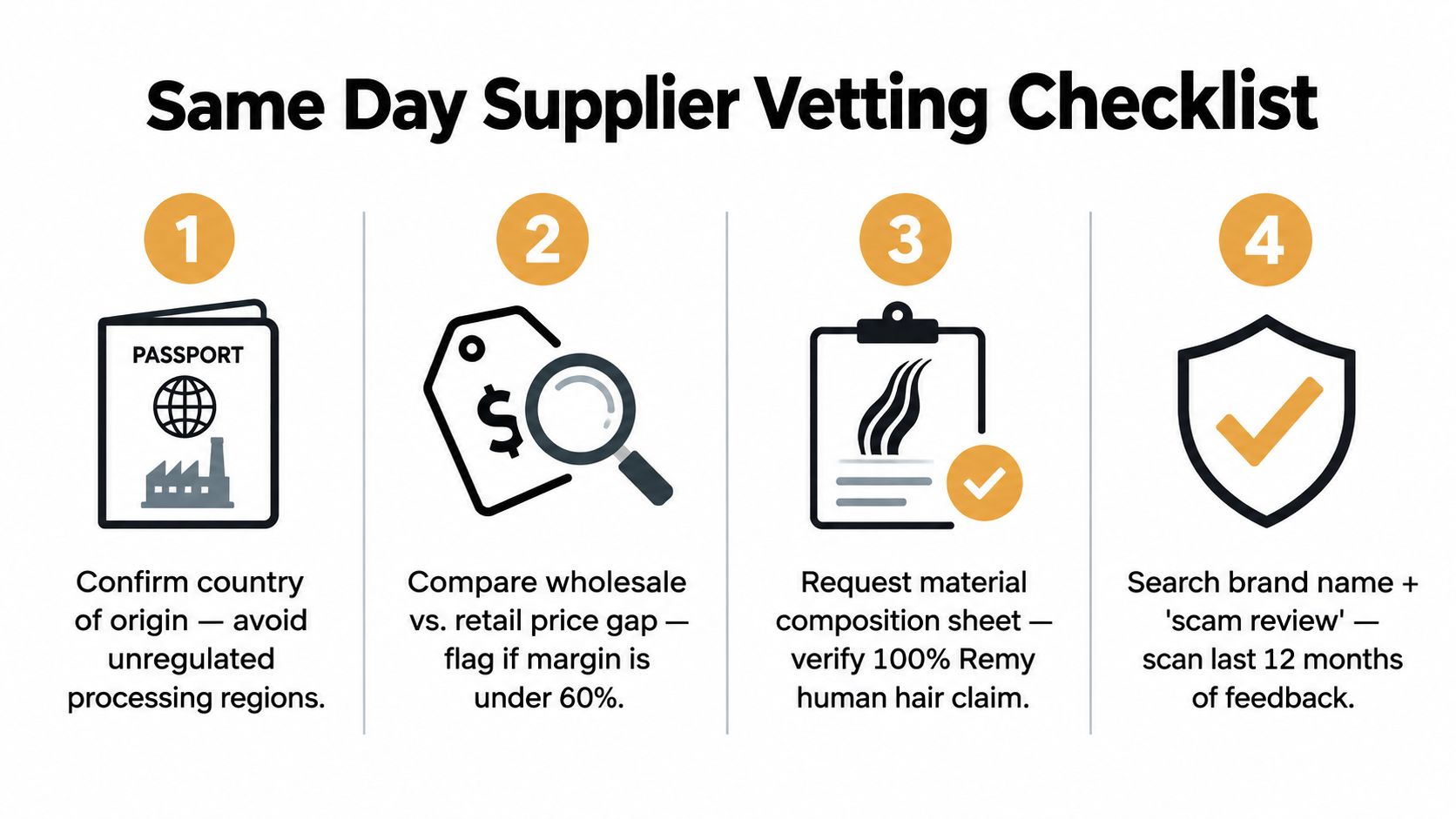
Use the first contact to find out how the supplier handles professional access, method range, and product specifications. Wholesale human hair extension buying guidance is useful background, but the direct conversation matters more.
Ask for clarity on:
Run hands-on checks immediately:
The first maintenance visit is the evaluation point. That's where matting, dryness, perimeter thinning, bond behavior, and seam fatigue stop being theoretical.
Use a simple pass-fail lens:
A supplier earns a place in extension services when the second appointment is easier, not harder.
The practical next move isn't adding random packs to a cart. It's opening a professional account with a supplier that's built to support licensed extension work.
That account matters because it organizes the relationship around method access, reorder clarity, and pro-only buying flow instead of casual retail traffic. For salons and independent stylists, that usually means visibility into available categories across wefts, tapes, strand methods, clip-ins, and bulk hair, along with access to education and account-level support that helps with selection rather than just checkout.
Before applying, have the basics ready so verification doesn't stall the process:
A Bellami hair dupe only becomes useful when it plugs into a stable ordering system and a repeatable install process. That's the shift worth making. Not cheaper hair. Better supply fit.
Licensed stylists who want a Bellami hair dupe that behaves like a professional supply relationship can start with Conde Professional. The catalog covers the main install categories, and the pro-account model makes more sense than trying to build extension services around consumer-style ordering.


