Your cart is empty
Tax included and shipping calculated at checkout

Drawer menu
Tax included and shipping calculated at checkout
A professional account gives you stylist pricing, priority support, early access to new releases, and education developed by working stylists.
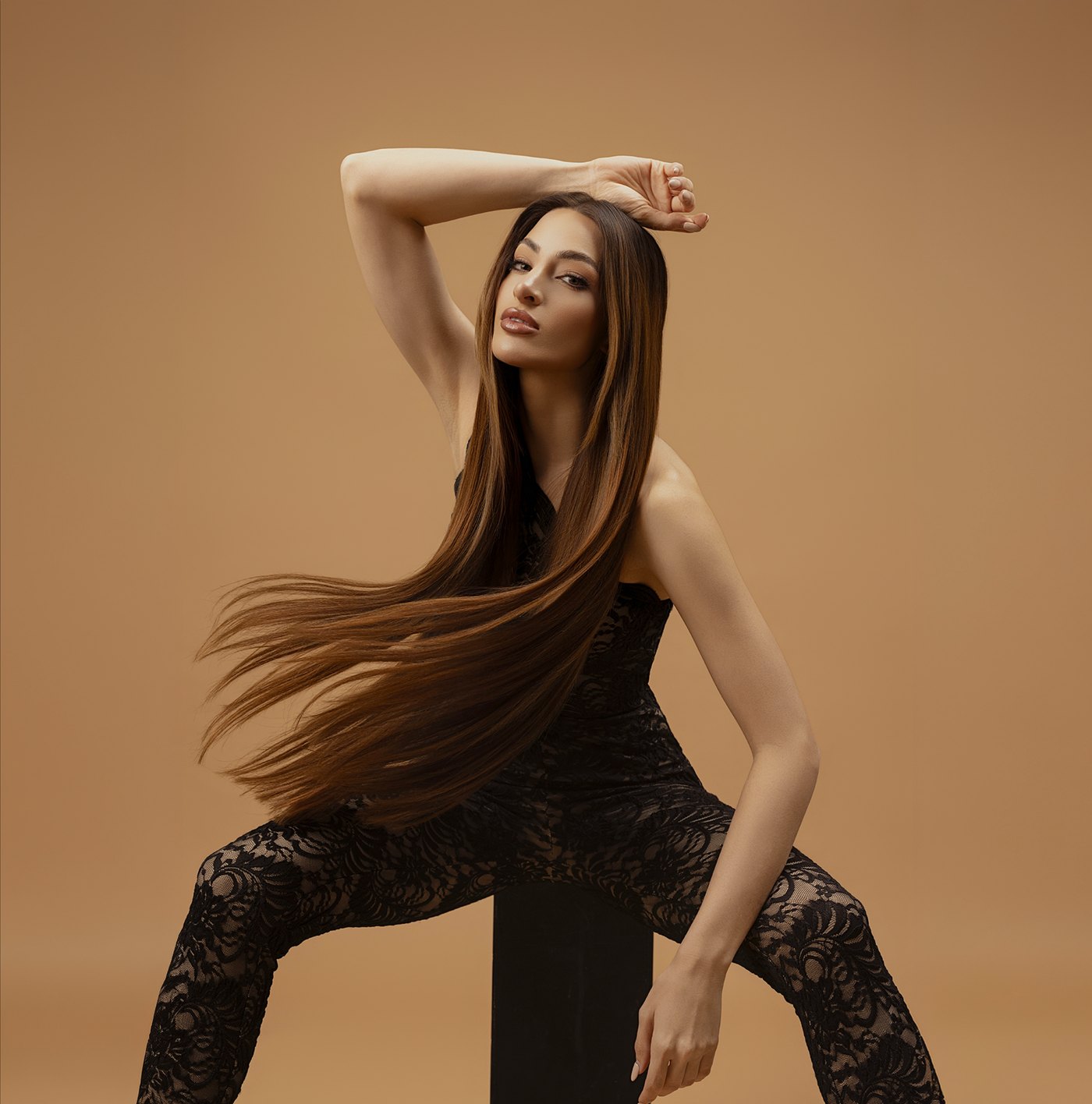

A client is in the chair with a soft natural bend through the mid-lengths, a straight root area, and enough density to expose every mismatch. The practical answer is to treat wavy human hair extensions as a blending and installation decision, not just a texture option. The wave pattern, cuticle direction, density, color placement, and attachment method all need to support the client's real styling habits.
Wavy extensions suit clients whose natural hair already bends, air-dries with movement, or needs added fullness without daily heat styling. They're less suitable for a client who expects a consistently sleek finish, has very fine hair that can't support the selected weight, or frequently changes between highly textured and straight looks.
Wavy human hair extensions are cuticle-intact human hair formed or selected to create a soft S-pattern between straight and curly. The texture adds movement and visual density while remaining adaptable enough for controlled blowouts, diffuse styling, or a more relaxed air-dried finish. The professional question isn't just whether the client likes waves. It's whether the extension texture behaves like the client's own hair under the conditions of daily wear.
Start with the client's natural pattern in its untreated state. A client with a loose bend through the lengths usually blends more naturally with wavy hair than with perfectly straight extensions, especially if the finished look is meant to appear effortless. A client with a stronger wave may need a deeper wavy pattern or additional styling to prevent a visible line between the natural hair and the added hair.
Wavy is usually a strong candidate when the client has:
Straight extensions may be the cleaner recommendation for hair that dries uniformly straight, particularly when the client wants a sleek finish and is comfortable styling the natural hair to match. Curly extensions are more appropriate when the natural curl structure is clearly stronger and a loose S-pattern would look under-textured.
The fiber still needs to be assessed as extension hair, not judged only by its wave. Cuticle integrity and alignment influence how the hair blends, combs, and responds to care. A wavy pattern can hide a construction problem at first because movement disguises minor irregularities. After washing, those problems become more visible through tangling, frizz, or uneven wave formation. A clear explanation of Remy human hair extensions helps stylists frame texture selection around hair behavior rather than a label.
Consultation rule: If the client's natural hair needs constant heat to resemble the selected extension texture, the texture choice may be creating extra work instead of reducing it.
A client may leave with a convincing blend, then return after washing with tangling at the nape, uneven waves, or frizz through the mid-lengths. The cause is usually not the wave alone. Wavy hair can blend beautifully, but it needs tighter control of friction, moisture, and tension than a uniformly straight texture.
Wavy hair changes direction more often along the shaft than straight hair. Each bend adds movement and apparent volume, while also creating more opportunities for neighboring fibers to interact during washing, brushing, sleeping, and drying. Treat texture choice as a blending and method-selection decision: assess the wave pattern, density, and how the client's own hair behaves between appointments.
Human hair behaves as a keratin fiber with measurable mechanical limits, as covered in our guide to the structure of hair. Approximate published measurements place tensile strength at 150 to 270 MPa, while the fiber may elongate up to about 40% before breaking, with results affected by humidity and strain rate. In salon terms, repeated wetting, forceful detangling, and high-tension brushing can leave wavy extension hair more vulnerable to breakage.
Run your fingers along a wavy strand and then reverse direction. You may feel resistance where the cuticle direction catches during the movement. Those changes matter because cuticle edges that meet can increase friction, especially around the nape and other high-contact areas. More bends mean more places for poor directional control to become matting during combing.
Remy hair is defined by aligned cuticles, with strands maintained in the same root-to-tip direction. One industry source describes a machine-processed benchmark in which at least 95% of the hair remains cuticle-intact, but chair-side assessment should still focus on performance in hand and after care. Cuticle integrity and alignment guidance offers terminology for supplier discussions.
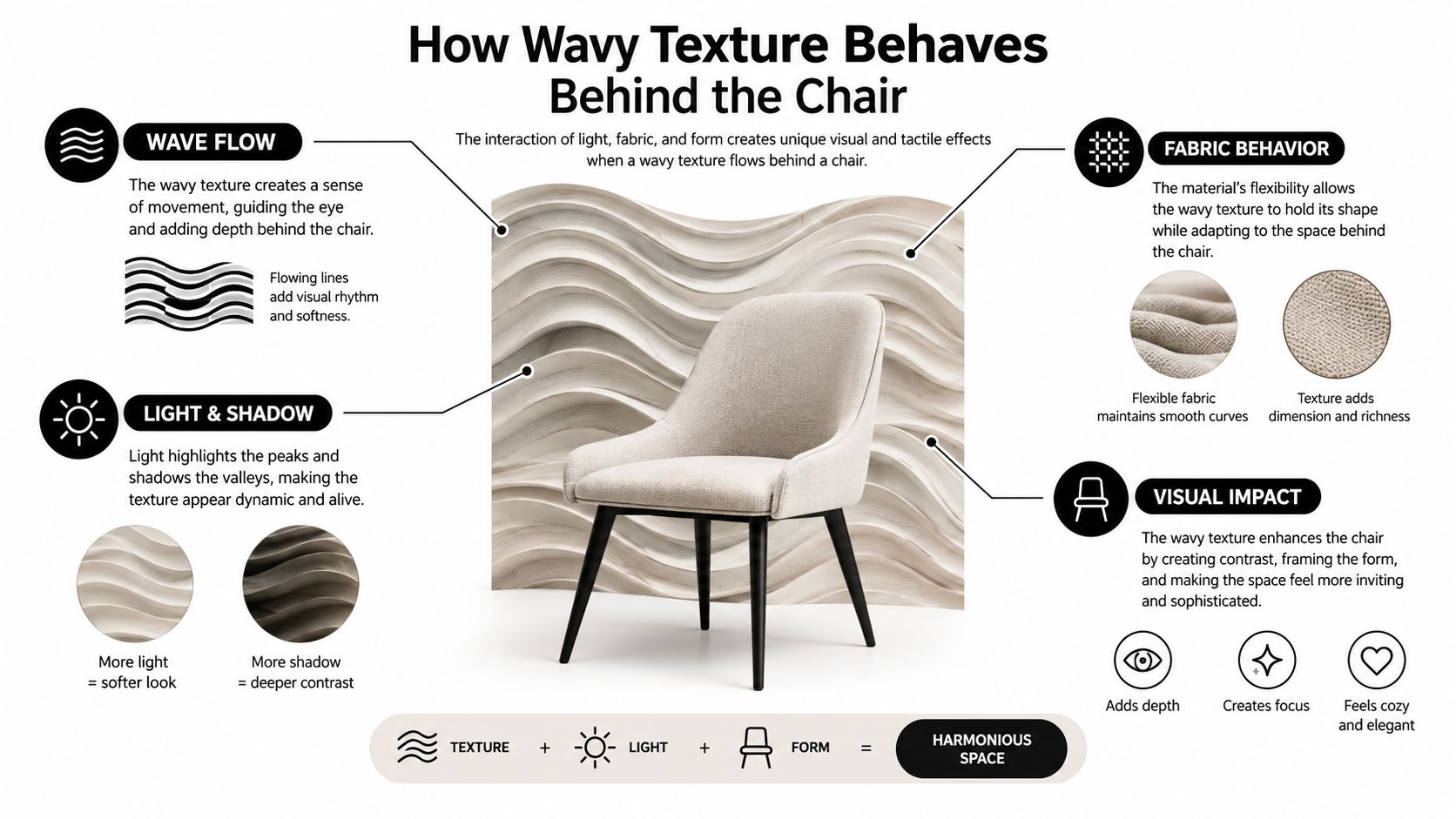
Check the hair in both directions from ends to root and root to ends. Slight resistance against the cuticle direction can be normal. Hair that feels unusually slick in both directions may have undergone heavy processing, so touch alone cannot establish quality. Add a combability check, inspect for short fragments and shedding, and complete a wash assessment when the purchase is significant.
The 6A through 10A grading language has no governing industry standard. These labels are supplier marketing rather than a regulated quality scale. Evaluate cuticle alignment, tangling, combability, shedding, and durability through repeated washing, as outlined in this Remy hair quality buying guide.
Texture selection should reduce the amount of correction required at home and during maintenance appointments. Straight, wavy, and curly extensions each create a different relationship between the client's natural pattern and the installed hair. The right choice is the one that keeps the blend believable through washing, drying, and normal movement, not only immediately after a finished style.
Straight hair gives the cleanest visual line and usually requires the least texture management. It can expose a mismatch quickly on hair with a strong natural bend, though, because the client's own hair may expand or turn while the extensions remain flat. Curly hair offers stronger pattern continuity for clients with defined curls, but it generally demands more careful detangling and pattern preservation. Wavy sits between those options, offering movement without the tighter bends associated with curly textures.
| Texture | Best Natural Match | Styling Effort | Blending Notes |
|---|---|---|---|
| Wavy | Natural bend, loose wave, air-dried movement | Moderate, with less daily heat when the pattern matches | Blends through movement and volume, but wave depth must correspond closely |
| Straight | Uniformly straight natural hair or clients seeking a sleek finish | Lower for a straight result, higher when matching natural wave | Creates a clean line, but can look separate from hair that expands or bends |
| Curly | Defined curl pattern and clients committed to curl-focused care | Higher, especially during detangling and refreshing | Matches strong curl structure, but loose natural waves may look under-textured beside it |
Wavy is often the most efficient choice for clients who want their hair to look finished without recreating a rigid style every morning. It isn't automatically the easiest texture. Wave creates more surface interaction than straight hair, and inconsistent pattern depth can make the blend look uneven even when the color is accurate.
The consultation should also account for the client's desired finish. A client requesting a sleek blowout for every appointment may be better served by straight hair, while a client who alternates between air-dried waves and controlled movement may gain more from wavy. A curly client who frequently straightens may need a separate discussion about whether a wavy texture will support the desired look without excessive manipulation.
The strongest texture match is the one that minimizes heat and force, then still looks intentional after the client washes it.
Start with the client's density, scalp visibility, movement needs, and maintenance tolerance. Wave can soften an attachment visually, yet it can also hide excess weight, friction, or tension until the client wears the hair through a full day. Method selection is therefore a blending decision, not merely a product choice.
A beaded row can preserve movement, but fine wavy hair may not have enough density to distribute its weight comfortably. Microlinks also need precise placement. Wave may conceal tension initially, then expose it through localized tangling or restricted movement. For the full method taxonomy, review our guide to hair extension methods.
Use a same-day check before committing: observe the client's dry wave, test whether the attachment stays concealed during movement, and confirm that the projected weight suits the natural density. Then match the method to the client's actual routine, not an idealized styling plan.
For Conde Professional's wholesale collection, Volume Weft, Thin Weft, Tape Weft, K-Tip, Tape-In, Clip-In, and Bulk provide method-specific routes for wavy clients. A professional account supports salon purchasing and access to education.
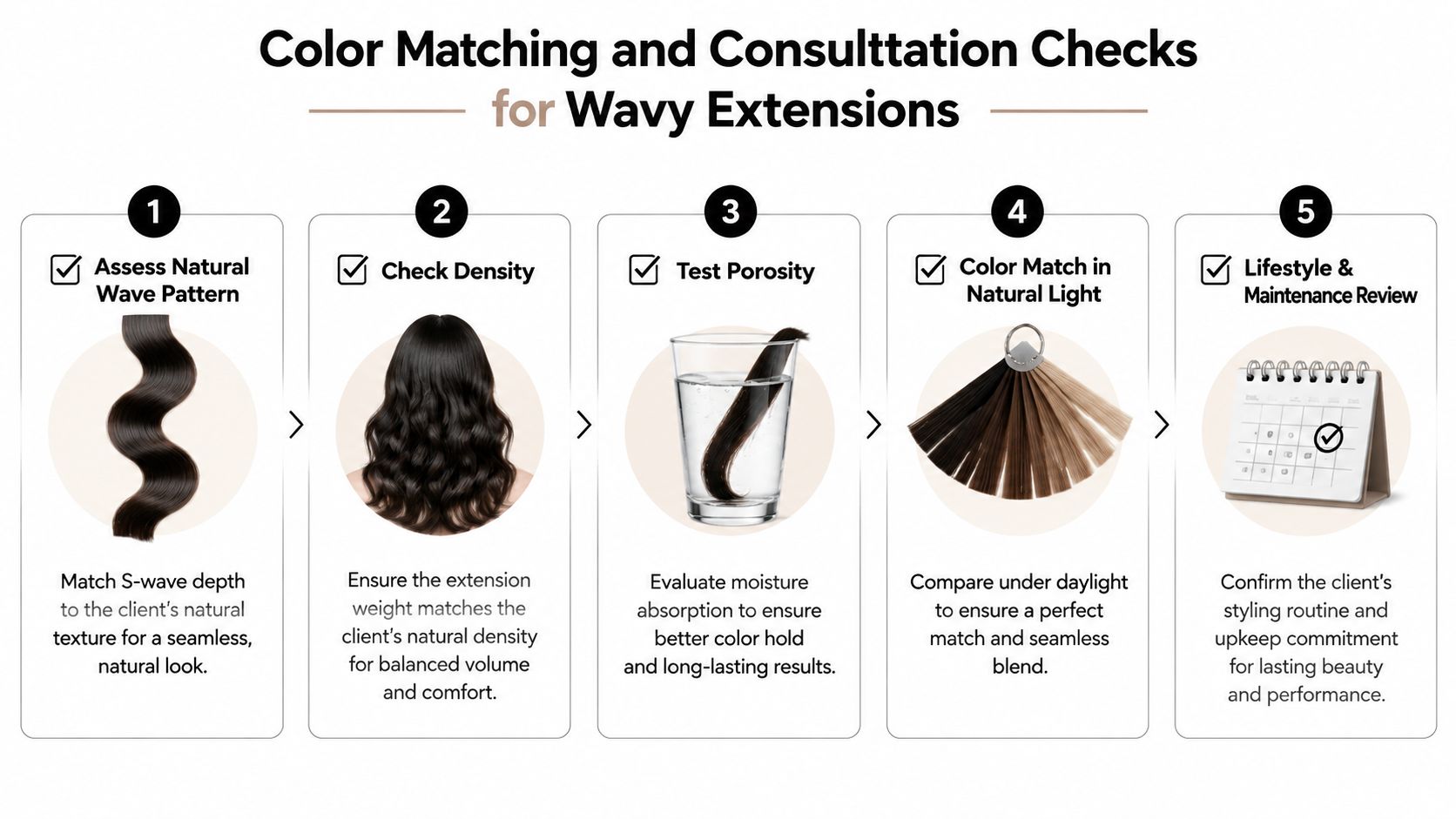
Color matching should happen after the stylist has assessed the pattern and density. Waves create shadow, reflection, and depth, so a shade that appears close on a straight swatch can read differently once the hair bends. The stylist needs to compare the extension and natural hair in conditions that reveal the full color relationship.
Use a same-day sequence rather than guessing from memory:
Conde Professional shade families include Solid, Balayage, Bronde, Highlights, Superblend, Rooted, and Fantasy. Solid shades can suit an even color field, while rooted and dimensional families can reduce the need to force one flat shade across natural variation. Highlights and balayage should be positioned according to where the client's own lightness sits, not placed at the ends because the name sounds similar.
Supplier questions should be concrete. Ask whether the hair is cuticle-intact, whether the cuticles remain aligned, how shedding is assessed, how the hair performs during combability checks, and what wash-durability information is available. A 6A, 7A, 8A, 9A, or 10A label cannot replace those answers, because the grading system isn't governed by an industry body.
Strand-test rule: If the extension will be toned, lifted, or subjected to repeated heat, test a small section before committing the full collection.
The stylist should record the selected shade family, the natural-light comparison, the wave match, and the planned method in the client file. That record makes the next move-up consultation more precise and helps the salon identify patterns in product performance without relying on vague grade labels. A methodical hair extension color matching guide can support that workflow.
Wave preservation begins during installation. The stylist should section cleanly, maintain even tension, and place wefts or bonds so the natural hair can move without being forced against the attachment. A wavy pattern can hide uneven tension during the initial finish, but the client may notice discomfort, tangling, or a distorted fall after the first wash.
Install the selected method according to its construction requirements, then check the hair in a relaxed state. The extensions shouldn't be pulled excessively to create a temporary smooth line. For wefts and bonds, balanced placement matters more than compressing the natural hair tightly against the scalp.
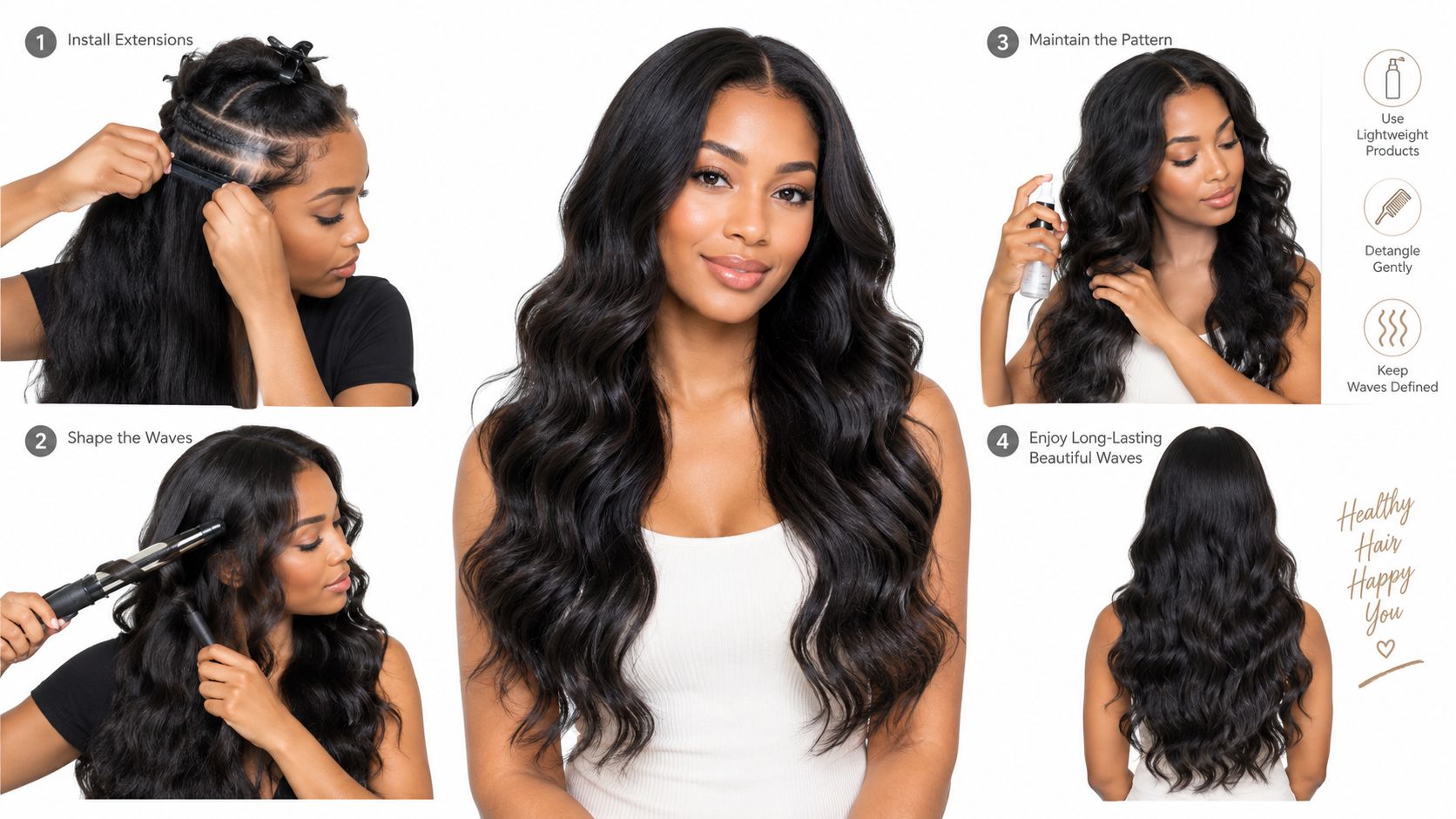
Maintenance appointments should be scheduled according to visible growth, attachment position, tangling, and the client's hair response, not an invented universal wear promise. At each move-up or reinstall assessment, inspect the scalp area, attachment security, shedding, and the condition of the natural hair before deciding whether the same method remains appropriate.
The material and pattern behavior described in this guide to wavy hair extensions should be translated into a client-specific routine. A stylist should give written instructions covering damp detangling, drying direction, heat discipline, and the point at which the client must return for assessment.
Wavy extension problems usually point to a mismatch in friction, tension, moisture, pattern, or density. Frizz after drying often comes from rough handling, excessive brushing, or a pattern that has been repeatedly flattened and reactivated. The chair-side correction is to reduce manipulation, reshape the hair while damp, and review the thermal routine.
Matting at the nape requires a closer inspection. Check for product buildup, friction from clothing or sleep, attachment spacing, and reversed cuticle direction. Remove compacted areas gently from the ends upward, then determine whether the installation or the home routine is creating repeated tension.
Wave drop can result from excessive heat, overhandling, or a natural pattern mismatch. If the client's hair has a stronger wave than the selected extension, the blend line may remain visible even after styling. A straight-looking strip through the top layer usually indicates that the sectioning, density distribution, or color placement needs correction rather than more heat.
Same-day troubleshooting checklist:
The concrete next step is to open a Conde Professional account, review the professional collections, and use the available shade guidance, courses, and method education before ordering for the next wavy install.
Conde Professional supplies licensed professionals with method-specific options including wefts, Tape-Ins, K-Tips, Clip-Ins, and Bulk, supported by color rings and stylist education. Visit Conde Professional to open a professional account and build the next wavy consultation around texture, density, color, and installation method.


