Your cart is empty
Tax included and shipping calculated at checkout

Drawer menu
Tax included and shipping calculated at checkout
A professional account gives you stylist pricing, priority support, early access to new releases, and education developed by working stylists.


Ethical hair extensions are two separate problems, fiber quality and labor provenance. India exported about $948 million of human hair in 2025–26, including $651.72 million of dressed or worked hair and $286.99 million of unworked hair, yet that scale doesn't prove that any individual weft was collected with consent or fair compensation.
A stylist can install smooth, cuticle-aligned Remy hair and still lack evidence about who supplied it, how that person was paid, or which workers processed it. The professional standard is therefore simple: test product performance and supply-chain ethics as separate claims. This guide gives salon professionals the questions, documents, and method decisions needed to test both before an order reaches the chair.
“Ethical” isn't a synonym for Remy, cuticle-intact, or single-donor. Those terms address the fiber. Ethical sourcing addresses consent, compensation, working conditions, and the ability to follow the hair from collection through processing and finishing. A buyer who checks only the fiber is auditing half the claim.
Consider a salon owner buying a weft labeled “100% Remy, ethically sourced.” The hair may have intact cuticles aligned in one direction, while the donor sold it under severe economic pressure through a temple auction with no direct relationship to the manufacturer. The fiber claim can be technically accurate, but the labor claim remains unproven. Temple donation can be more traceable and voluntary, but even that model depends on clear donor understanding and transparent downstream handling, as discussed in the journey of Remy hair from temples to tresses.
Fiber quality can be assessed through combability, directional cuticle integrity, shedding, texture consistency, and behavior after washing and heat styling. Premium hair is often sold as single-donor or clearly traceable hair with aligned cuticles, while mixed-source bundles and vague origin claims deserve scrutiny. “Remy” describes cuticles kept intact and aligned in one direction. It doesn't certify consent or fair pay, a distinction also made in this explanation of Remy hair and ethical sourcing.
Labor provenance requires different evidence. A supplier needs to explain how the hair entered the chain, who collected it, how compensation was handled, and which controls apply to sorting and manufacturing. A written ethical-sourcing policy, such as the framework outlined on Conde Professional's ethical sourcing page, is a starting point, not a substitute for batch-level documentation.
Salon owners evaluating broader cruelty free hair care brands should apply the same discipline. Cruelty-free language and ethical human-hair sourcing are related values, but neither automatically verifies the other.
Practical rule: Treat “Remy” as a performance question and “ethical” as a chain-of-custody question.
Hair enters a professional extension supply chain long before it becomes a hand-tied row, tape panel, or K-Tip. Every stage can preserve quality and accountability, or erase both.
Collection may involve temple donations, individual sellers, salon-floor cuts, rural buyers, or local brokers in collecting regions. Those routes aren't ethically interchangeable. A voluntary donation can be documented differently from a cash sale, and anonymous bulk collection makes donor consent harder to establish. Reporting on the international trade describes unclear origin claims and ambiguity over whether hair was donated, sold, or taken without proper consent, which is why industry reporting on the hair extension supply chain recommends asking for traceability rather than accepting labels such as “virgin” or geographic marketing terms.
The first supplier question should be: Where did this batch enter the chain, and can the collection point be identified? A country name alone doesn't answer it.
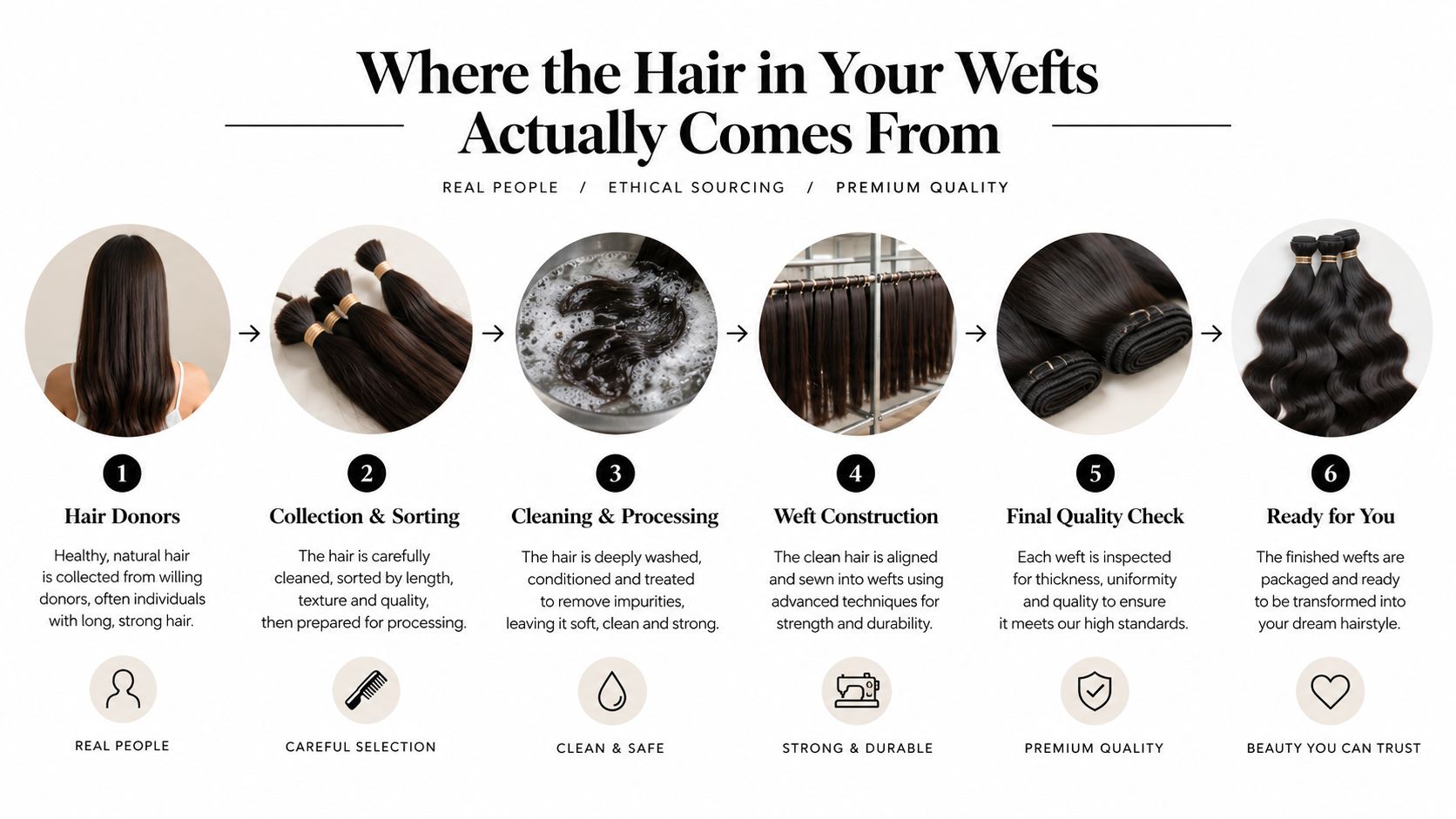
At processing hubs, workers sort hair by length, texture, and condition. Hand-sorting can preserve useful distinctions, but it can also conceal mixed origins if lots are combined before documentation is created. Chemical processing then affects the fiber directly. Acid treatment, silicone coating, steam texturizing, bleaching, and coloring can create a polished first impression while compromising the outer fiber and changing how the hair behaves after repeated wear.
The technical question isn't whether processing occurred. Nearly all commercial hair requires handling and finishing. The question is whether the supplier can describe the process clearly and show that cuticle direction was preserved rather than merely simulated with coating or steam smoothing. The professional guide to Remy human-hair extensions offers useful terminology for separating cuticle alignment from general marketing language.
Wefting, tipping, bonding, coloring, and packaging add more points where batches can be mixed. A supplier that can identify collection, sorting, processing, and finishing stages gives a stylist something auditable. A supplier that only provides a polished product photograph gives a stylist a sales claim.
An ethical sourcing claim should survive four separate questions: Was the hair obtained voluntarily? Was the donor compensated fairly where payment was involved? Were workers protected? Was processing managed responsibly? These pillars don't carry equal verification difficulty from a salon, but each matters.
Consent is the hardest issue to infer from finished inventory. Donors may donate through religious rituals, sell directly, or interact with collectors and intermediaries. A supplier should have a written donor-consent policy and explain how collection partners record voluntary participation. A generic statement that hair is “ethically sourced” isn't evidence.
Compensation applies most clearly where hair is sold rather than donated. The salon may not be able to verify the exact amount paid to each donor, but it can ask whether the supplier has a compensation standard, prohibits coercion, and monitors intermediaries. Refusal to answer indicates an accountability gap, not proof of abuse, but the buyer should treat that gap as a purchasing risk.
Labor conditions at sorting and processing facilities are more accessible through supplier policies, audit summaries, and inspection records. A documented Supplier Code of Conduct can cover raw-hair collection and factory processing, with inspections or audits and restrictions on regions associated with human-rights violations, as described in this ethical sourcing framework. Audits still have limits. A facility inspection may show workplace controls without proving what happened at the original collection point.
Environmental impact belongs in the same file. Processing can involve chemicals, water, and waste, so suppliers should explain effluent handling, water management, and disposal procedures. Stylists won't verify a treatment facility from behind the chair, but they can request written policies, chemical safety documentation, and audit scope.
| Pillar | What's Being Tested | Easiest Verification Method | Hardest but Most Definitive |
|---|---|---|---|
| Consent | Voluntary donation or sale without coercion | Donor-consent policy and collection description | Collection-point records or direct oversight |
| Compensation | Fair treatment of sellers and collectors | Compensation standard and intermediary policy | Verified payment records or on-site review |
| Labor conditions | Safe, voluntary work in sorting and processing | Supplier Code of Conduct and audit summary | Independent facility inspection |
| Environmental impact | Chemical, water, and waste controls | Processing policy and safety documents | On-site environmental audit |
A supplier's professional brand guidance for extension buyers can help frame questions, but the salon still needs documents tied to the actual inventory being purchased.
No traceability model proves everything. The right question is not “Does the supplier have a certification?” It is “Which part of the chain does this document cover?”
A Supplier Code of Conduct backed by inspections or third-party audits can provide useful evidence about factory labor, processing controls, and prohibited practices. It usually doesn't reach every individual donor or rural collector. The failure point sits at the beginning of the chain, where anonymous brokers may aggregate hair before it arrives at an auditable facility.
Temple-based collection can offer a clearer voluntary origin because hair is donated as part of a religious ritual. It still doesn't automatically prove what happens after donation. Sorting, auction, transport, processing, and mixing can weaken traceability if records stop at the temple.
Single-donor claims can support cuticle alignment, texture consistency, and a more precise origin story. They're also easy to print on a label and difficult to trust without batch codes, collection records, transfer documents, and matching inventory controls. If paperwork starts only at the factory, “single-donor” is an assertion, not an audit trail.
Some suppliers use cooperative-based systems that combine named collection areas, small-batch handling, and facility controls. This model can create stronger relationships with collectors and improve accountability across stages, but it still depends on accurate records and independent checking. A cooperative label alone doesn't establish consent, compensation, or environmental performance.
| Model | What It Proves | Common Failure Point |
|---|---|---|
| Facility audit | Conditions and controls at the audited site | Individual donor practices remain outside scope |
| Temple donation | A potentially voluntary collection route | Post-donation sorting and mixing |
| Single-donor lot | A defined donor or small batch if records match | Forged or incomplete chain-of-custody paperwork |
| Hybrid cooperative | Tighter relationships across collection and processing | Internal records may lack independent verification |
Stylists should ask where the paperwork chain begins, which parties are audited, and whether the batch on the invoice matches the batch in the documentation. The guide to ethically sourced hair extensions can support supplier conversations, but no model removes the need for direct questions.
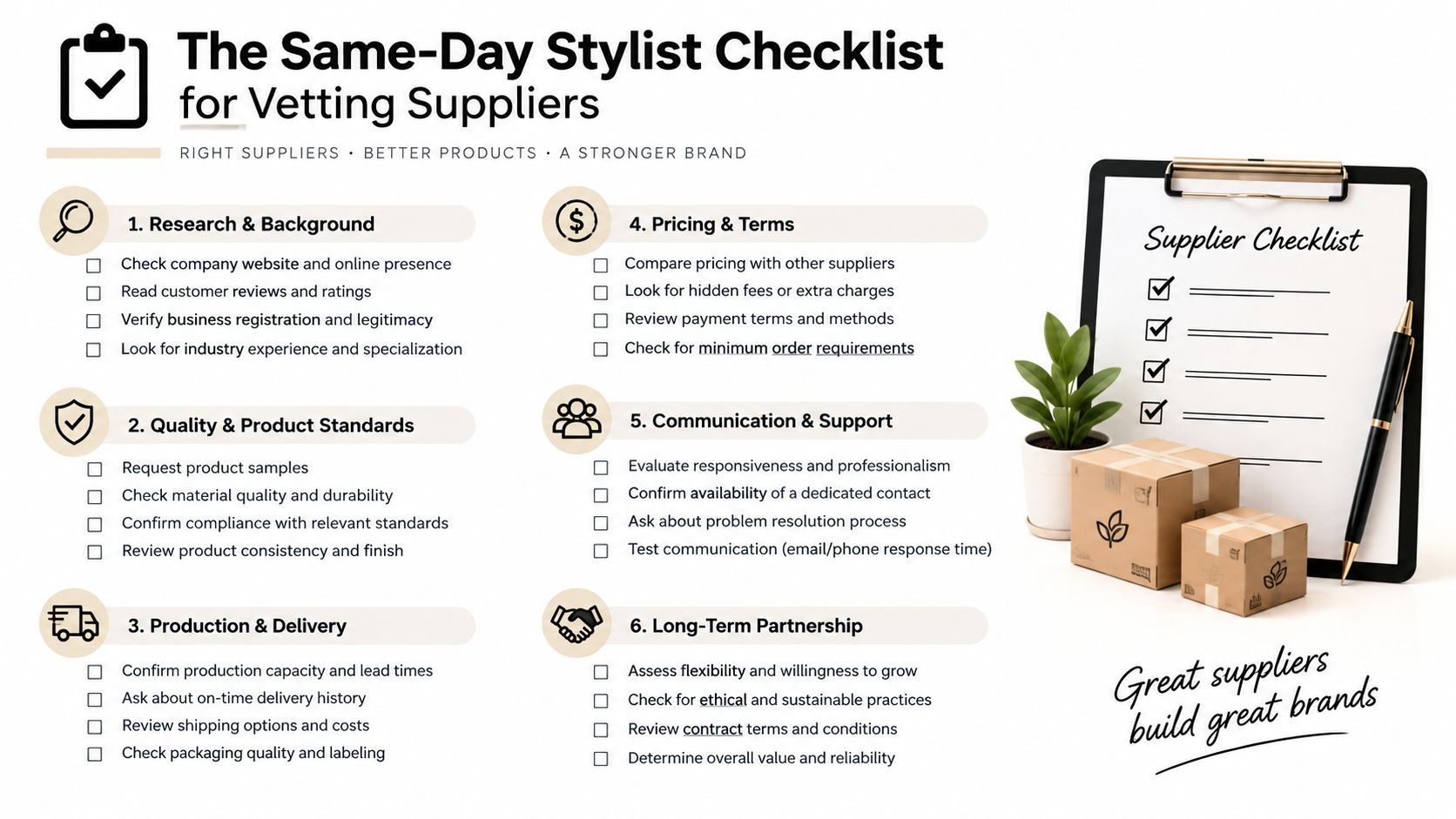
A stylist can screen a supplier during one focused email exchange or phone call. The objective isn't to demand private commercial details. It's to determine whether the supplier can provide enough evidence to separate a real control system from polished copy.
Ask these questions first:
A vague answer isn't a pass. It means the buyer should pause the order until the supplier provides usable documentation.
Ask where chemical processing and steam finishing occur, what type of stripping or coating is used, and how the supplier maintains cuticle direction. A supplier doesn't need to disclose a proprietary formula, but it should explain the process category and its quality controls.
Request performance evidence through a sample. Check combability dry and wet, directional feel, shedding at the weft, color consistency, and behavior after salon-standard care. Supplier grading systems such as 6A, 7A, 8A, 9A, and 10A have no governing industry body behind them. They're marketing labels, so measurable behavior matters more than the grade printed on the packaging.
A credible supplier should be able to provide:
Refusal to share certificates, unexplained country-only sourcing, unverifiable single-donor claims, and proprietary grades without measurable criteria are red flags. The wholesale human-hair extension buying guide can help a salon organize its procurement questions, but the supplier's answers still need to stand on their own.
Ethical sourcing doesn't rescue a poor method match. A cuticle-intact weft can still create excess tension on fragile density, and a well-documented K-Tip can still be the wrong install for a client whose hair cannot tolerate its load or maintenance demands.
| Method | Typical Fiber Grade | Provenance Strength | Best For / Wrong For |
|---|---|---|---|
| Hand-tied weft | Cuticle-intact or traceable human hair where documented | Depends on the batch and weft supplier | Useful for clients needing flexible row placement. Wrong for a client whose density can't support row tension. |
| Tape-In | Cuticle-aligned hair with adhesive panels | Traceability should connect panels to a batch | Suitable for controlled sectioning and efficient maintenance. Wrong for clients who won't follow attachment and removal care. |
| K-Tip | Strand-based, cuticle-intact hair when specified and verified | Documentation must cover individual or small-batch handling | Useful for discreet strand placement. Wrong for fine density where concentrated attachment points create avoidable traction. |
| Microlink or I-Tip | Strand-based hair with consistent direction and tip integrity | Requires clear documentation for hair and bead components | Appropriate where heat-free installation suits the client. Wrong for clients who manipulate or snag attachments repeatedly. |
| Clip-In | Varies widely by supplier and batch | Bulk-bin or mixed-source inventory is harder to verify | Best for occasional styling. Wrong for clients expecting permanent wear or salon-level integration every day. |
For fine density, reduce concentrated load and avoid installing more hair than the foundation can support. For active clients, attachment security and maintenance compliance matter as much as provenance. For clients seeking occasional volume, Clip-In hair may be practical, but the salon should ask whether the inventory is traceable or assembled from mixed bulk lots.
Conde Professional offers Volume Weft, Thin Weft, Tape Weft, K-Tip, Tape-In, Clip-In, and Bulk formats for professional selection. The method page doesn't replace a consultation. Density, sectioning, lifestyle, maintenance discipline, and the evidence attached to the specific batch still determine the right choice.
Chair-side rule: Choose the lightest method that delivers the target result, then verify the hair's provenance separately.
Gentle processing isn't a moral decoration. It affects how the fiber behaves under salon reality, including washing, heat, brushing, sleeping, and repeated move-up work. The cuticle is the hair's main structural defense against friction, tangling, and premature shedding, so aggressive processing can leave a product looking polished at install while creating roughness later.
A supplier that preserves directional cuticle integrity through collection, decontamination, and finishing gives the stylist a more stable starting material. A supplier that relies heavily on stripping, coating, or steam smoothing may produce a short-term cosmetic result that changes quickly once the surface treatment wears down.
The salon should evaluate hair after actual service conditions, not only straight from the package. Track:
The verified technical guidance doesn't support universal wear-duration promises, so suppliers and stylists shouldn't publish one longevity number for every method, texture, or client. A hand-tied row, Tape-In, K-Tip, and Clip-In face different mechanical stresses, and client maintenance changes the result.
Poorly processed hair consumes chair time through detangling, corrective brushing, replacement conversations, and avoidable client dissatisfaction. Better fiber stability can reduce those problems, but only when the salon also provides correct home-care instructions and schedules appropriate maintenance.
The commercial case is straightforward. A traceable, gently processed product can support more predictable service delivery, fewer emergency corrections, and stronger trust in the stylist's recommendation. Ethical processing protects the donor and the client, but it also protects the salon's labor margin.
Before opening a professional account, the salon owner should request a written origin disclosure and ask for batch-level traceability. The representative should be able to identify the country of raw acquisition, explain the collection route, and provide documents that connect the explanation to the inventory being sold.
Store the following in one location:
Third-party certifications should be checked independently through the issuing body's own records. A logo on a sales sheet isn't enough. The certificate should identify the covered organization, site, scope, and current validity.
End the conversation if the supplier refuses to disclose the country of origin, can't explain how single-donor claims are verified, or offers pricing far below market without a credible explanation. A low price doesn't prove exploitation, but unexplained pricing combined with missing records creates unacceptable supply-chain risk.
The first order should be a pilot, not a commitment. Test a 10–20 weft install across mixed hair types only if the salon can manage that order size and the supplier provides the required documentation, then record installation behavior, maintenance feedback, shedding, and batch consistency before scaling.
Open a Conde Professional wholesale account after the documentation review, not before it. The collection gives licensed professionals access to multiple install formats and salon-oriented support, so visit Conde Professional to review the professional range and begin a supplier conversation grounded in traceability.


