Your cart is empty
Tax included and shipping calculated at checkout

Drawer menu
Tax included and shipping calculated at checkout
A professional account gives you stylist pricing, priority support, early access to new releases, and education developed by working stylists.
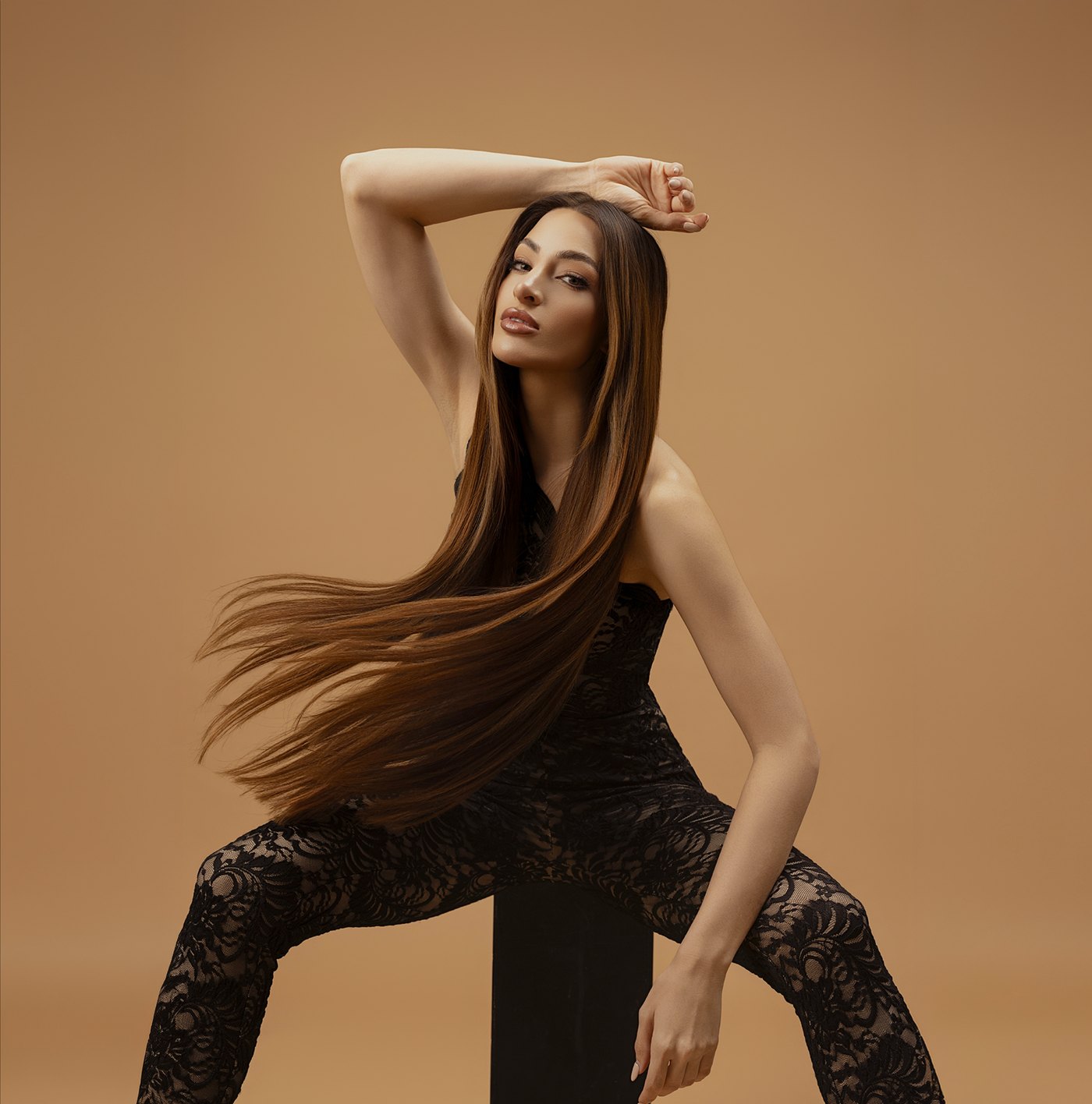

The popular advice, “red is just a matter of choosing the right shade,” produces inconsistent salon results. Professional hair color red is a pigment-engineering problem first and a shade-matching problem second, especially when the finished look includes human-hair extensions.
Natural red hair is the rarest natural hair color globally, appearing in about 1% to 2% of the population, or roughly 70 million to 140 million people. It's also geographically concentrated, with around 4% of Europeans reported to have red hair, particularly in Northern Europe (global population data on natural red hair). That rarity doesn't make every red formula difficult, but it does mean the salon must engineer a result rather than rely on a generic red swatch.
For a working colorist or extension specialist, the decisive questions are practical. What's the starting level? Which undertone is already present? How porous is the fiber? Is the target copper, auburn, crimson, burgundy, violet-red, or a brunette-based hybrid? Those readings determine the formula, application method, extension family, and maintenance conversation.
Red doesn't behave like brown or blonde in the bowl, and it shouldn't be evaluated as if it does. It's a fading-prone, formulation-sensitive shade family, not one universal hue. Copper, auburn, cherry, crimson, burgundy, and violet-red can share a red identity while requiring very different bases and neutralizing strategies.
Permanent oxidative color begins with colorless precursor and coupler molecules that react with peroxide under alkaline conditions. The resulting dyes form inside the fiber, but red results depend heavily on the balance of those ingredients and the developer used (professional chemistry of oxidative hair coloring). A bowl swatch can look saturated and even while the client's hair exposes uneven porosity, residual warmth, or artificial pigment that changes the final reflection.
Base level determines how much lightness already exists for the target. A dark brunette can receive red reflection, but it can't display the same luminous copper or clean crimson produced on a lighter canvas.
Undertone controls the direction of the red. Orange under a copper formula can amplify warmth beautifully. The same orange under a cool violet-red may create unwanted brown or muted plum.
Porosity controls retention and deposit. Virgin mid-lengths generally behave differently from over-processed ends, which can absorb quickly and release color just as quickly.
Target family determines the engineering brief. A copper-red service needs warmth and luminosity. A burgundy service needs controlled depth and violet balance. A cherry cola service needs brown structure so the red doesn't look flat or overly cosmetic.
Practical rule: A marketing card shows the intended family. A strand test shows what the client's fiber can actually produce.
Artificial red colorants are also more vulnerable to wash and light exposure than many other tones. Cosmetic science literature describes red dyes as more water soluble and more readily removed during washing, while research on colored hair found the greatest change after combined irradiation and shampooing, with deep fading observed in some pyrazole-based colors after repeated shampoo and light stress (cosmetic science review of red dye behavior).
The working thesis is simple. Formulate the red against the client's fiber first, then match the extension against the corrected result. If the extension ring drives the formula before the natural hair is stabilized, the stylist can create a clean match at installation and an obvious mismatch after the first fade cycle.
Oxidative red is built inside the hair rather than applied as a finished color molecule. The colorist combines precursor and coupler ingredients with peroxide, generally in an alkaline environment. Small molecules move into the fiber, then join to form larger colored dyes. The final shade follows the chemistry of that mixture, not the number printed on the tube.
Common red systems use primary intermediates such as p-diamines or p-aminophenols alongside couplers. Professional chemistry references describe red tones as specific combinations of magenta and orange intermediates. That balance explains why a small formulation change can move a result from copper to red-orange, or from crimson to violet (oxidative hair-color chemistry and red-forming intermediates).
On a natural red or pre-lightened base, 10 volume is generally the controlled choice for deposit-focused red work. It supports saturation without requiring unnecessary lift.
20 volume suits formulas that must lift underlying pigment while depositing red, particularly across Levels 5 to 7. The trade-off is exposure. More lift can create a brighter result, while also exposing fresh warmth and reducing the stable red deposit left in the fiber.
30 volume or higher can over-oxidize delicate red-forming intermediates and produce a duller result, especially when the target is vivid but controlled. Higher alkalinity can swell the cuticle faster, which may increase color release during later washing.
Fiber structure influences every stage, from porosity assessment through extension processing. Reviewing the structure of hair clarifies why cuticle condition changes both color uptake and release.
Developer strength receives attention, but mixing ratio often has the larger practical effect. Excess developer can dilute deposit and create unwanted lift. Too little can restrict the oxidative reaction, leaving the color underdeveloped or uneven.
Before mixing, the formula should answer three questions:
The chosen developer should follow the intended depth and movement of the red, rather than routine. For extension work, this distinction matters across both strand-by-strand pieces and wefts. A controlled deposit on a suitable base generally gives a more dependable match than an over-lifted shade that appears brighter during the first few days.
Red is therefore a pigment-engineering problem before it becomes a shade-ring problem. Stabilize the client's fiber, then judge the extension color against that result. The strand ring confirms the family, while the fiber determines what the formula can produce.
Red behaves according to the fiber in front of you. A red consultation begins with a physical assessment of level, undertone, and porosity, then connects those readings to the shade ring and the extension method. A copper can turn too orange on a warm base, while a violet-red can become muddy when the underlying pigment and porosity are ignored.
Separate a clean strand from the head and compare it with a physical ring under natural light. Natural red commonly sits around Levels 5 to 6, warm brunette around Levels 4 to 5, and brighter copper or fantasy families generally need a lighter canvas around Level 7 or above. These are formulation examples, not guarantees. Artificial color, uneven lift, and porosity can change the visual reading.
Level determines whether the service calls for deposit-only color or lift followed by deposit. A Level 5 brunette seeking cherry red requires a different plan from a Level 9 blonde seeking magenta. The same target can therefore need different pigment loading and processing decisions.
Undertone predicts how the added pigment will interact with the canvas. A Level 6 natural base already carries substantial orange-red underlying pigment. Direct violet-red over that warmth may read brown or murky instead of clean and jewel-toned. A restrained green or ash-violet adjustment can control unwanted orange, but excessive correction will flatten the red.
Porosity predicts both uptake and release. Over-processed ends may absorb a vivid tone quickly, then bleed it during cleansing. Healthier virgin areas can develop more slowly and hold the result more evenly. Check elasticity and surface condition across the head. A float assessment may reveal differences, but visual inspection and a strand test still determine the working formula.
Use these rules at the bowl:
Assess the natural hair before consulting a physical extension color chart. The ring helps compare the intended finished shade and identify the closest extension family. It does not dictate the starting formula, especially when strand-by-strand pieces and wefts have different saturation and visual density.
| Variable | What to Read | Formulation Implication |
|---|---|---|
| Level | Natural or artificial depth, plus the amount of lift required | Choose deposit-only or lift-and-deposit |
| Undertone | Orange, yellow-orange, gold, red, or violet influence | Decide whether warmth needs amplification or control |
| Porosity | Elasticity, surface condition, uneven absorption, and release risk | Adjust processing exposure, saturation, and end-zone strategy |
Record all three readings before selecting the target family. A formula can look correct in the bowl and still fail on the head when one axis is missing. Strand testing confirms how the pigment-engineering plan behaves on the actual fiber.
Red formulation works best as a sequence of decisions. First identify the canvas, then decide whether to deposit or lift, then select the target family, and only after that add neutralization. The following examples are working logic, not universal formulas, so the colorist still needs a strand test and the color line's technical directions.
A natural red or warm Level 5 to 6 base often supports a deposit-focused copper-red service. A practical example is 7.44 plus 6.4 with 10 volume, adjusted to the brand's prescribed ratio and assessed on a test strand. The lighter copper adds brightness, while the deeper copper provides structure.
For a softer refresh, a low-ammonia demi can veil the existing tone without forcing unnecessary lift. This is often the better choice on hair that already has the desired depth but has lost reflection. Violet can be introduced in a controlled amount when the natural warmth reads too orange for a cooler red target.
A brunette wanting visible red usually needs a lighter canvas. Pre-lightening toward a Level 7 orange-pale gold base can create enough room for copper, auburn, or a red-brown formula to show clearly. Once the canvas is even, 7.4 plus 7.0 can build a balanced red-brown result.
Residual orange needs careful evaluation. If the exposed warmth is stronger than the target allows, a small amount of green-based ash can help control it before final deposit. Too much green, however, can flatten the red and make the result look khaki or brown.
A pre-lightened Level 9 to 10 canvas can support violet-red and magenta-red families directly with controlled low-volume deposit. These shades need even saturation and careful attention to porosity. Boosters are risky on porous ends because they can create a dense, overly cool tip while the healthier sections remain transparent.
Gold has a useful role on ashy lift results. It can restore warmth where the canvas is too pale or too cool for a copper-red target. Green is reserved for unwanted orange control, while violet can cool excessive warmth when a cleaner red direction is required.
| Base Level | Target Red Family | Formula Example | Developer | Neutralizer Add |
|---|---|---|---|---|
| Natural Level 5 to 6 red | Bright copper-red | 7.44 + 6.4 | 10 volume | Violet only if excess orange needs cooling |
| Brunette Level 4 to 5 | Balanced red-brown | Pre-lighten toward Level 7, then 7.4 + 7.0 | 20 volume may be justified for controlled lift | Small green-based ash addition if residual orange is excessive |
| Pre-lightened Level 9 to 10 | Violet-red or magenta-red | Direct deposit in the selected cool-red family | 6 to 10 volume | Avoid unnecessary booster on porous ends |
Twenty volume is justified when lift is part of the service. It isn't justified just because the target is red. If the base is already light enough, added lift can expose warmth and encourage the red molecules to release sooner.
The extension match should be judged against the client's corrected hair, not a screen image or a glossy swatch card. Solid red families are the most straightforward because they behave like a single visual field. 1B Red, Auburn, and Burgundy can align cleanly with single-process deposit work when the depth and undertone are comparable.
Balayage and Rooted families require two separate matches. The root must sit against the client's natural regrowth zone, while the painted lengths need to match the post-toner mid-lengths. A single match at the ends can still produce an obvious root break after installation.
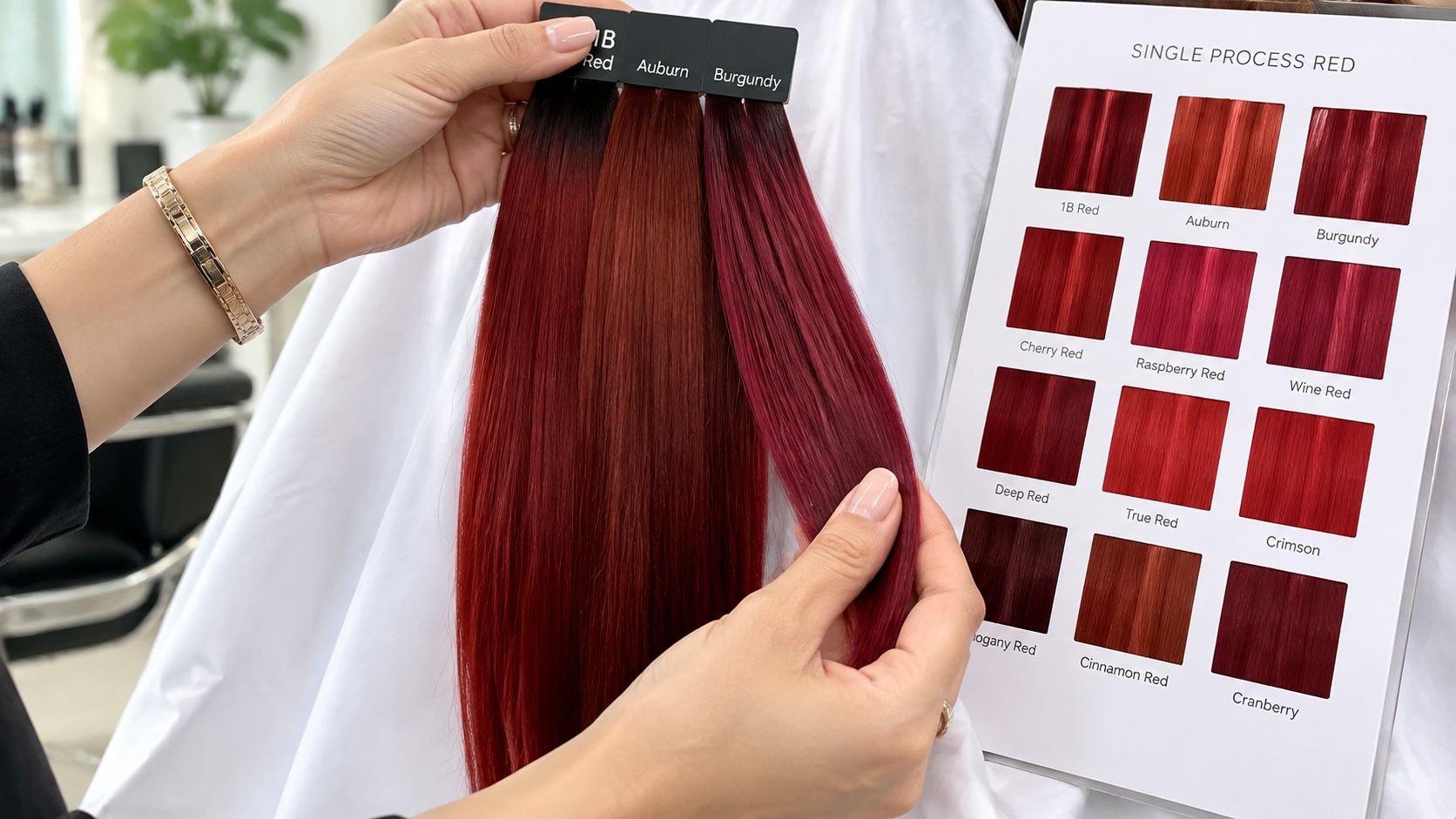
Superblend families, including Cherry Cola and Spiced Auburn, need a hidden weft test. Their dimension may not read accurately while the hair is hanging loose on a ring. Once installed, brushed, and styled, the brown-red relationship becomes more visible.
Fantasy families, including Crimson and Magenta, generally align with clients whose hair has been pre-lightened to around Level 9 or above. On a darker base, the extension can look brighter than the natural hair even if both are described as red.
The ring should be held vertically against the hair at ear level, with the client's hair gathered to expose the comparison zone. Natural light is preferable to salon LEDs, which can exaggerate warmth or suppress violet. Compare the client's regrowth, mid-length, and ends separately, particularly for Rooted or Balayage extensions.
The professional extension color-matching process should include a hidden strand test whenever the extension is dimensional, fantasy-toned, or being custom-colored. A ring beats a flat card because it shows direction, density, surface reflection, and the way the shade shifts across multiple strands.
Remy hair has two defining characteristics: the cuticle remains intact and the strands stay aligned root-to-tip in the same direction. That alignment supports smoother combability and less tangling, but the stylist still needs to inspect the actual bundle.
Letter grades such as 6A, 7A, 8A, 9A, and 10A aren't governed industry standards. Supplier marketing labels shouldn't replace checks of cuticle integrity, alignment, shedding behavior, combability, and wash durability.
Red extension work changes substantially according to the installation method. Strand-by-strand services prioritize controlled saturation around individual units. Weft services prioritize even saturation across a connected panel, with special attention to folds, edges, and attachment zones.
Fusion-bonded extensions use a low-heat connector to fuse keratin bonds to the natural hair. Micro-link methods use individual silicone-lined beads without heat or adhesive.
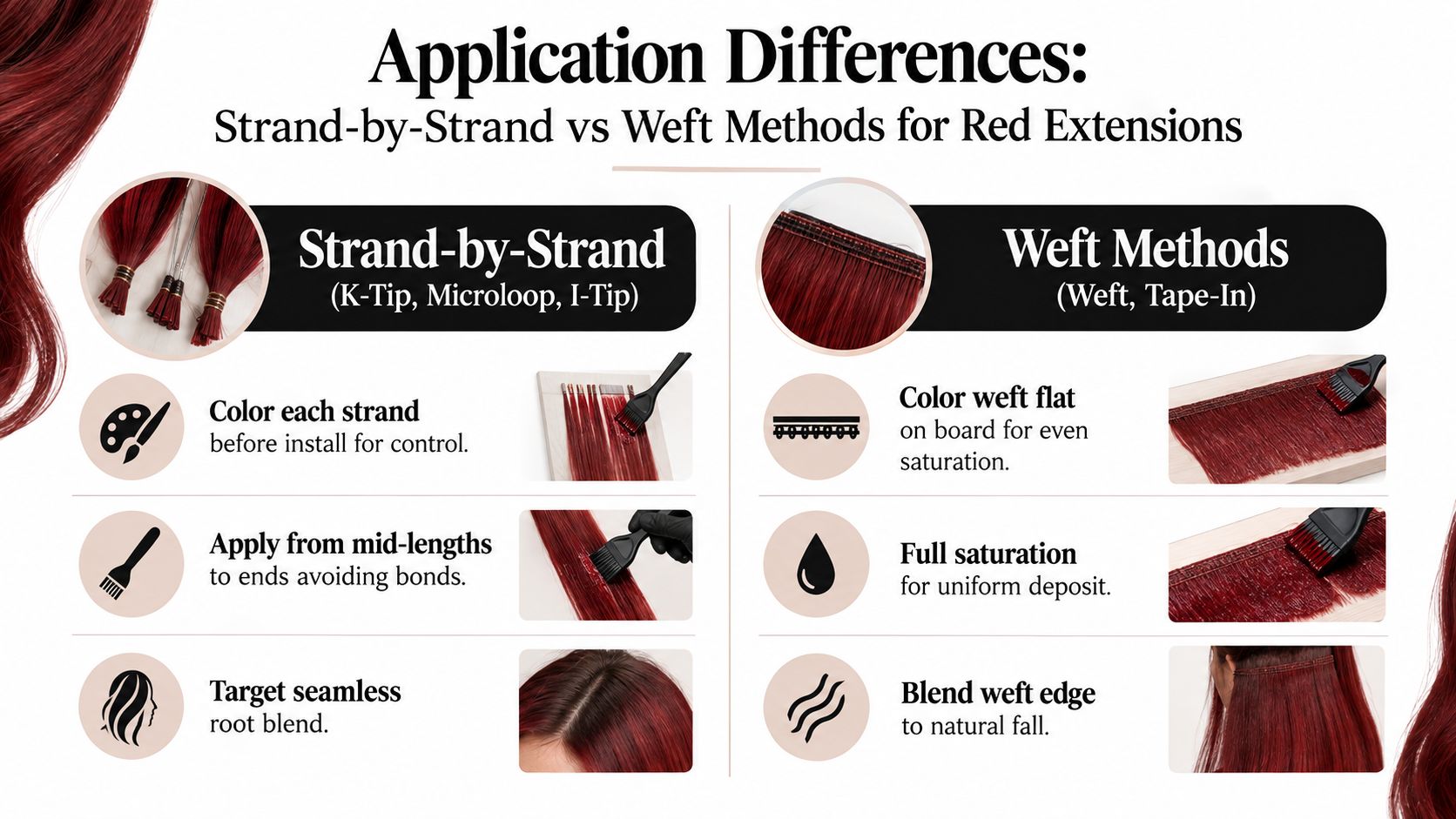
K-Tip, Microloop, and I-Tip units should be colored before installation on a clean board. Apply from mid-shaft through the ends, then address the tips last. Keratin tips must remain chemical-free, so protect the bond zone with barrier cream and keep product away from the attachment.
Microlinks need even saturation without pooling near the bead. Product trapped around the attachment can affect slip, movement, and later maintenance. The aim is a consistent red deposit through the visible length, not maximum saturation at every point.
Conde Professional's extension method collection includes strand-by-strand and weft options suited to different installation plans. The choice still depends on the client's density, styling habits, desired blend, and tolerance for maintenance.
Volume Weft, Thin Weft, and Hand-Tied wefts should generally be colored as a unit on a flat surface. Paddle-dip saturation can work for a full panel, but the fold must stay open enough to prevent uneven uptake. The visible edge needs the same attention as the center.
Tape Weft and Tape-In methods create adhesive constraints. Solvent-based color shouldn't approach the tape tab, and any post-color sealing step must preserve slip without compromising the attachment. A silicone-based topcoat can restore surface glide on the hair lengths, but it must stay clear of the adhesive area.
Application warning: Don't treat a weft like a wide strand. A folded weft can absorb unevenly, and a fully saturated panel can reveal banding once installed.
Color retention may also differ between extensions and biological hair because extension cuticle direction can vary across some wefts, and attachment points can trap heat during styling. That makes controlled processing and aftercare more important than just matching the first-day tone.
Red maintenance starts with pigment behavior, not a generic color-safe shampoo recommendation. Set the expected fade curve before installation, because washing, light exposure, heat, minerals, and attachment movement affect the visible tone differently across natural hair and extensions.
Define the target family clearly. Copper usually softens toward gold or orange. True red can lose saturation and reveal underlying warmth. Violet-red may look flatter or redder as its cooler component releases. The client should know which change is acceptable and when a salon refresh becomes necessary.
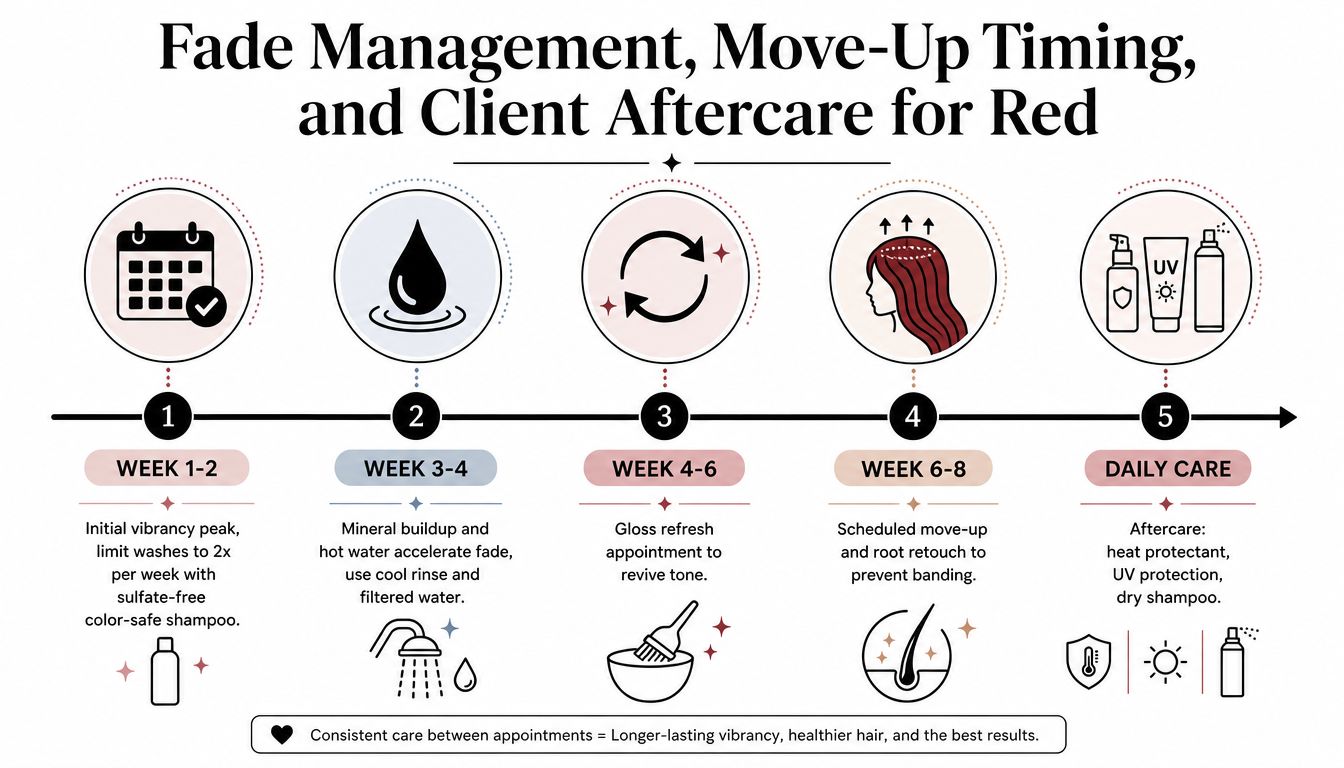
Recommend a sulfate-free, color-safe cleansing routine, then set washing frequency around scalp needs and styling habits. A color-depositing mask can maintain reflection between appointments, but the deposit must match the red family. A copper mask will not maintain violet-red, while a red mask can push copper toward an overly pink result.
Hot water, mineral exposure, UV, and repeated heat styling accelerate visible change. Put heat protection and UV protection in the written aftercare plan, rather than leaving them as checkout advice. For a fuller routine, direct the client to our aftercare guide.
Extension movement follows a separate schedule from color fade. Assess strand-by-strand and tape-based systems as the natural hair grows. Bead-row and similar foundations commonly receive move-ups around 6 to 8 weeks, according to extension method and move-up guidance. Set the appointment from growth, slippage, tangling, attachment condition, and the client's installation, rather than from the calendar alone.
The move-up is also a color decision point. Use a custom toning bath when the extension retains the correct depth but has lost reflection. Reserve full recoloring for a genuine mismatch or major target change, because repeated recoloring adds unnecessary porosity. On strand-by-strand hair, check representative pieces individually. On wefts, assess the panel and its visible edge, since a single average reading can hide uneven fade.
A printable basin card can state:
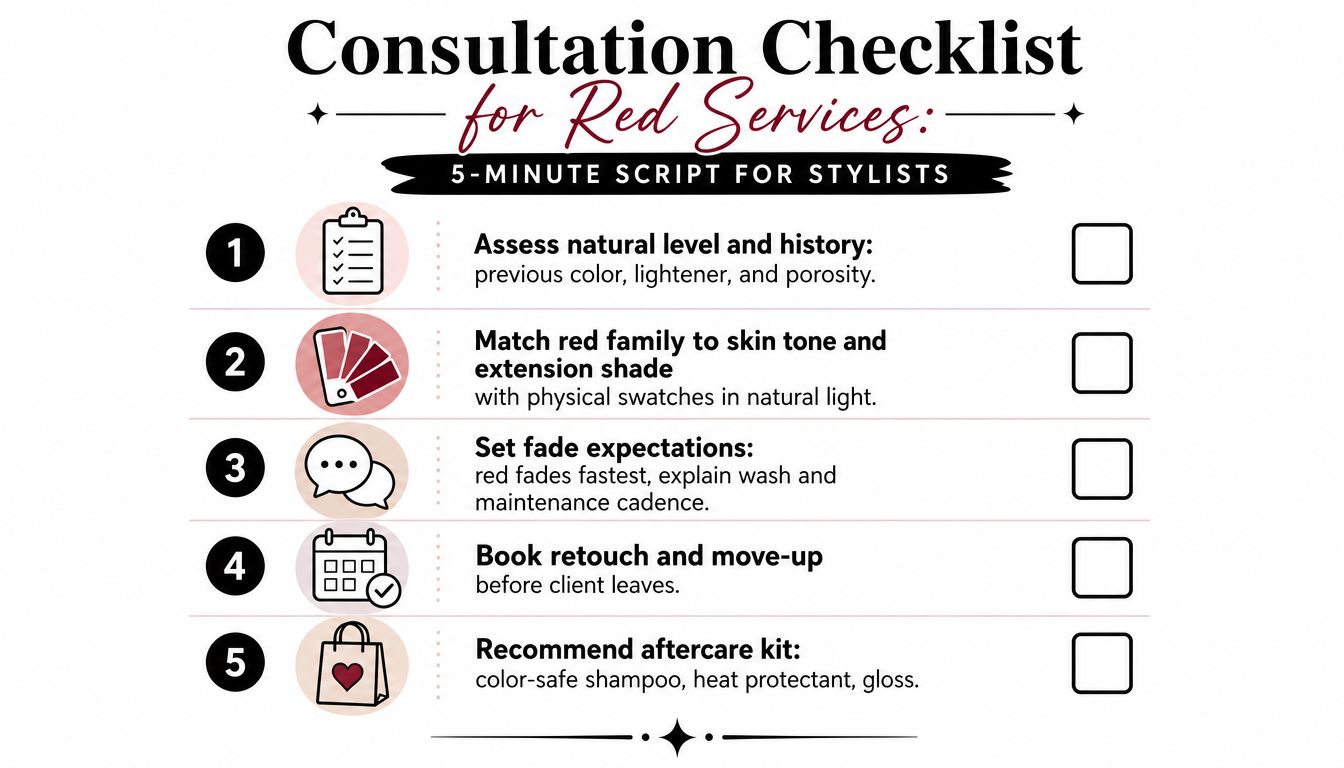
A red service succeeds or fails during consultation. The stylist should ask about box color, previous lightening, current porosity, swimming, heat styling, cleansing habits, and the client's tolerance for visible fade. Each answer becomes a formulation constraint.
The five-minute script can run like this:
The same-day checklist should include a strand test, a float-and-slide porosity check, written developer and mixing-ratio notes, and a signed expectation record. Supplier questions should cover cuticle alignment, shedding behavior, combability, wash durability, shade-ring availability, and which methods suit the planned install. 6A through 10A labels should never substitute for those checks.
Salon owners building a stronger professional sales process can also review these actionable beauty ecommerce strategies for ways to connect consultation education, product selection, and rebooking without reducing a technical service to a retail transaction.
The practical next step is to open a professional wholesale account before the appointment, so the stylist can source the required reds, developers, extension shade rings, and installation method through a licensed-pro workflow.
Conde Professional supplies professional extension systems including Volume Weft, Thin Weft, Tape Weft, K-Tip, Tape-In, Clip-In, and Bulk for red color-matching and installation planning. Licensed stylists and salon owners can visit Conde Professional to open a professional account and review the collection before the next red consultation.


