Your cart is empty
Tax included and shipping calculated at checkout

Drawer menu
Tax included and shipping calculated at checkout
A professional account gives you stylist pricing, priority support, early access to new releases, and education developed by working stylists.
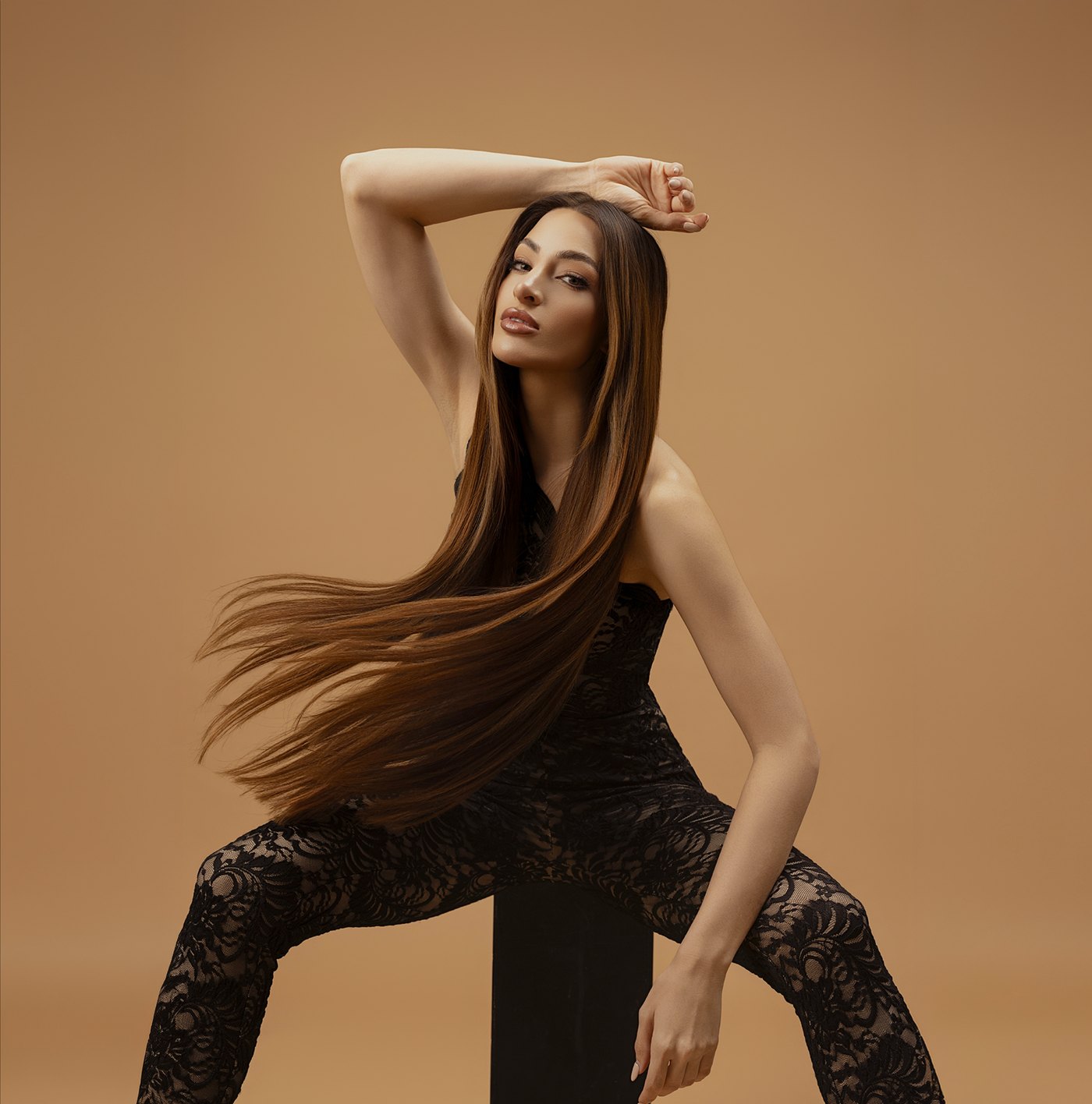

A blonde curly client sits in the chair asking for fullness, length, and a result that still looks like her own curl pattern. The practical answer is to match curl behavior first, blonde dimension second, and installation mechanics third. Wefts suit clients who need distributed volume, tape-based methods can provide a flatter attachment where the curl can conceal the panels, K-Tips offer strand-level placement, and Clip-Ins make more sense for temporary event styling than committed daily wear.
For licensed stylists, blonde curly extensions require more than selecting a light shade and reproducing a straight-hair blend. Curl compression breaks up highlight placement, spring changes perceived density, and lightened fiber responds differently to brushing and cleansing. The sections below move from fiber behavior to shade mapping, method selection, blending, aftercare, and bridal work, with trade-offs stated plainly and a same-day chair-side checklist included.
The category itself is commercially established. The global hair extension market was valued at USD 2.87 billion in 2025 and is projected to reach USD 5.54 billion by 2034, a forecast implying roughly 93% growth over nine years. Europe represented 24.83% of global revenue in 2025, or USD 1.33 billion, and was expected to reach USD 1.46 billion in 2026, according to Fortune Business Insights' hair extension market overview. Curly textures and blonde shade families sit inside this broader professional category, where precision matching and natural movement matter behind the chair.
The immediate question is not “Which blonde matches?” It's, “How will this blonde behave after the curl expands, compresses, dries, tangles, and gets reinstalled?” That distinction determines the method, the placement, the cutting plan, and the aftercare language the client receives before leaving the salon.
A client with fine, high-density curls may need volume without a heavy horizontal line. A client with dense curls may want length but not a visible, straight extension edge. A bride may need a temporary transformation that can support a defined down style or an updo without committing to a long-term install. Those are different jobs, and blonde curly extensions shouldn't be prescribed as if they were one service.
For distributed fullness, a hand-tied or other weft-based approach can place hair across a beaded row, giving the stylist control over density and placement. For a flatter attachment near the root, tape-based methods may work when the client's curl pattern can conceal the panel and the natural hair provides adequate coverage. K-Tips allow strand-level mapping around shape, density, and parting. Clip-Ins are practical for occasional styling, photography, and events, but they're not automatically the right choice for a client seeking permanent daily volume.
Chair-side answer: Match the extension's curl pattern and porosity to the client before discussing the blonde shade family. A visually perfect color still fails if the curl expands at a different rate or the fiber loses definition after cleansing.
The consultation should establish the desired outcome in salon terms. Is the client asking for more circumference through the perimeter, controlled length through the mid-lengths, brightness around the face, or a temporary event silhouette? The answer changes how much hair is installed, where it sits, and whether a fixed method is justified.
Blonde adds another variable because lightened hair tends to be more porous. That affects toner retention, dryness, frizz response, and the way the extension reflects light beside the natural hair. A solid blonde may look acceptable under salon lighting but appear disconnected outdoors, while a rooted or multi-tonal blend can give the curl more visual depth.
European demand also reinforces the professional context. Independent market models place Europe's share of global hair-extension demand at approximately 25% to 31% in the mid-2020s, with estimates ranging from about USD 1.16 billion in 2023 to USD 1.73 billion by 2031, or from USD 1.72 billion in 2024 to USD 3.16 billion by 2035, depending on the model. Germany was estimated to represent 19% of the European hair-extension market in 2026, worth roughly US$420 million, while the UK, Germany, and France are repeatedly identified as major national markets in Persistence Market Research's European market analysis. The commercial lesson is straightforward. This is a mature salon category, not a novelty service, but curly blonde work still demands pattern-specific judgment.
A blonde curly install can look matched at the consultation and disconnected after its first wash. The reason is structural. Curl pattern changes how the fiber carries tension and reflects tone, while blonde processing changes how it absorbs and releases moisture and color. Treating the service like straight-hair extension work creates avoidable stress, uneven brightness, and faster maintenance demands.
Curly hair is not a straight fiber with a bend added later. Its shape changes the direction of the cuticle, the friction between neighboring strands, and the path tension follows during detangling. A curl works like a coiled spring. It lengthens under gentle pull, then contracts again, so brushing, repeated installation or removal, and rough handling place stress across changing points of the fiber. The same principle applies when assessing curly weave behavior and construction.
Curly human hair has weaker cuticle adhesion and lower tensile resistance than straight hair. Microscopy and X-ray CT observations showed gaps between cuticles and between the cuticle and interior under stretch, as documented in Milbon's technical findings on curly hair strength. For blonde curly extensions, detangling should begin at the ends with controlled tension, and installation and removal should avoid unnecessary pulling.
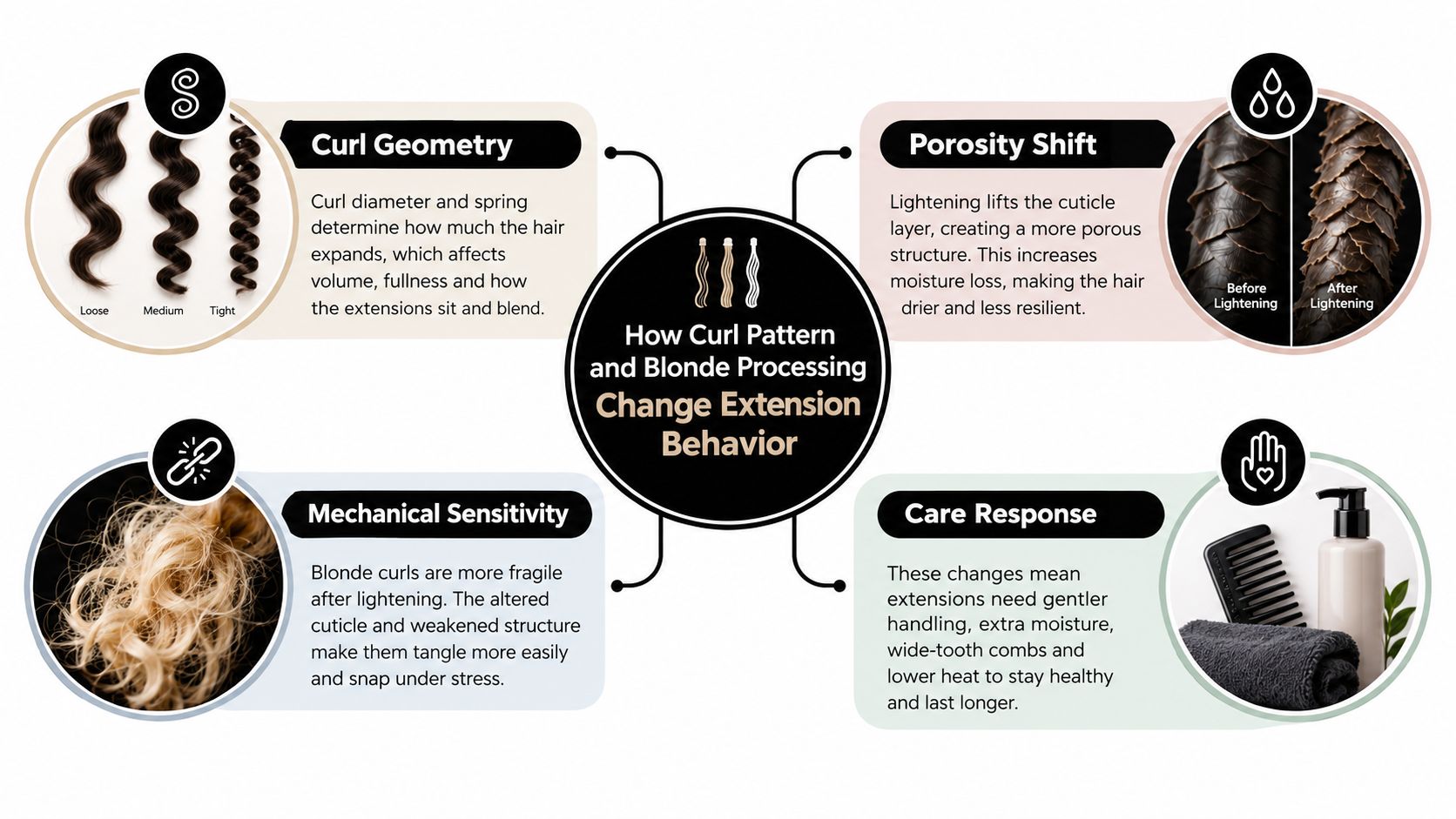
Lightening adds porosity to an already mechanically sensitive fiber. In one study, bleached blonde hair showed 65% dye leaching during the first 30 minutes, compared with 58% for untreated natural blonde hair, indicating faster dye adsorption and desorption in the bleached sample. The findings in the published study on dye behavior in bleached blonde hair support gentler cleansing, cooler water, and color-depositing maintenance for blonde extension work.
Color movement is only part of the assessment. A supplier's grade label does not predict how a processed curl will behave. 6A, 7A, 8A, 9A, and 10A aren't governed quality standards. No international standards body, government agency, or industry association regulates those labels, so suppliers may define them differently. Hair Extensions by Nature's explanation of extension grading directs attention to checks a stylist can perform:
Ask how the hair is constructed, which curl patterns are available, how the shade behaves after washing, and what handling the supplier recommends. Request a color ring and swatches in the intended curl pattern. Clarify whether the shade is solid, dimensional, rooted, or blended. Assess the sample both dry and hydrated, because curl contraction can make the tone and density appear deeper.
The working model is direct. Curl increases mechanical sensitivity, while blonde processing increases porosity-related color movement. Shade placement, tension, cleansing, and testing must therefore be planned around the curl pattern, not borrowed from a straight-hair workflow.
Straight hair presents color in relatively continuous lines. Curly hair interrupts those lines with bends, shadows, and changing surface angles. A highlight that looks bold on a straight swatch may appear scattered and softer once the curl compresses. A solid blonde can look heavier because the curl groups reflect the same tone in concentrated patches.
Conde Professional's shade families give a useful vocabulary for that discussion: Solid, Balayage, Bronde, Highlights, Superblend, Rooted, and Fantasy. The selection shouldn't be based on the family name alone. The stylist needs to predict how each tonal structure will read inside the client's curl clumps.
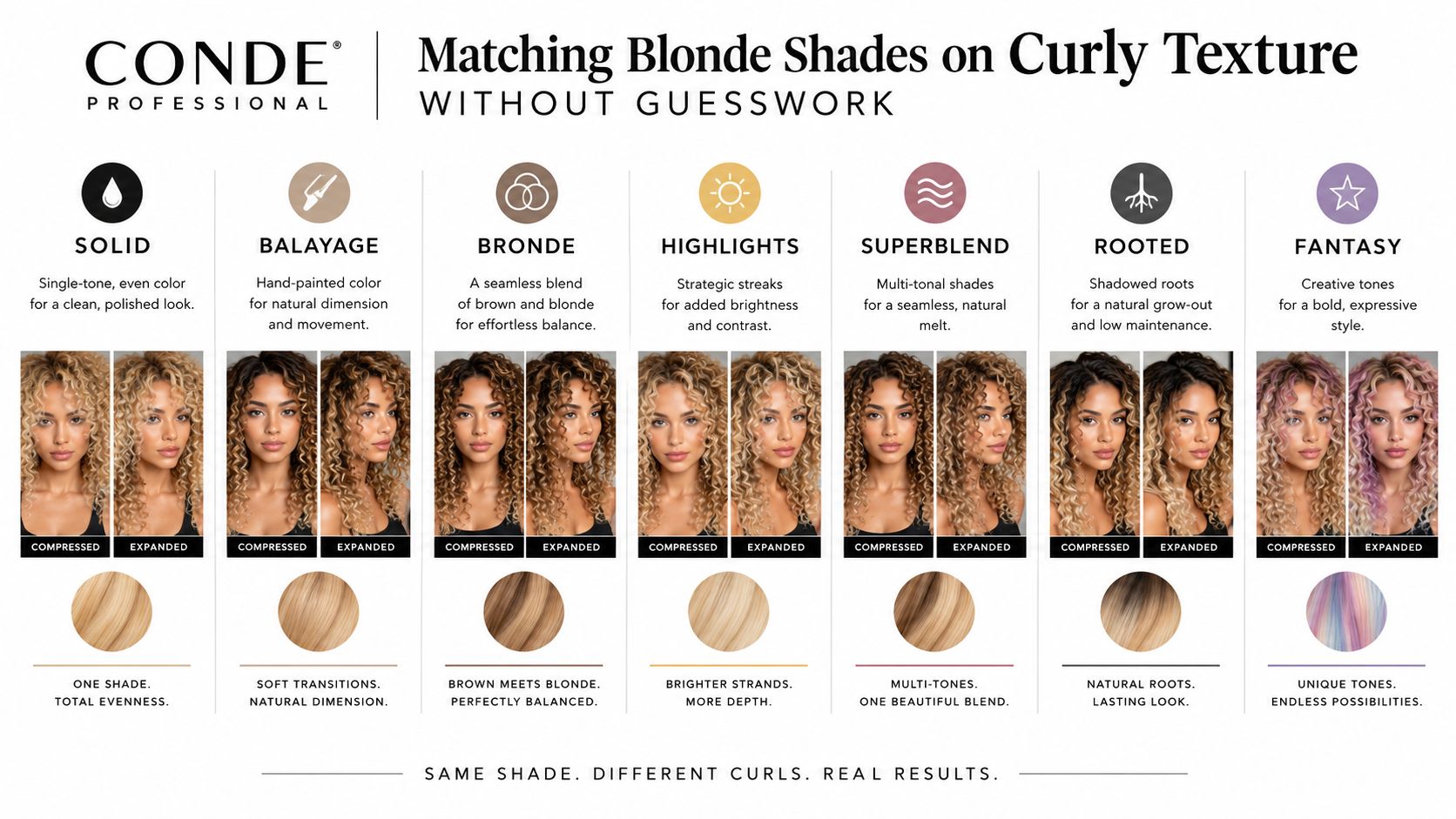
Trend coverage increasingly favors warmer, softer, sun-kissed, rooted, and multi-tonal blondes, while flat blonde receives less attention. The practical gap is that straight-hair trend logic doesn't explain how curls scatter or concentrate brightness. Conde Professional's color-matching education is a useful reference point, but the final decision remains a visual mapping exercise.
First, isolate the natural depth or level without letting the brightest strand control the match. Then identify the undertone, such as warm, neutral, or cool, and note where the client already has dimension. Finally, map that dimension to placement. A rooted family may sit closer to the attachment area, while brighter pieces can be reserved for the perimeter or face frame where the curl opens.
Check the color ring in natural light and the salon's working light. If studio lighting is heavily warm or cool, the eye can approve a match that fails in daylight. Photograph the chosen swatch beside the client's hair, then document the family, tone, placement, and curl pattern for reorders or move-ups. If one family matches the root but not the ends, blending two families can be more controlled than forcing one shade to perform both jobs.
Method selection should follow the client's density, curl tightness, lifestyle, and styling goal. The attachment mechanic changes how weight is distributed, how the curl hides the install, and how easily the stylist can adjust the shape later.
Hand-tied wefts are sewn onto a beaded row, while tape-ins are sandwiched near the root with adhesive wefts. Fusion extensions bond individual strands with heated keratin, and micro-link methods clamp individual strands with small beads, as outlined in this professional overview of extension methods. Those mechanics matter more than the label “curly compatible.”
| Method | Install Mechanics | Curl Compatibility | Best For |
|---|---|---|---|
| Hand-tied weft | Sewn onto a beaded row | Strong for curl patterns that need distributed volume and concealed rows | Clients seeking fullness across a controlled section |
| Tape Weft | Adhesive weft placed near the root | Suitable when natural curl can cover the panel and tension remains low | Flatter attachment needs with adequate coverage |
| Tape-In | Adhesive-backed panels sandwiched near the root | Can work on suitable density and looser curl patterns, but panel visibility and slippage require assessment | Controlled placement and a flatter profile |
| K-Tip | Individual strands bonded with heated keratin | Useful for mapping around curl shape and density, with careful bond placement | Strand-level movement, perimeter work, and customized distribution |
| Micro-link | Individual strands clamped with small beads | Can provide flexible placement, but beads must be concealed and tension monitored | Clients suited to strand-level application without adhesive |
| Clip-In | Removable wefts attached with clips | Practical for temporary use, but clips can show or concentrate pressure in fine curls | Bridal trials, events, photography, and occasional styling |
For Conde Professional options, the relevant collections include Volume Weft, Thin Weft, Tape Weft, Tape-In, K-Tip, Clip-In, and Bulk. Bulk hair can support custom work where the stylist needs to build or modify a finished piece rather than install a preconstructed panel.
A dense curl pattern may overwhelm a narrow weft or expose a flat panel once the natural hair expands. Fine curls may not tolerate concentrated attachment points, especially if the client wants substantial volume. Clip-Ins aren't the right choice for a client who expects uninterrupted daily wear, and tape-based methods aren't automatically suitable for a client whose curl pattern leaves the panels visible during movement.
For an updo, strand-level placement may offer cleaner control than a broad row. For a down style, a weft can provide efficient density if the row remains hidden through curl clumps. The correct recommendation is the one that supports the requested silhouette without forcing the client's natural pattern to cover an incompatible construction.
Preparation determines whether the blend survives the first wash. The stylist should assess the client's natural curl in a clean, product-light state, then compare the extension after it has been hydrated and allowed to reveal its actual contraction.
Start with a gentle cleanse and avoid loading the hair with heavy silicones before the consultation or install. Dry the natural hair fully, because wet curls can appear longer, looser, and more uniform than they will once dry. Compare porosity and texture, not just the visual outline.
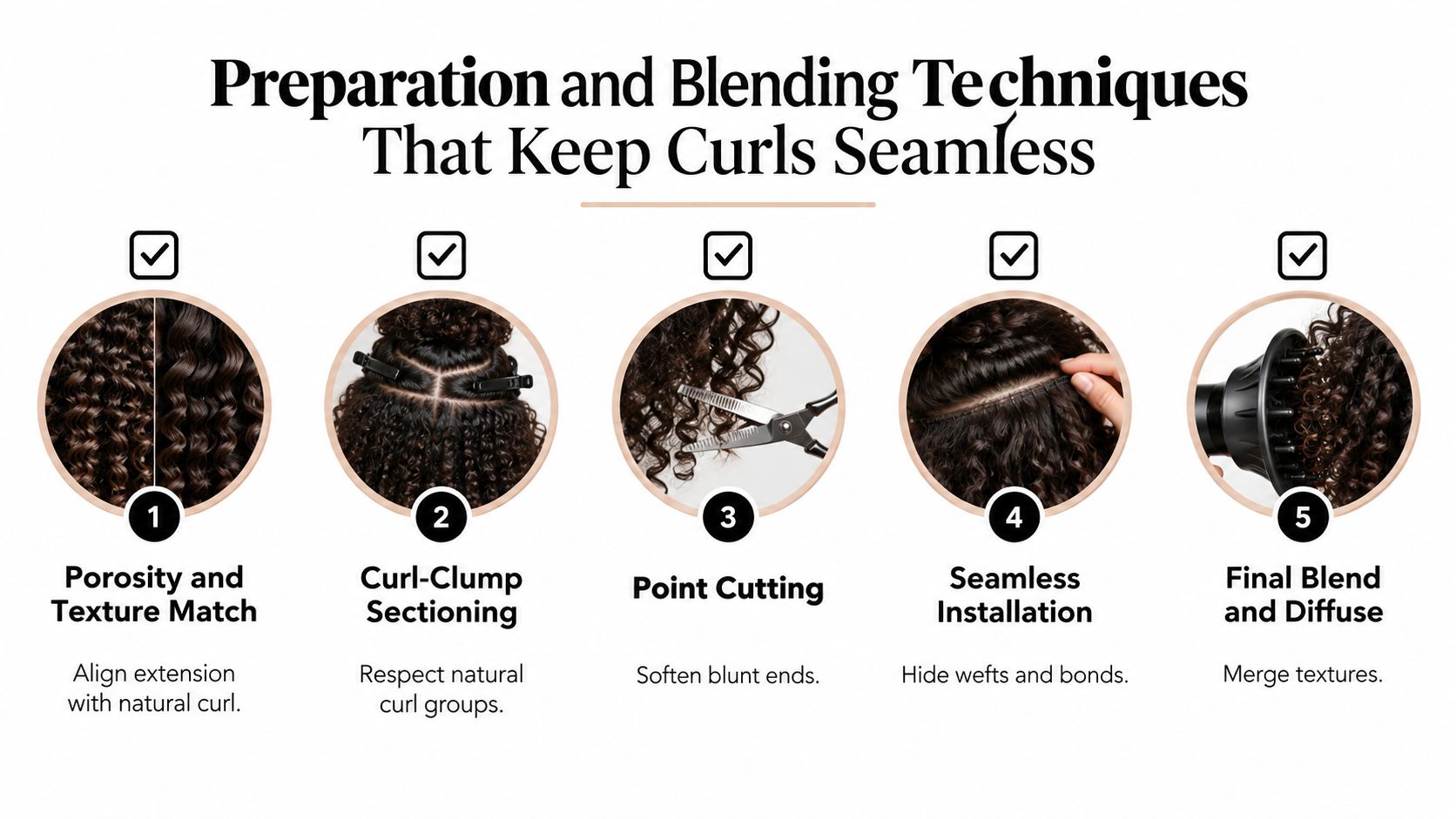
Section according to the client's natural grouping rather than imposing rigid, straight lines everywhere. A clean technical section is still necessary for the attachment, but the visible blend should return to the client's curl architecture. Over-directing the hair away from its normal fall can create a temporary blend that collapses after washing.
Before anchoring, check:
Install the attachment where curl naturally creates shadow. A beaded row should sit in a section that can cover it without forcing the hair upward. Bonds and beads need enough space for movement, but they shouldn't sit where the curl repeatedly rubs against them during detangling.
Point cutting softens blunt extension ends without creating a visible shelf. On tighter curls, work curl by curl or in small clumps, because cutting a fully stretched section can produce an unexpected jump in length after recoil. Diffuse the natural hair and extension together on a controlled setting, then evaluate the silhouette from the front, sides, and back.
A stylist can use Conde Professional's guide to coloring extensions when a shade adjustment is appropriate, but color work should never substitute for correct initial matching.
Same-day specifics checklist
The maintenance system has to protect two vulnerable features at once: curl structure and blonde color retention. Bleached blonde fiber releases dye more readily than untreated natural blonde fiber, so aggressive cleansing can expose tonal change quickly. Curly fiber also responds poorly to rough detangling, over-manipulation, and product buildup.
Use a sulfate-conscious cleansing routine suited to the installation, and keep the water cooler rather than hot. Conditioner belongs on the lengths and ends, not the attachment area. A color-depositing product can help maintain the intended tone, but the stylist should select it according to the shade family and porosity rather than applying a strong toner blindly.
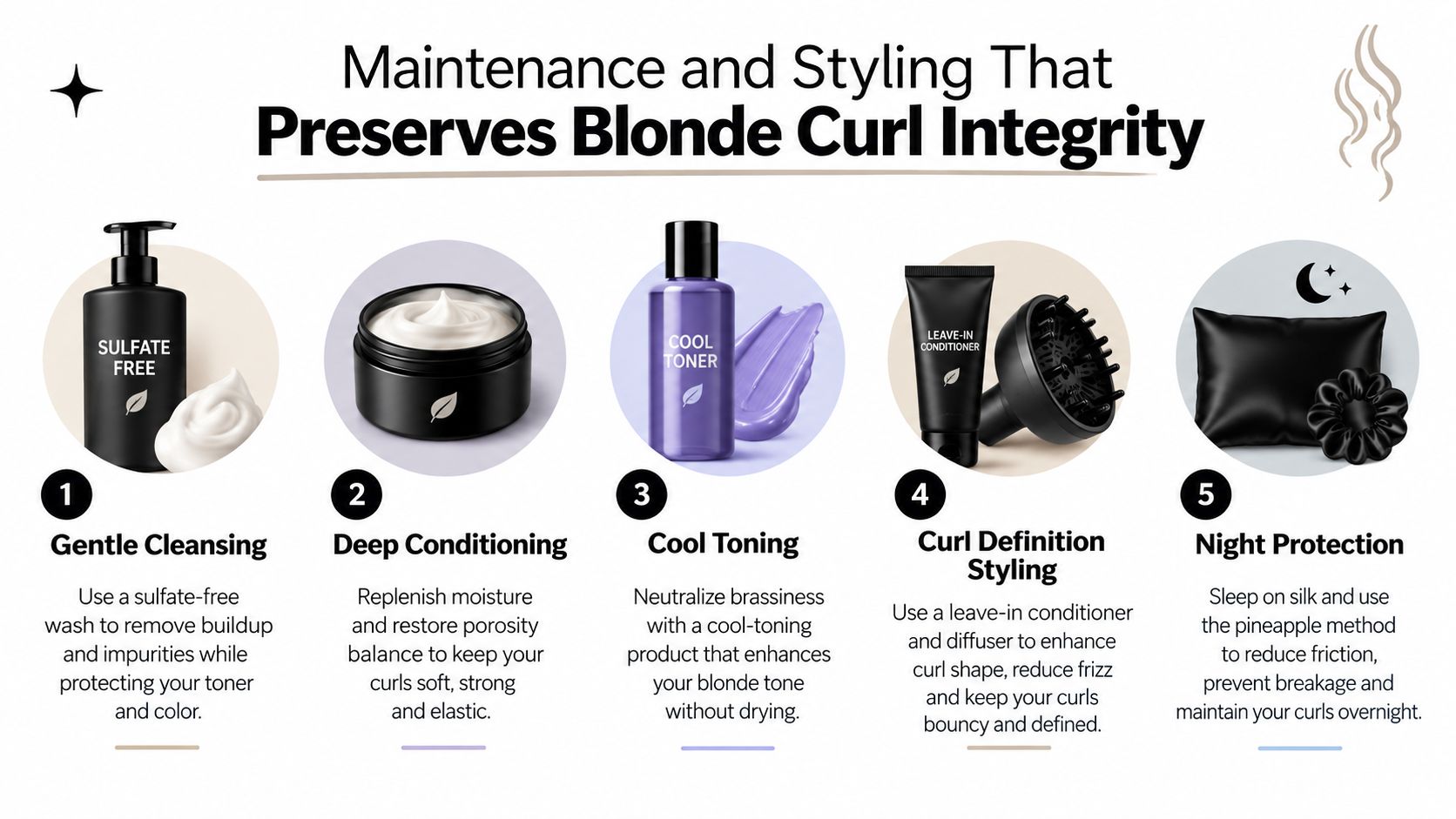
Detangle from the ends upward with a wide-tooth tool or another curl-appropriate implement. The attachment should be stabilized with the other hand so the force doesn't transfer directly to the bond, bead, or weft. Work in manageable sections and don't rake through dry, compressed curls unless the service plan specifically calls for reshaping.
Apply leave-in and curl-defining products to damp hair, scrunching upward to preserve clumping. Air-drying limits manipulation, while diffusing can help merge the natural and extension textures when used with controlled airflow and heat discipline. Touching the curls repeatedly while they dry encourages frizz and separates the clumps the stylist created.
Client language: “The blonde needs gentle cleansing because the tone can release quickly, and the curl needs low-tension detangling because repeated pulling can weaken the fiber.”
Night protection reduces friction. A silk surface, a loose pineapple arrangement where appropriate, or another non-compressive method can help preserve the curl shape. The client shouldn't sleep with wet hair, and attachment points should remain free from heavy oils, waxes, and dense product layers.
Dryness usually calls for better water balance, conditioning on the lengths, and less heat. Frizz can indicate disrupted clumps, friction, excessive touching during drying, or a mismatch between the natural and extension texture. Matting near the attachment requires immediate section-by-section detangling rather than waiting for the next appointment.
Move-up planning should be based on visible growth, attachment position, tension, and the client's curl expansion, not a fabricated universal schedule. Conde Professional's extension care guidance can support the client handout, while the stylist adjusts the plan to the installed method and the client's actual hair behavior.
A bride requesting long, blonde curls for photographs needs a method that supports the planned silhouette, not merely the desired color. For a down style with visible movement, a concealed weft may supply efficient fullness. For a structured updo, K-Tips, micro-links, or carefully positioned Bulk hair may give the stylist more control around the shape. Clip-Ins can be appropriate for temporary event work, especially when removal after the occasion is part of the plan.
A trial should test the complete system, including shade under photography lighting, curl expansion after drying, attachment concealment, veil or accessory placement, and movement through the intended style. The stylist should photograph the result from multiple angles and record the family, placement, and finishing products for consistency on the event day.
Humidity makes curl control less predictable, so the kit should include the client's approved defining product, a light finishing product, a wide-tooth detangling tool, clips for section control, and a method-specific touch-up plan. The bride should know how much movement the style can tolerate and which signs indicate that she should stop manipulating the hair.
Conde Professional supplies professional extension methods and shade families for licensed stylists, including wefts, tape-based options, K-Tips, Clip-Ins, and Bulk hair. A salon owner or extension specialist ready to standardize blonde curly consultations should open a professional account with Conde Professional, then request shade guidance and education support before the next color-matching appointment.


