Your cart is empty
Tax included and shipping calculated at checkout

Drawer menu
Tax included and shipping calculated at checkout
A professional account gives you stylist pricing, priority support, early access to new releases, and education developed by working stylists.


Micro K-tip extensions are individual pre-bonded strands fused to natural hair with controlled heat, and the professional category sits inside a market valued by independent reports between about USD 2.9 billion and USD 10.8 billion in 2025–2026, depending on scope and methodology. They earn their keep on fine-to-medium density hair, short bobs, and targeted zones where strand-level control matters more than the speed of a weft install.
That market context matters, but it doesn't make micro K-tip the default answer. The method is precise, discreet, and useful for selected clients, yet it carries a higher installation workload and demands stricter density planning than a row-based method. A strong consultation should establish whether the client's hair, routine, desired result, and maintenance tolerance justify that trade-off.
Micro K-tip extensions are individual keratin-bonded strands applied one at a time. A thermoplastic keratin capsule is heated, molded around a small section of natural hair, and left to cool into a semi-permanent attachment. Salon guidance places the bond heat range at approximately 150–220°C, depending on the formulation, while typical micro bonds carry about 0.6–0.8 g of hair per strand and can produce roughly 130–150 attachment points per 100 g of hair. Those figures are detailed in this technical explanation of keratin-bond K-tip extensions.
The word micro describes the strand size and bond footprint, not a completely separate extension family. Compared with a larger fusion tip, the attachment occupies less visual and physical space. That lets a stylist distribute smaller additions around the face, crown perimeter, parting, or a short bob without creating obvious bond points.
Micro K-tip is most defensible on fine-to-medium density hair that needs controlled length or volume rather than a heavy full-head transformation. The low attachment weight and small footprint make it useful for:
The method becomes less efficient as the requested coverage expands. A client with dense, coarse hair who wants substantial full-head length may need too many individual attachments for the appointment time and service economics to make sense. A Volume Weft or another row-based solution may distribute the required hair more efficiently.
Market segmentation still places keratin-bond and micro-link methods alongside tape-in and clip-in techniques, which reflects their established role in professional extension services. Hair extensions accounted for 38.2% of global human hair products revenue in 2025, approximately USD 3.7 billion, according to this human hair products market analysis. Micro K-tip belongs to that professional-service trajectory, but its value comes from precision, not from being universally superior.
For product planning, stylists can review the K-Tip hair method guide before deciding how much of the head needs strand-by-strand work.
The bond is a load-management device, not decorative packaging. Its size, shape, taper, polymer behavior, and the amount of hair encapsulated all influence comfort, movement, slippage, and removal.
A micro K-tip normally arrives as a pre-tipped individual strand. The keratin or thermoplastic polymer surrounds the extension hair at the factory, leaving a compact tip that can be reheated and molded around the client's natural hair. Some systems use formulations described as Italian keratin, while others use acrylic-based polymers. Those labels alone don't establish performance. The useful questions concern how evenly the tip melts, whether it spreads predictably, and whether it forms a clean bond without excess bulk.
A micro tip generally reduces the material at the attachment point compared with a standard K-tip. That can lower the visual footprint and the weight carried by each natural section, but it also means each bond holds less hair. The stylist compensates with more attachment points when the target is substantial coverage.
The result is a direct chair-time trade-off:
K-tip sources describe professional placement close to the scalp, with one salon supplier specifying bonds positioned as close as 1 cm from the scalp and fused at approximately 180–200°C. The practical lesson isn't to copy a temperature blindly. Formulation, tool calibration, section size, and the manufacturer's protocol govern the setting.
Practical rule: Micro sizing only solves a density problem if the extension strand and the isolated natural section are balanced. A small bond carrying too much hair still behaves like an overloaded attachment.
Bond failure doesn't come only from tip size. Excess oil, insufficient heat, uneven pressure, poor isolation, and a bond placed against the scalp can all contribute to slipping or discomfort. Removal also requires a controlled process, not force. The keratin bond remover guide is relevant to the service plan because a stylist should know how the bond will be opened before promising reuse or a smooth move-up.
Hair quality needs the same scrutiny. Labels such as 6A, 7A, 8A, 9A, and 10A aren't regulated grades. They are supplier-created marketing terms, so the meaningful checks are cuticle integrity, alignment, shedding, combability, and wash durability, as explained in this hair extension grading overview. A smaller bond attached to poorly aligned or fragile hair won't become a premium result through sizing alone.
Micro K-tip should win only when strand-level precision outweighs the speed and coverage of a row-based install. The comparison changes with density, desired placement, routine, and the client's tolerance for maintenance.
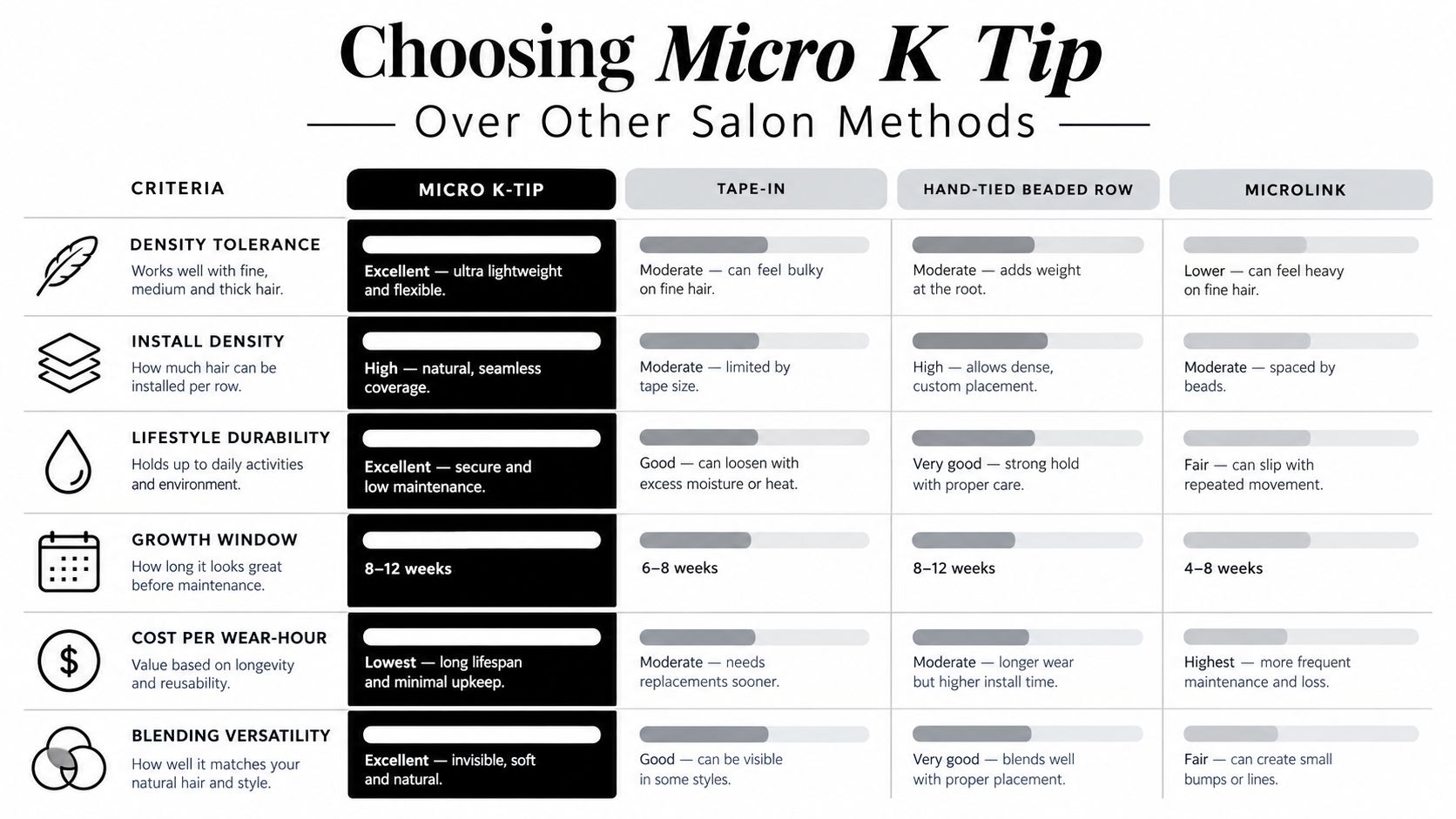
| Criterion | Micro K-tip | Tape-in | Hand-tied beaded row | Microlink |
|---|---|---|---|---|
| Density tolerance | Fine to medium density with careful section control | Fine to medium density where surface area can be supported | Medium to dense hair, depending on row design | Fine to medium density with careful bead placement |
| Install density | High precision, one strand at a time | Broader panels | Efficient coverage across a row | Individual or small-group placement |
| Lifestyle durability | Useful for frequent washing or swimming when aftercare is sound | More sensitive to product, oil, and panel care | Strong coverage, but row tension and drying require attention | Dependent on bead security and natural-hair support |
| Growth window | Requires planned bond checks and move-up | Requires panel maintenance | Requires row move-up | Requires bead move-up |
| Cost per wear-hour | Can be high when many strands are needed | Often more efficient for broad coverage | Often efficient for volume and length coverage | Varies with attachment count and service time |
| Blending versatility | Excellent for targeted, irregular placement | Strong for broad sections | Strong for density and layered shapes | Strong for localized placement |
Micro K-tip has a clear niche on low-density hair, face-framing length on bobs, and clients who wash daily or swim. Individual placement allows the stylist to leave fragile or exposed areas untouched while building density where the haircut needs it. It also supports a blended result when the natural hair has uneven density from one zone to another.
Tape-in can serve a client better when the goal is broader coverage with fewer attachment decisions. A hand-tied beaded row is often the more sensible choice for a dense client requesting substantial length and volume in one appointment. Microlink may be appropriate when the stylist wants individual placement without a fused keratin bond, provided the bead system and natural-hair support are suitable.
The method is the wrong call for a client with a known sensitivity to the bonding system, a client who refuses the required maintenance cadence, or a dense, coarse head where the number of micro strands would make the install inefficient. The professional hair extension method guide can support a method discussion, but the final decision still belongs in the chair.
North America is a particularly important regional market, with one global report estimating 35.88% share in 2025, while another projects the U.S. market from USD 1.07 billion in 2025 to USD 1.717 billion by 2031. Those projections indicate a mature professional category, not proof that every client needs the most detailed attachment method. Service fit still determines the result.
Micro K-tip installation rewards repeatable mechanics. The stylist should establish the working pattern before picking up the first strand, because inconsistent section size creates uneven load distribution and makes later troubleshooting harder.
Start with clean quadrants and a controlled micro-row pattern. The row should be thin enough to conceal the bonds but stable enough to support the selected strand. Use a rattail comb to isolate a clean section, remove short or weak hairs that would otherwise enter the bond, and keep the natural hair flat without compressing it against the scalp.
The bond should sit close to the root while preserving natural lift. Professional guidance describes placement as close as 1 cm from the scalp, while the supplied installation framework calls for approximately 5–8 mm where the system and section support that positioning. The manufacturer's protocol and the client's hair behavior take priority. A bond placed directly against the scalp restricts movement and can create discomfort as the hair shifts.
Match the extension strand to the isolated natural section before applying heat. The natural section shouldn't be visibly thinner than the extension load, and the stylist shouldn't compensate for a weak section by squeezing more hair into the bond.
A controlled fusion sequence looks like this:
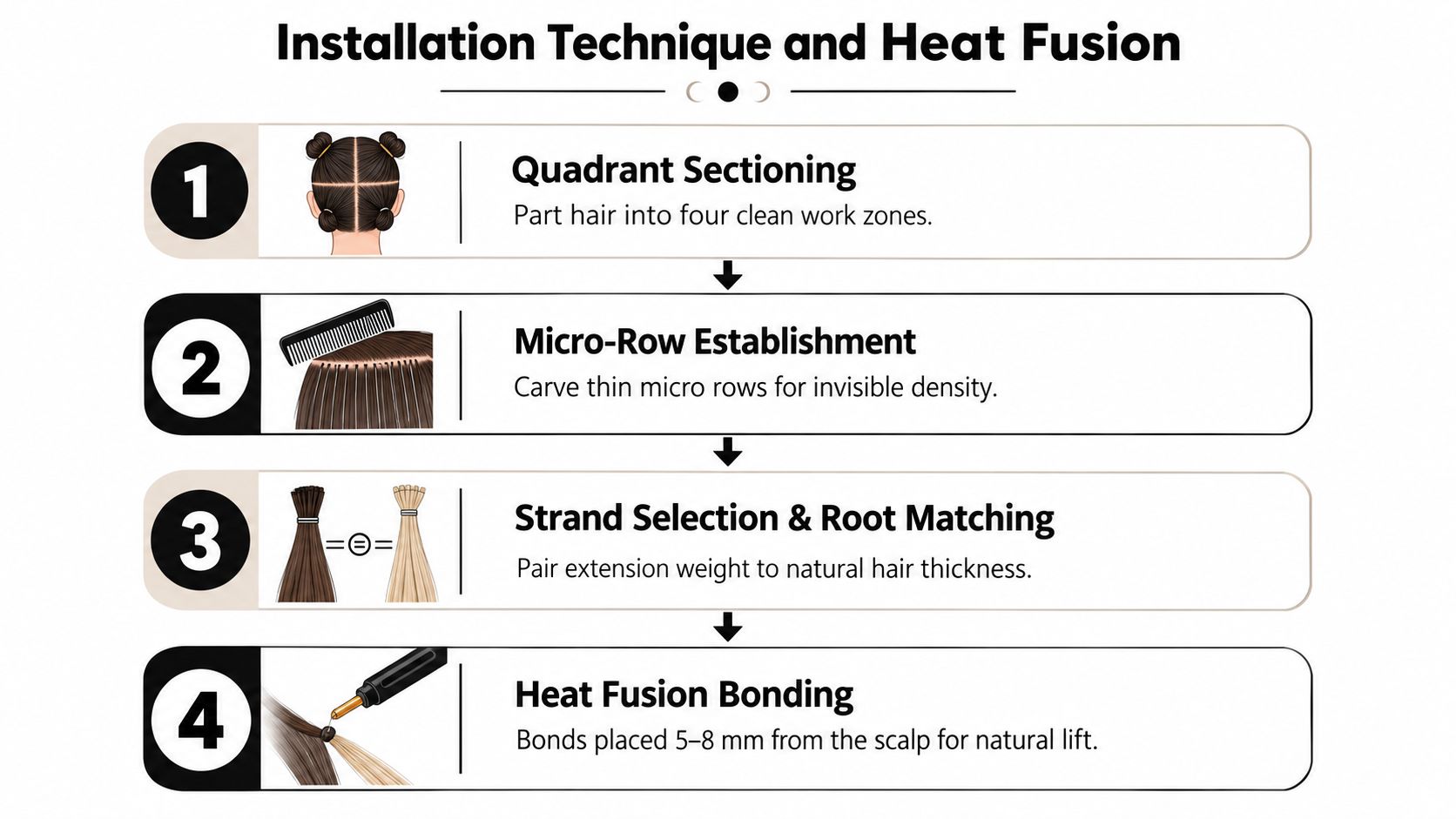
Overheating causes the keratin to creep and spread beyond the intended footprint. That creates a flatter but potentially weaker or more visible bond, and it can transfer excess heat into the natural hair. If the polymer spreads, stop, allow the area to stabilize, remove excess material according to the system protocol, and rebuild rather than layering more heat over a compromised attachment.
The best fusion work looks uneventful. The section is clean, the bond is compact, and the client doesn't need to tolerate a hot tool lingering at the root.
Appointment timing must be quoted from the planned attachment count and coverage, not from the phrase “full head.” A partial perimeter or face-frame install is a different service from a dense full-head set. The stylist should reserve enough time for precise isolation, bond checks, blending, and documentation rather than trying to match the pace of a tape or weft appointment.
For method-specific preparation, the fusion hair extensions guide provides a relevant reference point before the service begins.
A micro K-tip install exposes poor matching quickly because every strand has an individual exit point. The color must work at the root, through the mid-lengths, and across the client's movement pattern, not only under the salon's overhead lighting.
Use the Conde, Pure, and Balayage shade rings to assess the natural hair in daylight and under the salon's service lighting. Solid shades can anchor a uniform base, while Balayage, Bronde, Highlights, Superblend, Rooted, and Fantasy families can support more complex color plans. A multi-tonal client may need lowlight and highlight placement rather than one universal shade.
Blending two bond colors within one install can reduce the appearance of isolated dark or light capsules, particularly around a dimensional root. Photograph the match before installation, including the crown, sides, and perimeter. The hair extension color matching guide can be used alongside the physical shade rings, but the client's actual hair remains the deciding reference.
Texture matching is equally important. Cuticle-aligned Remy hair generally behaves more predictably than a synthetic blend under brushing, heat, and humidity, but the stylist still needs to compare the extension's wave pattern, density, and finish with the client's natural hair. A straight extension placed into a consistently wavy head may require styling after every wash, while a texture mismatch at the perimeter will show even when the color is correct.
No universal strand count or gram total should be assigned from a photograph alone. The plan should account for the client's density, the target length, the perimeter, the haircut, and the amount of natural hair available to support each bond.
| Client Density | Strand Count Full Head | Total Grams | Extension Length vs Natural |
|---|---|---|---|
| Fine | Set after section and support assessment | Set from the selected strand weight and coverage | Longer than the perimeter, but only enough to blend without overloading |
| Medium | Set from the desired coverage and haircut shape | Adjusted for coverage, texture, and strand balance | Longer than the perimeter with room for shaping |
| Coarse | Often requires broader coverage or a different method | Determined by the desired density and method efficiency | Longer than the perimeter, with enough volume to match the natural ends |
Over-bonding at the temples remains a common error. The area may look sparse, but it also has limited support and high visibility. A lighter, more selective placement usually blends better than forcing a full density plan into the hairline.
Micro K-tip planning should also account for the final cut. The extension needs enough extra length to blend into the natural perimeter, but excessive length creates a disproportionate weight and a larger styling burden. A professional supplier such as Conde Professional offers K-Tip alongside Volume Weft, Thin Weft, Tape Weft, Tape-In, Clip-In, and Bulk options, so the method can be selected after the density plan rather than before it.
Micro K-tip maintenance isn't a vague “come back in a few months” conversation. Salon guidance places some keratin-bond checks around 6–8 weeks, while other professional guidance describes a broader 8–12-week interval for keratin-bond methods. A separate salon source reports micro keratin tips lasting around 12 weeks, with some clients returning at 8 weeks, and professional installation ranging from approximately $500 to $3,000 depending on coverage. These figures are outlined in this micro keratin extension maintenance guide.
The appropriate schedule depends on growth, tangling, bond movement, hair density, and the client's routine. A move-up isn't automatically a full reinstall. The stylist assesses each bond, opens it with the appropriate heat and removal process, slides it to a fresh position, and re-seals it only when the extension hair and natural hair remain in workable condition.
Clients need direct rules rather than a long product list:
A practical troubleshooting matrix keeps the correction proportional to the problem.
| Symptom | Likely cause | Corrective action |
|---|---|---|
| Slipping bond | Incomplete fusion, oil, excess natural hair, or poor section balance | Remove the compromised bond, reassess the section, and reapply with clean isolation |
| Matting at the scalp | Skipped brushing, moisture left at the root, or delayed maintenance | Detangle carefully if the hair is sound, then correct the care routine and service timing |
| Visible bond dots | Incorrect color, oversized spread, or placement too close to the surface | Reposition or replace the bond and adjust color or section depth |
| Breakage at attachment point | Excess weight, tension, heat exposure, or an unsuitable natural section | Remove the attachment, assess the hair, and redirect to a lighter or different method |
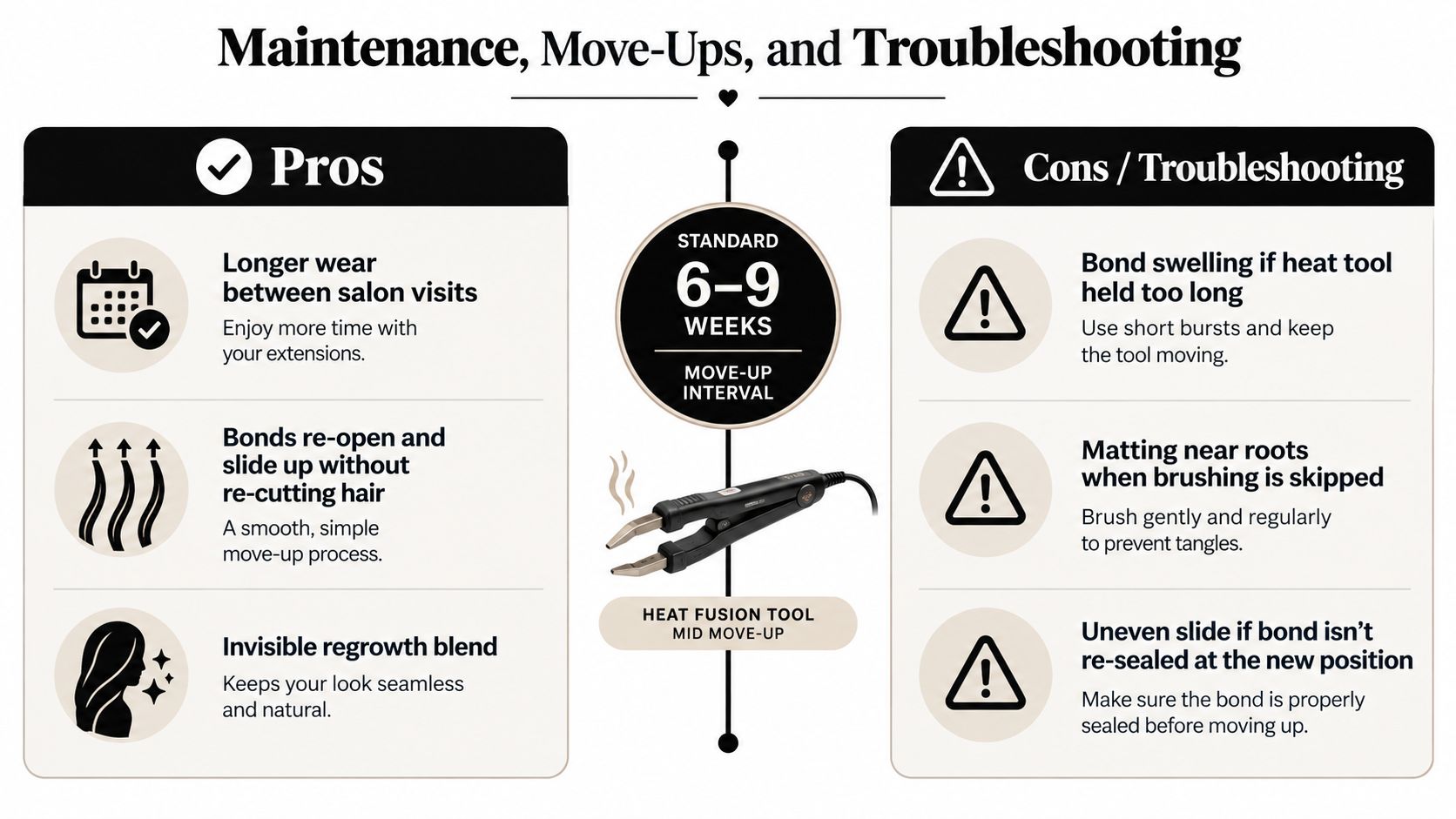
Full removal is the correct response to overlapping bonds, heat damage above the attachment, severe matting, or patterns suggesting traction alopecia. A stylist shouldn't repair an attachment when the natural hair is already showing stress. Scalp sensitivity also needs careful screening. Irritation may arise from bonding agents, adhesives, or metals, and contact dermatitis can occur with extension systems in sensitive users, as discussed in this dermatology guidance on extension-related risks. A client with eczema, previous scalp reactions, or unexplained symptoms should be referred to an appropriate medical professional rather than promised that a bond is risk-free.
A useful consultation script is straightforward: “The hair and bonds have moved beyond a repairable point. Continuing to add or reseal attachments could increase stress, so the responsible service today is removal and reassessment.”
The consultation should end with a method decision, not just a shade selection. A stylist can use a short filter during booking or chair-side assessment and classify the outcome as go, hold, or redirect.
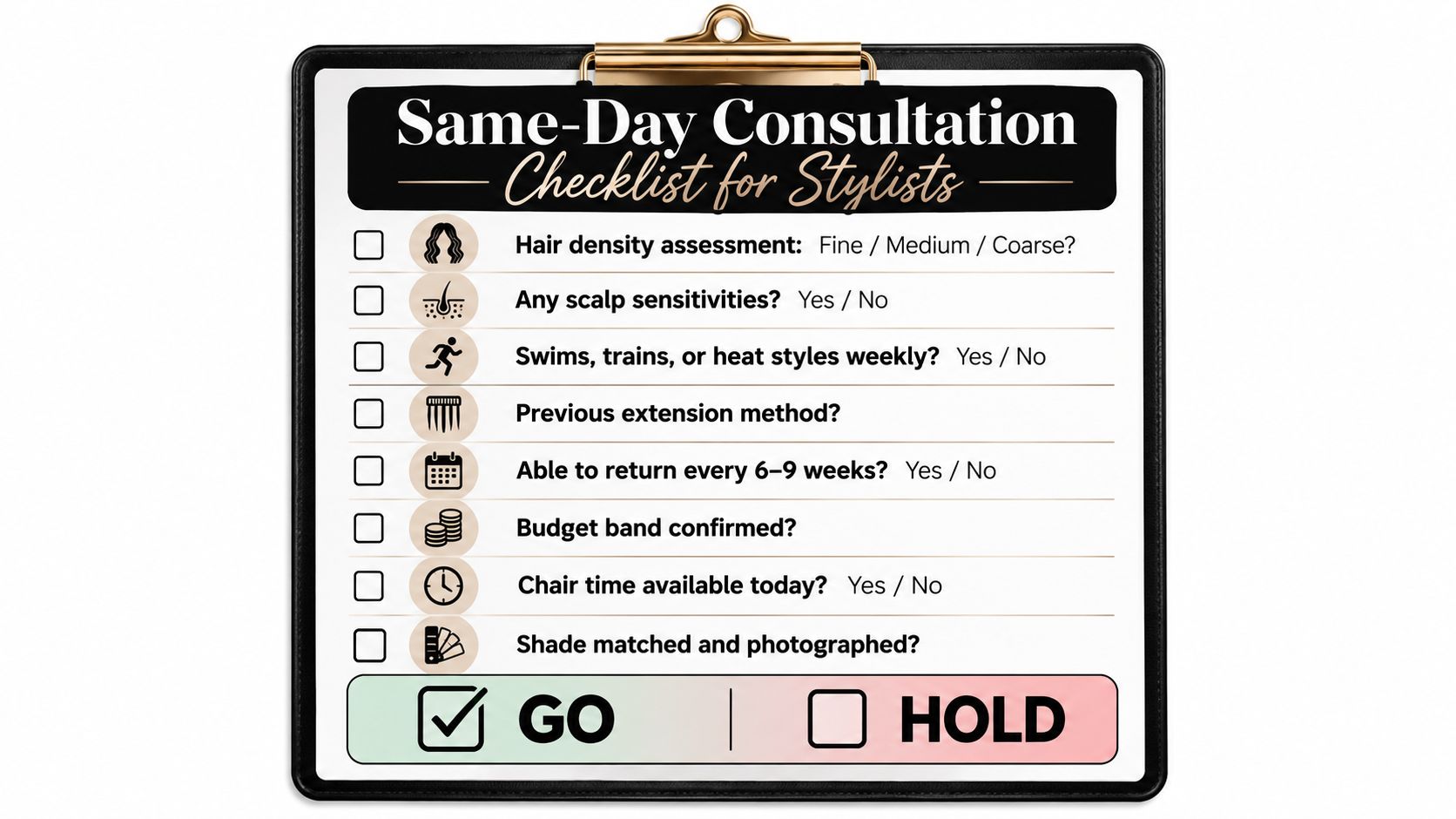
Choose micro K-tip when the client has suitable support, needs targeted length or density, accepts individual attachment time, and can maintain the bonds. Choose tape when broad placement and efficient coverage make more sense. Choose a hand-tied beaded row for substantial density or length on hair that can support a row. Consider microlink when the client needs individual placement without a keratin fusion system and the bead plan is appropriate.
A hold means the hair needs recovery, the scalp needs professional evaluation, the color service is too recent, or the client hasn't accepted the maintenance requirements. A redirect means the requested coverage, density, or lifestyle conflicts with micro K-tip mechanics.
The market continues to expand, with one forecast projecting growth from USD 3.05 billion in 2026 to USD 5.54 billion by 2034 at a 7.74% CAGR, while another projects USD 4.13 billion in 2025 to USD 4.41 billion in 2026 at a 6.6% CAGR. Those projections from hair extension market research support continued professional demand, but a profitable service still depends on correct method selection and honest maintenance planning.
The next practical step is to audit the salon's current consultation form against the eight filters above, then photograph one completed density and shade plan before ordering hair. Conde Professional offers professional extension collections spanning K-Tip, Tape-In, Clip-In, Bulk, Volume Weft, Thin Weft, and Tape Weft, along with shade-matching resources for licensed professionals. Visit Conde Professional to review the available methods and build the next micro K-tip consultation around the client's actual density, texture, and service commitment.


