Your cart is empty
Tax included and shipping calculated at checkout

Drawer menu
Tax included and shipping calculated at checkout
A professional account gives you stylist pricing, priority support, early access to new releases, and education developed by working stylists.


A moving shade or length can disappear from a salon shelf just before a booked install, forcing a reschedule or an expensive substitute. The wrong texture match creates a different problem, because the stylist has to manage the client's expectations after the hair has already been purchased and prepared.
Hair extension supplies wholesale is a procurement decision before it's a price decision. Stockouts, batch-to-batch grade drift, and import lead times determine whether a supplier protects or damages a salon's margin. Northern American wholesalers source finished extensions mainly from China, India, and Vietnam, which together supply 70–80% of volume, and a typical factory-to-U.S.-warehouse cycle can take 6–10 weeks, including processing and quality control, according to reporting on the economics of the human-hair trade.
A stylist who runs out of a fast-moving beaded-row length or a reliable balayage shade doesn't just lose a product sale. That shortage can block an installation, disrupt the move-up schedule, and send the client to another salon. A low unit price offers no protection if the hair arrives late, changes texture between batches, or sits unsold because the color system doesn't match the salon's clientele.
Stockout exposure is the first risk. A salon carrying its entire method range through one vendor may have a simpler purchasing process, but one production delay can affect Tape-In, K-Tip, Volume Weft, and Bulk appointments at the same time.
Grade drift is more difficult to see. A first sample may be smooth and cuticle-intact, while a later lot has more surface roughness, inconsistent density, or a different wave response after washing. That difference can lead to extra prep time, client dissatisfaction, and replacement work.
Import lead time is the third risk. Neutral market analysis describes North America as structurally import-dependent, with Asian suppliers providing 75–85% of regional finished-goods value and typical lead times of 6–10 weeks. The same analysis describes EU lead times of 8–12 weeks for ethically sourced premium hair, making replenishment planning part of quality control rather than a simple shipping calculation. These figures appear in a market analysis of wholesale hair supplier risk.
Practical rule: The lowest quoted cost is irrelevant if the salon can't reorder the same usable shade, texture, and method before the next booking cycle.
A supplier should therefore be evaluated as a risk partner, not a catalog. The same discipline used to compare wholesale hat box prices applies to extension purchasing: compare the complete commercial picture, including availability, replacement handling, documentation, and consistency, rather than only the line-item price. Salon owners building a broader purchasing system can also review professional hair product brand considerations, then turn those principles into a written supplier scorecard.
A supplier's strongest product may not be the right fit for the method mix performed in a particular salon. Tape-ins, machine-wefts, hand-tied rows, clip-ins, fusion bonds, and sew-in wefts place different demands on construction and consistency. The useful question isn't “Which vendor has the premium line?” It's “Which vendor can repeatedly deliver the specifications this method requires?”
A Tape Weft or machine-weft program needs a stable sewn edge and controlled shedding. A Thin Weft or hand-tied application needs a clean, flexible return edge that lies close to the scalp without unnecessary bulk. K-Tip work depends on uniform pre-bonded tips, while Clip-In performance depends on secure clip attachment and a base that stays flat during removal and reinstallation.
| Extension method | Critical supplier deliverable | Failure mode if missed | What to ask |
|---|---|---|---|
| Tape-In | Even adhesive weft construction and consistent texture | Slippage, visible separation, or a poor blend | Are adhesive tabs consistent across the lot, and how are replacement tabs handled? |
| Volume Weft or machine-weft | Strong stitching and controlled shedding | Loose hair, unraveling, or excessive salon prep | How is weft integrity checked before dispatch? |
| Thin Weft or hand-tied row | Clean return edge and consistent bundle density | Itching, bulk, or uneven row placement | Can the supplier provide close-up construction photos from the current batch? |
| K-Tip | Uniform bond size and predictable bond behavior | Uneven fusion, weak attachment, or difficult removal | Are bond dimensions and processing instructions documented? |
| Clip-In | Secure clips and a flexible, flat base | Clips pull away or the piece shifts during styling | How are clip attachments tested after repeated opening and closing? |
| Bulk | Consistent strand direction and usable texture | Uneven blending in microlinks or custom bonding | Is the bulk hair supplied with direction identified and documented? |
Color matching has to be assessed within the salon's own level and tone system. A supplier that calls a shade “medium brown” may not match the stylist's existing color ring, and a bundle can show banding internally even if its outer surface looks acceptable. Weight per bundle also needs a stated tolerance, because inconsistent density changes the number of pieces required for a full install.
Method selection should reflect the client's hair and the service plan. Tape-In may distribute weight across a broader section and suit a flat row application, while strand-by-strand K-Tip or Bulk work may be more appropriate for detailed placement. The method guides in this overview of hair extension methods can support that evaluation, but supplier testing still determines whether the delivered construction is workable.
Labels such as 7A, 8A, 9A, and 10A aren't regulated quality grades. No international standards body, government agency, or industry association governs those labels, so each supplier can assign its own meaning. A buyer comparing two “10A” bundles may be comparing different products entirely.
The same caution applies to terms such as virgin, raw, and Remy. Remy has a meaningful construction principle, namely intact cuticles oriented in the same direction from root to tip, but a label alone doesn't prove that the principle has been maintained. Independent guidance on hair-extension grading identifies measurable checks such as cuticle integrity, alignment, shedding, combability, and wash durability as more useful than the grade label.
These checks expose what marketing language hides. A salon purchasing Remy products can also use this guide to Remy human hair extensions as a reference for the cuticle principle, then verify the actual sample rather than accepting the name on the invoice.
A useful sample protocol should test representative stock, not a single polished swatch. Each vendor should provide two bundles and two closure samples before a volume order is considered. The samples need batch numbers, product names, shade references, and the supplier's written specifications attached to the record.
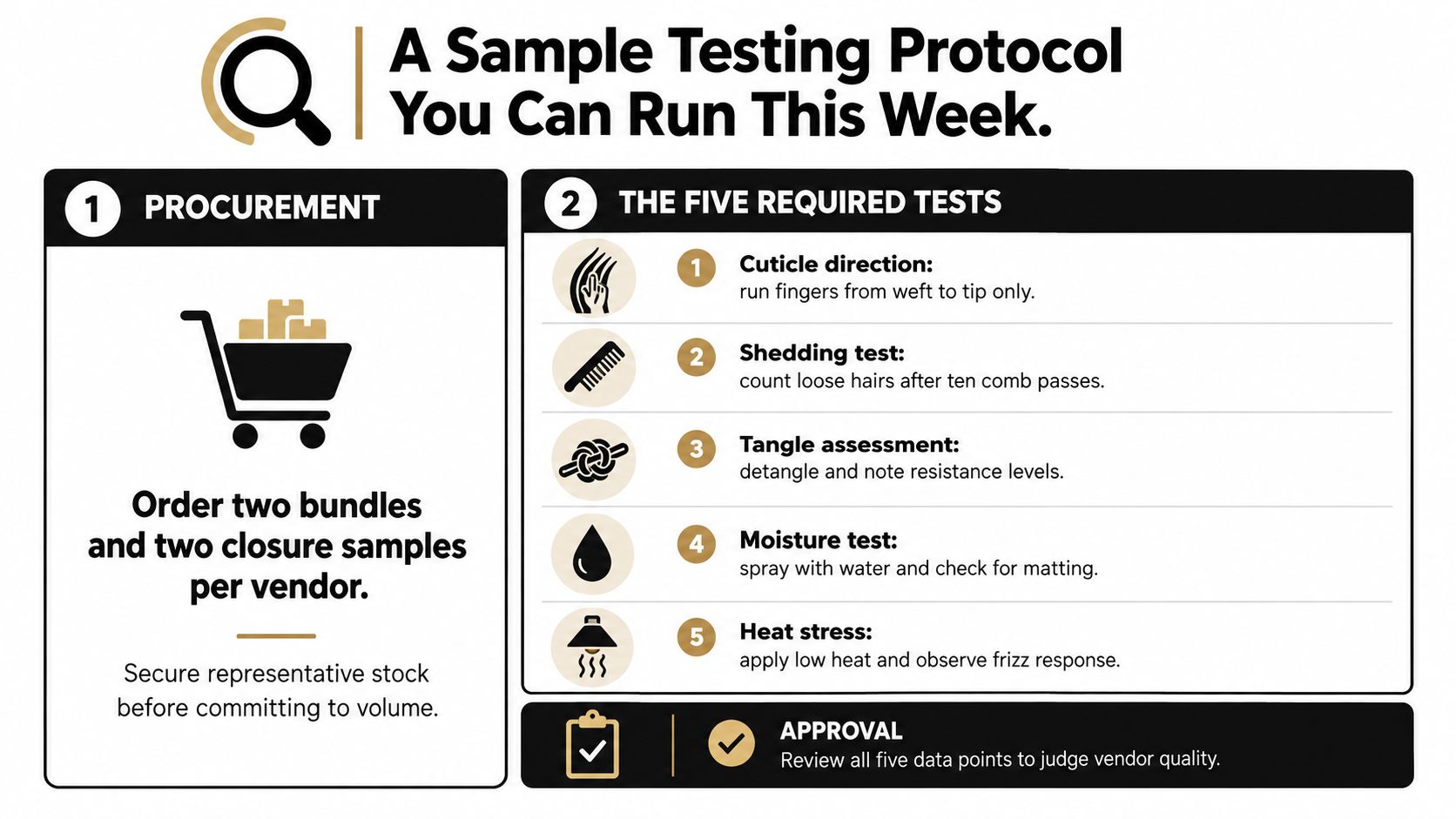
Photographs should come from a fixed angle with the same background and lighting. The batch number belongs in every file name and on every physical sample, because a supplier can't investigate a defect that isn't tied to a lot.
The debrief should be short and specific. The buyer should send the photos and ask three direct questions:
The supplier's response is part of the test. Clear answers, complete documents, and a willingness to address weak results indicate a more workable relationship than polished product language. Buyers can use this guide to purchasing hair extensions wholesale alongside the recorded sample results, but the final decision should come from observed behavior.
A wholesale order without written protections turns every reorder into a new gamble. Before funds are transferred, the buyer should have a specification sheet that identifies the product, method, shade system, length tolerance, weight tolerance, construction details, and the quality threshold for shedding.
A vague promise to “replace defective hair” isn't enough. The agreement should explain how defects are reported, the inspection window, the evidence required, and whether the supplier issues a replacement or refund. A defect allowance should be expressed as a percentage of units rather than as permission to reject only one bad bundle, and return shipping should sit with the supplier when the documented defect level exceeds that allowance.
| Clause | What to require | Why it matters |
|---|---|---|
| Product specification | Written shade, texture, length, weight, and construction details | Creates a reference for batch comparison |
| Defect allowance | A stated percentage of affected units and a reporting process | Prevents disputes over what qualifies as a defect |
| Returns | Inspection window, evidence requirements, and shipping responsibility | Protects margin when the shipment fails inspection |
| Third-party inspection | Who may inspect, who pays, and where the charge sits in the MOQ tier | Avoids surprise costs during a quality dispute |
| MOQ structure | Minimums by method, shade, length, and reorder | Prevents unnecessary inventory commitments |
| Reorder terms | Pricing validity, batch continuity, and notice of changes | Reduces exposure to unplanned margin loss |
| Exclusivity | Narrow scope, defined duration, and termination rights | Stops the salon from being locked in prematurely |
| Renewal | No automatic renewal without written approval | Keeps purchasing decisions deliberate |
The supplier should also state whether a replacement comes from the same production batch, a later batch, or available stock. That distinction matters when the original problem is grade drift rather than an isolated damaged unit.
For buyers negotiating an agreement, LA Law Group APLC negotiation guidance offers useful general context on documenting commercial terms. A salon does not need an elaborate contract for every purchase, but the material terms must exist in writing before the wire goes out.
The right sourcing channel depends on the salon's service mix. A stylist who builds custom color blends every week needs dependable shade recuts and responsive problem-solving. A salon stocking a small range of standard methods may value immediate availability and straightforward returns more than factory customization.
Domestic distribution usually trades a higher unit cost for shorter replenishment paths and simpler return handling. Direct importing can provide more control over specifications and landed cost, but it also places production scheduling, customs exposure, and documentation on the buyer. Neither model removes risk. Each moves the risk to a different part of the operation.
| Channel | Lead time | Consistency | Recourse if batch fails |
|---|---|---|---|
| Domestic distributor | Usually shorter for stocked items | Depends on available batch and storage control | Often easier communication and returns |
| Direct importer | Longer and exposed to production and customs variables | Can be strong with documented specifications and lot control | Buyer carries more investigation and shipping risk |
| Trade show supplier | Immediate sample access, production timing still requires confirmation | Samples can be assessed in person, but production must be verified separately | Depends on written terms after the event |
| Online B2B marketplace | Varies by seller and inventory | Catalog breadth doesn't prove repeat-batch control | Recourse may be limited without a direct agreement |
| Brand-direct supplier | Depends on stock and production schedule | Education and product continuity may be more accessible | Stronger when the supplier documents lot history and replacement terms |
Trade shows are useful for handling a weft, checking a bond, and comparing color under real light. They don't prove that the production shipment will match the sample. Online marketplaces offer breadth, but a broad catalog can make it harder to establish accountability when a lot underperforms.
Brand-direct sourcing may provide better education access and a clearer path for re-cuts, but it can also require a more structured account and a larger commitment. Ethical documentation deserves separate attention, particularly because premium supply is concentrated and vulnerable to sourcing volatility. Buyers assessing that issue can review ethical hair extension considerations and then ask what documentation the supplier can provide.
A reliable supplier is rarely identified by the first quotation. The relationship becomes visible after the first sample has been approved, the first reorder contains a different production batch, and the buyer reports a problem that requires action.
The first three orders should have distinct jobs. Order one establishes the baseline, including product quality, packing accuracy, communication, and dispatch reliability. Order two tests repeatability by requesting the same shade, length, texture, and weight from a different production batch. Order three tests scale by adding volume or introducing a new SKU only after the first two orders have met the written standard.
A professional account should have an acknowledgment target of within 24 hours, tracking information within 48 hours of dispatch, and a named contact who understands the salon's previous orders. These are commercial expectations to document, not assumptions to make after a delay.
The feedback loop should include defect counts, texture notes, photographs, client complaints, and the affected batch number. A supplier can't correct a recurring issue from a message that says only “the hair felt different.” Specific evidence gives the account contact something to investigate and gives the buyer a record for the next order.
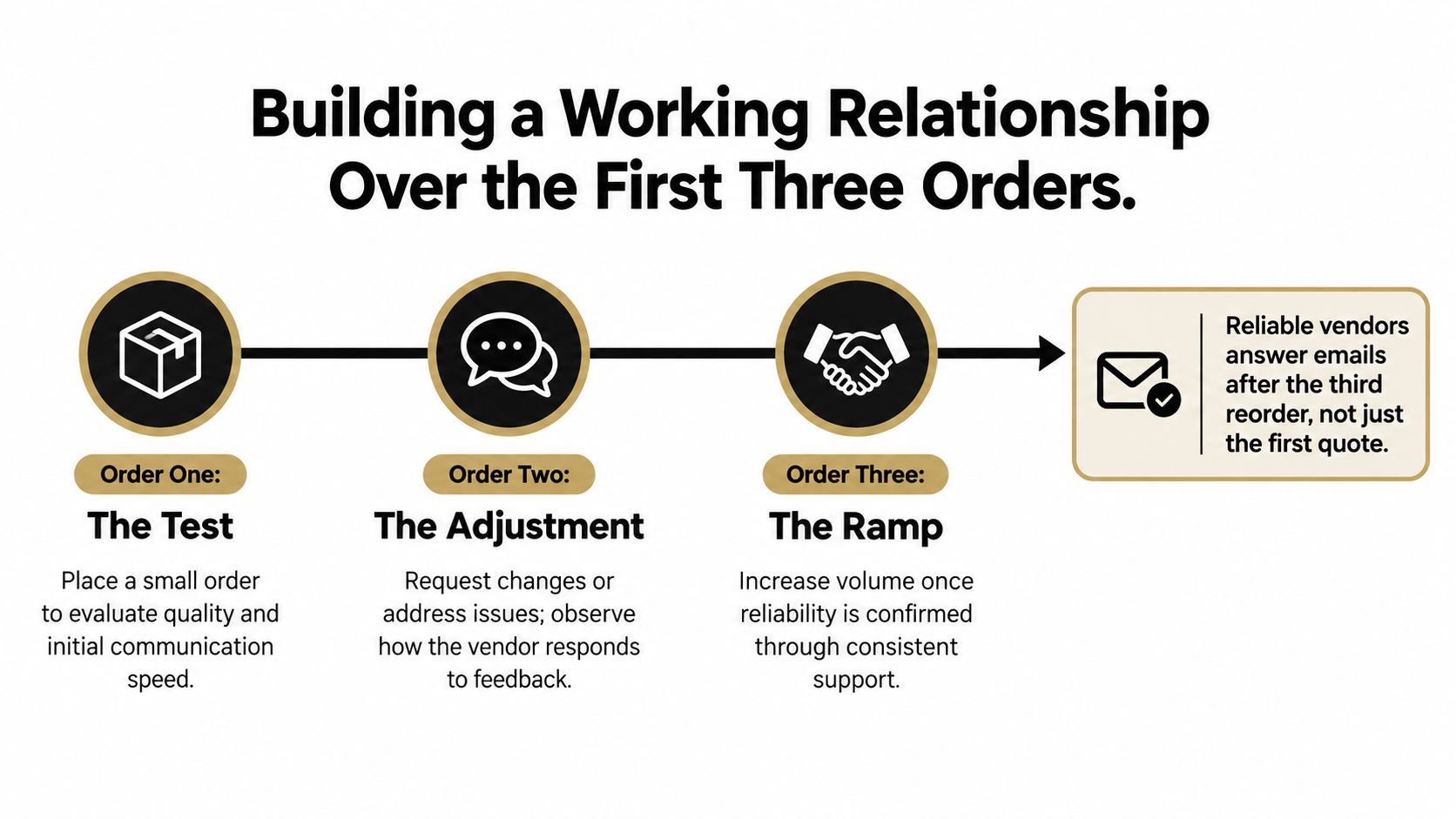
The buyer should escalate when the same defect appears across two consecutive batches, when response times deteriorate after the first order, or when pricing changes without notice. A supplier that answers enthusiastically before payment but becomes vague during a quality complaint hasn't demonstrated partnership.
A supplier earns trust through the third reorder, not through the first quote.
The salon can maintain a primary supplier while qualifying a secondary source for critical shades or methods. That isn't disloyalty. It is a practical response to import dependence and the risk of allowing one vendor to carry every appointment-critical SKU.
A salon can lose margin before the first appointment if a supplier confirms a shade, misses the replenishment window, or sends a different hair grade in the next batch. Open a professional wholesale account, but treat the request as a procurement-risk check rather than a route to the lowest quote.
Send one concise request with three items:
Name methods such as Volume Weft, Thin Weft, Tape Weft, K-Tip, Tape-In, Clip-In, or Bulk. Do not accept “premium hair” as a usable specification. Grade labels do not show how the cuticle will behave behind the chair. Ask for the lot number and test the sample for dry and wet comb resistance, snagging, shedding, matting, and alignment after washing. Record observations against the method and shade so the next batch has a practical reference.
Keep the supplier's reply with the quotation. Before sending a wire transfer, obtain written confirmation of lead times, batch continuity, defect allowance, and the remedy if the sample fails. Record the sample lot number before the first wash, then require the supplier to acknowledge the testing record. Do not fund a volume order until that sheet is signed, because lead-time, stockout, and grade-drift risk cannot be recovered after payment.
Conde Professional supplies licensed professionals with Volume Weft, Thin Weft, Tape Weft, K-Tip, Tape-In, Clip-In, and Bulk options, along with professional tools, color guidance, and education. Stylists and salon owners can review the wholesale collection and open a professional account with Conde Professional before requesting samples and method-specific purchasing terms.


