Your cart is empty
Tax included and shipping calculated at checkout

Drawer menu
Tax included and shipping calculated at checkout
A professional account gives you stylist pricing, priority support, early access to new releases, and education developed by working stylists.


The most popular advice about bulk Remy hair is to judge it by softness, shine, or a supplier's grade label. That approach fails behind the chair. Professional buyers need to inspect bulk hair as a raw material, verify its processing history and traceability, then match its structural condition to the method being built.
Bulk hair can produce excellent custom work, but it also transfers more quality-control responsibility to the stylist. The lot must deliver usable yield, consistent direction, manageable friction, and enough structural strength for the intended fabrication process. A polished product photo can't answer those questions.
Bulk Remy hair is loose human hair sold before it has been converted into a finished attachment system. From a salon perspective, it's an upstream material for custom fabrication, not just another retail format. A stylist may sort it for hand-tied construction, ventilate it, form it into a weft, prepare K-Tip bonds, or use it in a specialized knotting workflow.
The distinction matters because finished extensions have already passed through a construction process. Bulk hair hasn't. Its performance depends on what the supplier delivered and what the stylist does next.
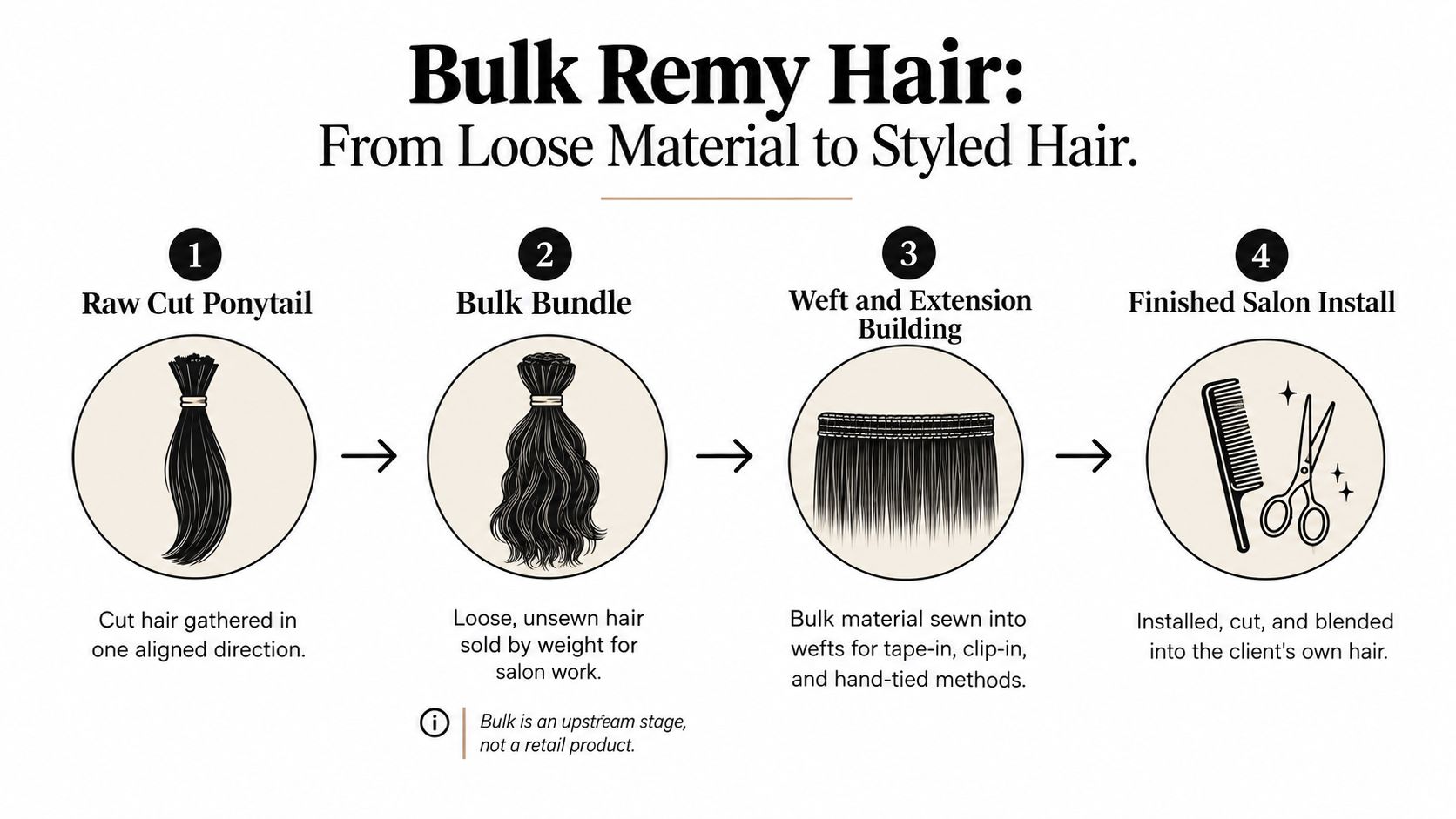
The intended method should determine the receiving inspection. Hair selected for a custom Volume Weft or Thin Weft workflow needs reliable direction, even ends, and enough cohesion for sewing or sealing. Hair being prepared for K-Tip work needs controlled separation and predictable bonding behavior. Material for Tape Weft, Tape-In, or Clip-In customization must be assessed for consistency across the finished width or attachment area.
Bulk is also useful when a stylist needs to control texture placement, create specialized sections, or work with a knotting technique that doesn't suit a preconstructed weft. It becomes the wrong choice when the salon lacks time for sorting, batch testing, or conversion. A pre-made Bulk option or finished method may be more efficient when the installation needs predictable construction with minimal fabrication.
Every new batch deserves the same basic inspection before it enters booked client work:
The trade classification reinforces why origin alone isn't a sufficient quality test. UN Comtrade tracks worked human hair used for wigs and similar products under HS heading 6703, while unworked human hair is commonly tracked separately under HS 0501. Available trade analysis reports that India exported approximately $187.9 million of unworked human hair in 2023, compared with about $3.9 million from Pakistan, a roughly 48-to-1 difference between those two cited exporters, as shown in the UN Comtrade data reference.
China is identified as a major processing and re-export hub, with finished and semi-finished human-hair goods shipped to more than 100 countries, according to the same trade reference. That supply chain can involve collection in one region, sorting and processing in another, and manufacturing elsewhere. The professional question is therefore not just “Where did this hair come from?” It's “Can the supplier document cuticle direction, inspection, weight, color consistency, and strand integrity for this batch?”
Remy quality starts with cuticle direction, not with the word human. The cuticle is the fiber's outer protective layer. When those scales remain intact and run consistently from root to tip, neighboring strands create less opposing friction, so the hair generally combs more predictably and resists tangling more effectively.
That effect becomes especially important in loose bulk material. Before conversion, every strand can contribute to the behavior of a weft, bond, knot, or hand-tied section. If the lot contains mixed directions, damaged scales, or heavily coated strands, the stylist may discover the defect only after the hair has been fabricated and installed.
Chemical processing can lift or remove cuticle scales, expose the cortex, and create longitudinal fissures. Excessive bleaching can also create pores within the cortex as pigment is oxidized. Those changes reduce elasticity and tensile strength, which increases the likelihood of matting, splitting, and breakage during brushing or hand-tied application, as detailed in the research on hair fiber structure and damage.
The salon consequences follow a practical sequence:
That last point catches experienced stylists because a coated bundle can feel excellent on arrival. The more meaningful test is how the sample behaves after controlled washing and drying. A temporary slick finish isn't equivalent to intact, aligned cuticles.
Practical rule: If the hair feels unusually slippery before washing but becomes rough, resistant, or heavily tangled afterward, the initial softness shouldn't be treated as proof of Remy quality.
A receiving inspection should compare several samples rather than approving the lot from a single visual check. Test directional uniformity, shed rate, end evenness, and friction during root-to-tip and tip-to-root combing. Note whether the hair stays grouped or separates into short, irregular fibers during handling.
A simple inspection record can include:
| Observation | What to record |
|---|---|
| Direction | Consistent root-to-tip alignment or mixed orientation |
| Combability | Smooth, moderate, or high friction in each direction |
| Shedding | Light, noticeable, or excessive fall-out during handling |
| Ends | Even, naturally tapered, or dominated by short fibers |
| Wash response | Retains manageability or becomes rough and resistant |
| Surface feel | Consistent fiber feel or evidence of temporary coating |
Storage affects the material after approval. Hair intended for repeated salon wear should remain dry, be detangled with low-tension tools, and avoid unnecessary chemical reprocessing. Surface damage compounds through repeated handling, so a lot that barely passes receiving inspection shouldn't be subjected to aggressive customization without a further strand test.
The wrong method can expose a weak lot quickly. Dense hand-tied work, repeated ventilating, tight sewing, or heavy thermal styling places more handling demand on the fiber than a conservative custom application. If the batch shows inconsistent direction or high friction, switching to a different attachment plan is more responsible than trying to hide the defect with product.
A color chart tells only part of the story. Processing history changes how bulk hair stretches, bends, holds tension, and tolerates customization. Virgin, lightly processed, bleached, and dyed lots shouldn't be treated as interchangeable inputs, even when they match the target shade.
In one controlled evaluation, tensile-strength values were approximately 3.2 for virgin hair, 2.8 after bleaching, and 2.7 after bleaching plus dyeing, with reported reductions of 12.5% and 16.6% relative to virgin hair. The study didn't find those differences statistically significant after a single treatment, but the directional decline remains operationally relevant for repeated salon handling, as reported in the controlled evaluation of treated hair.
Virgin or lightly processed bulk is generally the stronger input for work that involves substantial manipulation. It's better suited to thermal styling, ventilating, braiding, or forming custom wefts when the receiving inspection confirms good fiber condition.
Bleached hair may still be appropriate for a custom build, but the decision should depend on the condition of the actual lot. A pre-lightened shade can save a stylist from performing a chemical service, yet the hair may have less tolerance for additional manipulation. Dyed hair can be suitable for a controlled color match or conservative toning, but further lightening introduces another risk variable.
Bleaching disrupts keratin disulfide chemistry and can substantially lower breaking load. Excessive bleaching produces brittle, torn cuticles and cortical damage. A stylist shouldn't infer strength from a bright finish or soft initial feel.
Use this decision pattern:
A useful strand test evaluates the sample wet and dry. Watch for rapid elongation, roughness, snapping under moderate tension, or a dramatic change in feel after drying. Those signs suggest the lot may not tolerate the proposed service process.
Color matching also needs a mechanical record. Note the base color, previous lightening, dye history, toning, and any available processing information before approving the hair for a client. The shade may be correct while the fiber is wrong for the requested method.
For additional preparation guidance, the professional discussion of dyeing hair extensions can sit alongside the strand-test record rather than replacing it. Education doesn't eliminate the need to test the specific batch.
The wrong choice is using fragile, highly processed bulk for a build that demands repeated tension, dense attachment, or extensive thermal finishing. A stronger virgin lot may cost more at purchase, but a weak processed lot can create rework, wasted fabrication time, and a compromised finished result.
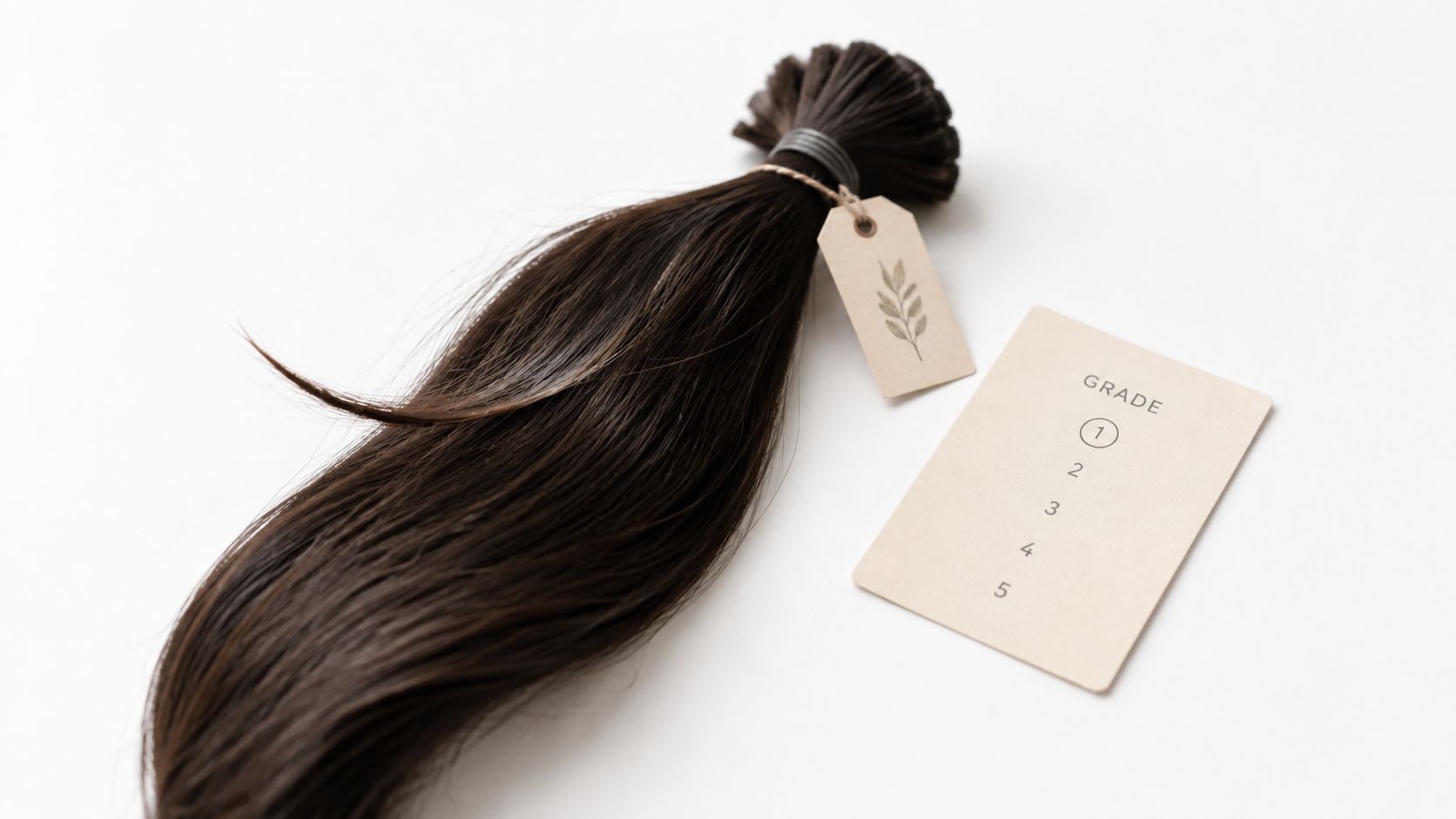
A 6A, 7A, 8A, 9A, or 10A label can sound precise while offering little control over a bulk purchase. These categories are supplier-created marketing terms, not grades administered by an official international standards body. No governing organization makes one supplier's 10A equivalent to another supplier's 10A, as noted in this technical discussion of human-hair grade labels.
The number may help identify how a supplier positions a product, but it cannot confirm the lot's usable yield, processing history, or performance during fabrication. Those decisions require a receiving record tied to the specific batch.
Keep the earlier inspection record with the purchase file, then add observations that show whether the material will produce consistent work. A useful record should be repeatable, specific to the lot, and easy to compare during reordering.
Three checks add information beyond a surface grade:
A supplier should also explain its inspection criteria, weight verification, color controls, and documentation for the specific lot. If those details are unavailable, treat the grade as a provisional description rather than purchasing evidence.
For terminology, the professional explanation of Remy human hair extensions can clarify what Remy describes. The purchasing decision still rests on documented batch performance.
Bulk intended for custom wefts or K-Tip preparation deserves close review because conversion exposes inconsistencies that may remain hidden in a loose bundle. Short fibers reduce finished yield, mixed direction can create uneven construction tension, and inconsistent color becomes more visible after distribution across the completed piece. Treat the grade number as a starting point for supplier questions, and let the batch record determine whether the lot earns a reorder.
Remy describes hair direction and cuticle alignment. It doesn't prove consent, compensation, collection conditions, or chain-of-custody. A salon buying bulk hair needs to separate the material's technical description from the conditions under which it entered the supply chain. Clients may ask where the hair originated, who collected it, and how the supplier supports its sourcing statement.
Terms such as virgin, raw, Remy, and ethically sourced answer different questions. Virgin usually refers to processing history. Raw generally describes less processed material, although supplier definitions vary. Remy concerns cuticle direction. Ethical sourcing concerns collection, payment, documentation, and handling through the chain.
A higher price does not verify these claims.
Request documents before accepting a broad statement in a product description. Useful questions include:
Industry reporting identifies ethical sourcing as a major market constraint, with as much as 30% of available hair estimated to come from unverified suppliers. Newer market analysis describes digitally tracked supply chains that record origin, collection, processing, and authenticity in market reporting on human-hair sourcing. Treat that estimate as market context, not a universal measurement of every supplier or region. It still shows why a product label cannot carry the full ethical claim.
A salon can communicate clearly without repeating claims it cannot support. If the supplier provides country-of-origin and chain-of-custody records, describe exactly what those documents cover. If the supplier offers only a general ethical statement, explain that the statement has not been verified at the level of the purchased batch. For a fuller walkthrough, see this guide to ethical hair extensions, then verify whatever the supplier puts in writing.
Sourcing may span India, Southeast Asia, South America, and other regions with different collection practices and labor risks. Processing may take place elsewhere, creating additional distance between origin and the finished product. Country of origin establishes context. It does not establish Remy quality or ethical treatment on its own.
If the documentation stops at the product name, say so to the client in those exact terms and let the paper trail, not the label, carry the ethical claim.
Bulk hair lowers cost only when the salon controls usable yield, fabrication time, and replacement risk. A low bundle price means little if short fibers, inconsistent processing, or failed construction consume the margin.
Create the purchasing file before booking the client. Record the requested texture, length, shade, processing history, cuticle direction, stated weight, intended method, and inspection criteria. Add the supplier's lot identifier, quote, shipping terms, duties, and any written sourcing or quality documentation. Before building the file, review this guide to buying hair extensions wholesale so the terms in supplier quotes match the criteria used at receiving.
The receiving process should confirm what was invoiced, what the hair can produce, and whether the lot deserves a reorder. Avoid repeating the full cuticle and shedding examination here. Cross-reference the inspection record from the earlier quality section, then complete four financial controls:
The infographic's receiving workflow includes “Comb ten strands, count fall-out” and a “Reorder point: 2 weeks of salon bookings” panel. Treat those as repeatable prompts for the salon's own system, not universal specifications. The receiving sheet should reference the salon's established combing, shedding, color, and surface checks rather than duplicate them in every reorder review.
Price the usable material, not the delivered bundle. The calculation should include unusable short fibers, fabrication labor, receiving loss, shipping, duties, expected rework, and the time spent replacing or correcting a failed build.
Landed cost per usable unit = purchase cost + shipping + duties + receiving loss + fabrication labor + expected rework.
Compare that figure with the service quote before the appointment. If import conditions or tariffs change, revise the quote before installation instead of absorbing the difference after the work is complete.
Recent market reporting describes serious supply-chain disruption. It reports that 2025 tariff changes produced duties exceeding 125% before temporary adjustments, with some salons facing procurement markups as high as 145% and shifting toward suppliers in India, Vietnam, and Cambodia, as reported in the market analysis of hair-extension purchasing conditions. The same analysis identifies raw-hair availability, export restrictions, pricing volatility, inconsistent quality, and counterfeit or mislabeled 100 percent human hair as continuing risks.
Those conditions make reorder records part of margin control. Compare each new lot with the previous batch for invoiced weight, usable yield, color consistency, cuticle direction, shedding record, and fabrication performance. A supplier can deliver one acceptable shipment and a later lot that requires more sorting or processing. Reordering should follow documented batch results, not familiarity or a low quote alone.
Bulk preparation does not remove installation responsibility. Added length and weight increase load through the attachment, especially on fragile or chemically treated natural hair. A peer-reviewed case report links sustained extension tension with follicular inflammation and recommends keeping extensions no more than twice the wearer's natural-hair length, while also aligning extension cuticles in the same root-to-tip direction as the natural hair, as reported in the British Journal of Dermatology case report.
A review summarized by Johns Hopkins researchers classified braids, dreadlocks, weaves, and extensions among the highest-risk hairstyles for traction alopecia, particularly alongside chemical straightening. The review recommends reducing tension and periodically removing high-tension styles, with practical guidance that weaves and extensions should be removed for a period after six to eight weeks, as summarized in the clinical review coverage.
Select the installation after assessing density, chemical history, attachment tension, finished length, and total extension weight together. A beaded row may overload a fragile section. Microlinks, fusion bonds, hand-tied construction, or a lighter finished build may distribute the demand more appropriately. The clinical recommendations on camouflage and extension-related tension also support adjusting volume, length, and expected wear to the client's baseline condition.
Before booking client work, complete the batch receiving sheet, confirm the intended fabrication, document usable yield, and request inspection and sourcing records in writing. Professionals building a wholesale workflow around salon methods can open a professional account with Conde Professional and review its Bulk, Volume Weft, Thin Weft, Tape Weft, K-Tip, Tape-In, and Clip-In collections alongside education and specialist support.
Conde Professional supplies professional hair extension collections and salon-focused education for stylists evaluating bulk material, custom fabrication, and finished installation methods. Visit Conde Professional to open a professional account, review wholesale collections, and request product or shade guidance before the next bulk-hair order.


