Your cart is empty
Tax included and shipping calculated at checkout

Drawer menu
Tax included and shipping calculated at checkout
A professional account gives you stylist pricing, priority support, early access to new releases, and education developed by working stylists.

Softness and price are poor ways to choose professional hair color brushes. The right brush controls where the formula lands, how much product reaches the hair, how cleanly zones stay separated, and how safely color can be applied near extension attachments.
A salon brush should be judged as part of the chemical service, not as a disposable accessory. Bristle material, head shape, handle grip, sectioning control, cleanability, and replacement criteria all affect the result. That standard matters most during repeated root work, dimensional painting, and extension color matching, where a small loss of control becomes visible in the finished hair.
Professional hair color brushes are application-control systems, not commodity tools. Bristle spacing, section separation, handle shape, and product release determine how a stylist moves from a bowl to a subsection. A soft brush may feel pleasant in the hand, but it can still flood a root, drag a lightener across a foil boundary, or leave a thin film through dense hair.
The design principle is older than most modern salon branding. A 1965 U.S. patent filing described a hair-coloring method using a brush with spaced tufts that were dipped into color and drawn across selected strands. A German patent application filed on February 25, 1985, for a brush intended to apply hair-coloring agents, was published in Europe on September 3, 1986, and granted in 1989. A later U.S. patent publication from 2010 described a kit with two brushes matched to trays, including a brush divided into three bristle sections aligned with three product compartments. The record supports a straightforward conclusion: brush geometry has long been engineered for controlled deposition, not decoration. (Patent history for hair-color application brushes)
That control shows up differently across services. Highlights need clean foil boundaries and predictable saturation. Balayage needs a brush that can spread and feather without creating a hard product edge. Root applications need compact, even coverage close to the scalp. Extension color matching requires enough restraint to compare a formula against cuticle-intact, Remy, or double-drawn hair without saturating an attachment point before the shade has been confirmed.
Practical rule: A brush earns its place by controlling product, sectioning, and hand movement under real salon conditions.
A useful evaluation lens has four parts:
Stylists can find a broader discussion of professional product selection in Conde Professional's guide to professional hair products and brands, but the buying decision should remain tied to the service. Price and appearance are secondary if the brush changes saturation, timing, or attachment safety.
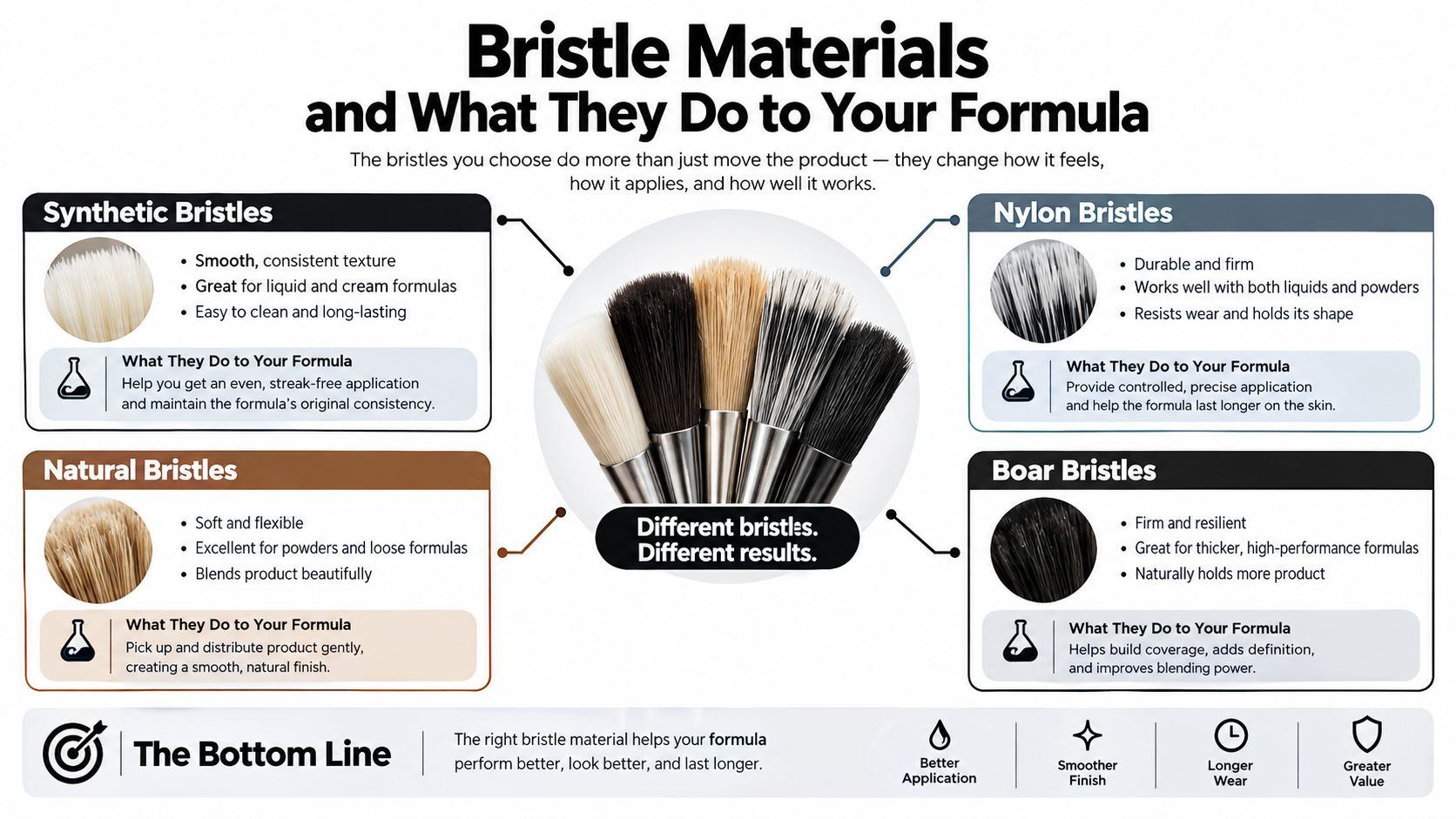
Bristle material changes how color behaves at the brush-to-hair interface. That matters more than softness or price, because product control affects saturation, timing, and how safely you can work near fragile zones or extension attachments. Synthetic nylon or polyester bristles are the practical default for oxidative color and lightener. They resist chemical wear, clean up more predictably than absorbent natural fibers, and keep more of the mixed formula available for release onto the hair instead of holding it inside the bristle bundle.
Natural fibers can feel pleasant in the hand, but they introduce a variable many colorists do not need. An absorbent brush can load heavily from the bowl, hold part of that mixture back, then release unevenly across the next subsection. On sheer glossing work, you may get away with that. On root coverage, controlled lift, or any zone where timing and deposit need to stay tight, that inconsistency shows up fast.
Flexible nylon suits services where the brush needs to spread and feather rather than press a heavy line into the hair. It gives better surface glide for balayage, soft transitions, and dimensional placement where a gradual edge matters. If the chemistry is meant to diffuse visually, the bristle needs some give.
Firmer, denser nylon does a different job. It holds tension through thicker sections, pushes formula into resistant regrowth, and lays down a more compact film close to the scalp. That same firmness can work against you on porous ends, compromised hair, or around wefts, tapes, bonds, or beads. Too much pressure there can flood an area that should stay clean, or move formula into an attachment point before the match is confirmed.
Tip shape also changes the result. Tapered or feathered ends help soften the line where product meets untreated hair, especially in transition zones. They do not fix poor sectioning or overloaded application. If the brush carries too much product, the first contact still leaves a hard block, no matter how refined the tip looks.
Build quality deserves the same scrutiny as bristle type. Repeated contact with oxidative color, bleach, and disinfection can change stiffness, loosen the bundle, or trigger shedding if the brush is poorly assembled. Handles matter too. The material has to tolerate your cleaning routine without cracking, loosening, or trapping residue where chemistry can sit between services. A specialty tool such as Conde Professional's loop brush in classic Havana acetate should be judged by the same standards: release, control, cleanability, grip, and whether it protects precision work in the zone you are servicing.
Brush geometry determines how much hair can be saturated per pass and how accurately the formula can be placed. Wide, dense heads cover larger sections and full lengths with fewer reloads. Narrow or angled heads reach the hairline, partings, extensions, and foil boundaries without forcing a wide tool into a small working area.
A sectioning tail can reduce tool changes during a service, but only if it's rigid enough to create a clean parting. A flimsy tail encourages repeated passes, uneven subsections, and unnecessary pressure against the scalp. The most useful handle has enough structure for sectioning and enough grip security to remain stable when gloves, cream color, or disinfectant make the surface slippery.
| Brush Type | Best For | Key Behavior |
|---|---|---|
| Wide, dense head | Large sections and full-length saturation | Spreads a substantial film across more hair per pass and can reduce reloads |
| Narrow head | Root touch-ups, partings, and detail work | Places product accurately in compact subsections |
| Angled head | Hairlines, foil boundaries, and extension areas | Uses the edge to reach tight zones without flooding adjacent hair |
| Flexible, feathered head | Balayage and soft transitions | Spreads product gradually and reduces abrupt visual edges |
| Firm, dense head | Resistant roots and thick sections | Maintains tension and delivers concentrated coverage |
| Brush with rigid sectioning tail | Four-quadrant work and repeated partings | Keeps sectioning consistent while limiting tool changes |
A virgin single-process application illustrates why shape and loading work together. Cosmetology training materials specify a four-quadrant pattern created with a center part, followed by application to mid-lengths and ends in quarter-inch subsections while avoiding the scalp initially. The root area is applied later, and the formula should be mixed in a non-metal bowl according to the manufacturer's directions. (Virgin single-process sectioning and application safety)
A wide brush may move efficiently through the mid-lengths and ends, but a narrow brush gives better control when the root application begins. The point isn't to use one brush for every stage. It's to avoid asking a single geometry to perform conflicting jobs.
A contoured or non-slip handle matters during repetitive applications. When the grip slips, the stylist often compensates by increasing finger force, tightening the wrist, or changing the angle of the brush. Those adjustments can reduce consistency before fatigue becomes obvious.
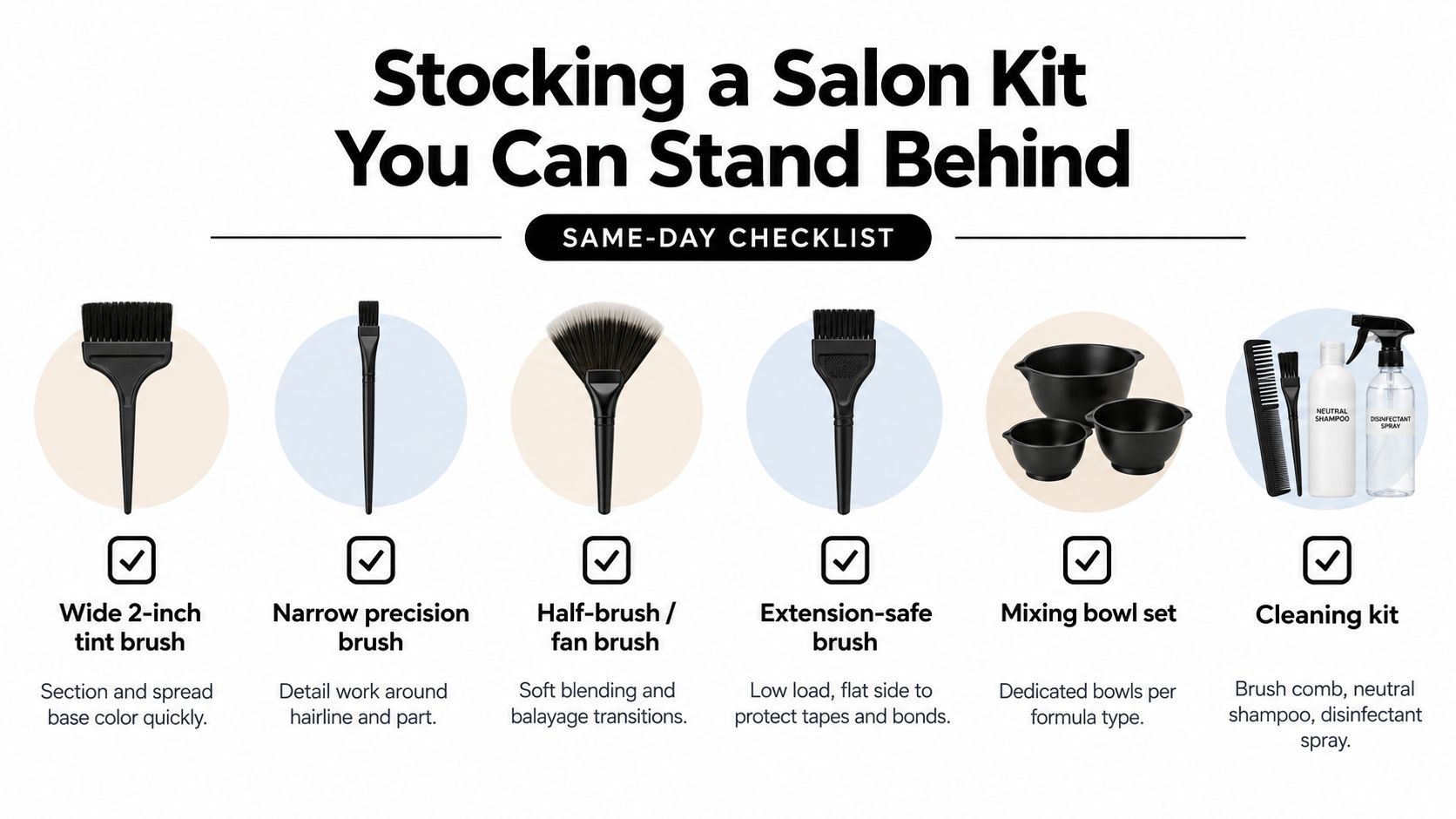
A practical station often needs a wide brush, a narrow or angled brush, and a rigid-tailed brush. Conde Professional's brushes and combs collection can be assessed against that service-based setup rather than selected by softness alone.
Extensions expose sloppy brush work fast. A brush is not just carrying color here. It is controlling where chemistry stops, how cleanly zones stay separated, and whether tapes, bonds, links, or tracks stay intact after the service.
Product load has to drop the moment extension hair enters the service. Whether you are working on a Volume Weft, Thin Weft, Tape Weft, K-Tip, or Bulk piece, overloaded bristles push formula into places you did not intend. That is how a simple shade adjustment turns into adhesive contamination, swollen bonds, or cleanup at the attachment point.
Start by wiping excess formula against the bowl before the brush touches the hair. The first pass should map placement and direction. Full saturation comes later, and only where the method allows it. On a weft or loose piece, a flexible or feathered brush edge can blur a line without flooding the base. Around a compact root area or a tight install, a narrower firm brush gives better edge control, but the pressure still needs to stay light.
Test before you commit. Paint a small, discreet area, let it develop enough to read the undertone, then compare it against the client's natural hair and the target blend. That is a safer call on Tape-In, Clip-In, and Bulk hair, and it helps on installed methods too. Extension hair can grab differently from the client's own hair, so a controlled preview saves a full correction.
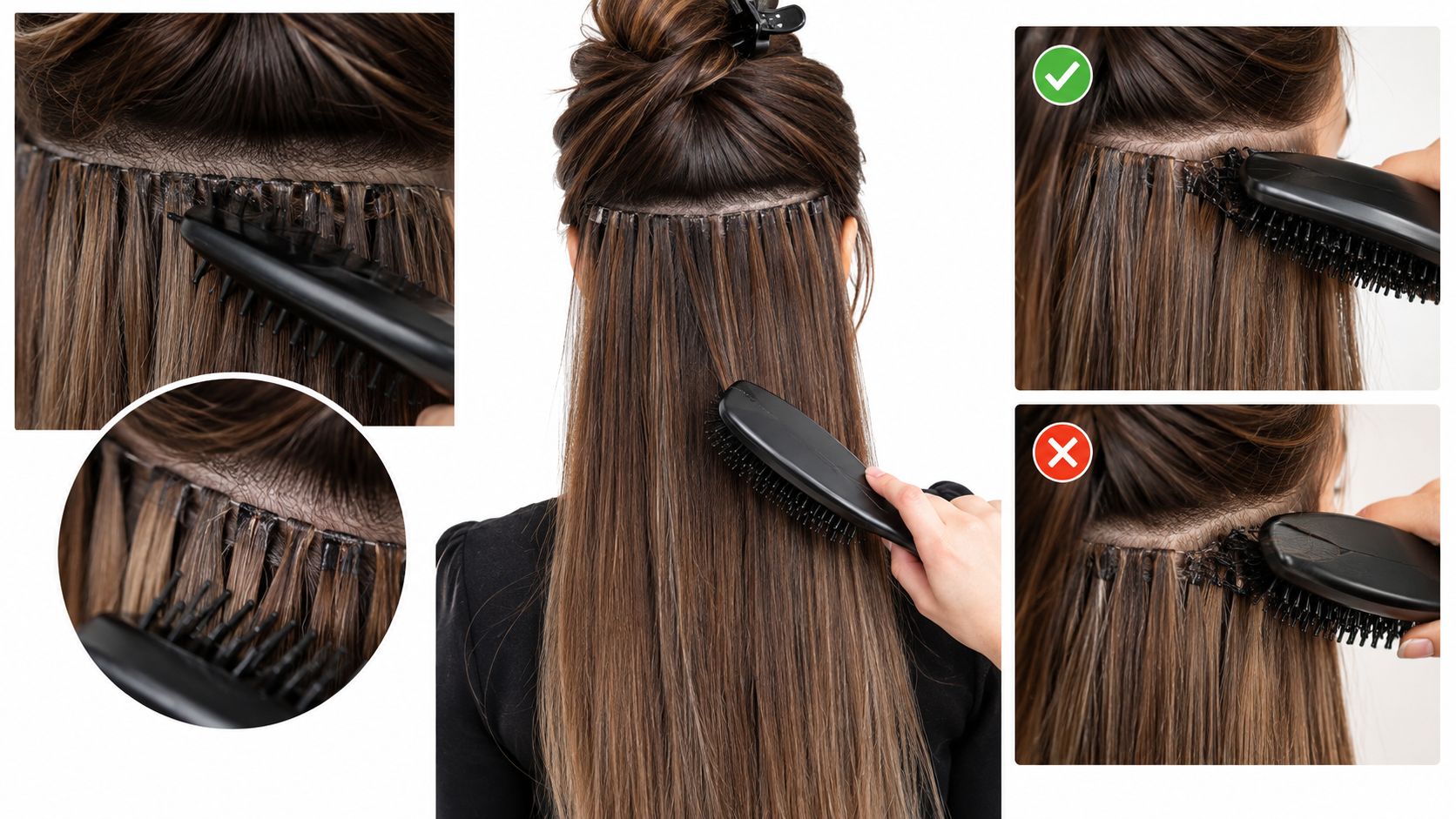
Zone work gets riskier around extensions because one brush mistake changes both processing and attachment safety. A common salon example is a two-zone service where the midshaft is applied first with a stronger developer, then the scalp area is applied with a fresh mixture at a lower strength, with timing started only after the second zone is complete. If those mixtures blur together on the brush or at the hair, the result can shift before you see it.
Use a dedicated brush for each mixture when the formula changes by zone. That keeps developer strength where it belongs and makes your timing cleaner. Around extension hair, that separation matters even more because reworking an uneven result near an attachment is rarely gentle.
Some installs should not be colored in place at all.
If there is a real chance the formula can reach adhesive, keratin, beads, or stitching, the safer move is to remove the extension hair, color it separately, or decline the chemical service until the method changes. Brush skill does not override method limits. It only helps you stay inside them.
For method-specific prep and handling, Conde Professional's guide to dyeing hair extensions follows the same working principle: control product load, protect the attachment, and treat extension hair as its own technical material.
Brush hygiene is a professional obligation because colorists handle hair cosmetics far more often than consumers. A 2022 occupational-exposure study reported exposure ranging from 4 to 78 times higher for hairdressers than consumers, depending on the task. For full-head permanent or oxidative color using 6% to 12% hydrogen peroxide, consumers typically colored their hair about once per month, while hairdressers could perform the service up to four times per day. The study also reported root or regrowth coloring approximately three times per week for relevant hairdresser categories, with each coloring service averaging 15.0 minutes. Among hairdressers performing these services, 99.3% carried out the task and 95.2% reported wearing gloves. (Occupational exposure during hair-coloring services)
That frequency makes a brush's cleaning protocol part of service quality. A professional label doesn't establish microbial safety, and color precision doesn't prove that a tool is ready for the next client.
A single-client workflow may allow immediate cleaning and disinfection before the next service, while a multi-client station needs enough brushes to prevent rushed reuse. Salons should follow local infection-control requirements and the product label for the chosen disinfectant. EcoQuest Purifiers sterilization boxes may be considered as part of a broader storage and sanitation system, but additional equipment doesn't replace cleaning, chemical compatibility, or the required wet contact time.
Discard a brush when the filament bundle is visibly deformed, shedding, permanently splayed, or unable to release product evenly. A cracked ferrule or handle should also remove it from service, especially if the crack can retain residue. Adhesive-contaminated components that can't be cleaned without damaging the assembly shouldn't return to the color station.
A working color station doesn't need a drawer full of near-identical brushes. It needs tools assigned to clear jobs, stored in a way that separates clean equipment from used equipment, and tested against the chemistry and service mix in the salon.
A salon can test a prospective brush before committing to a full order. Weighed brush loads show how much product the brush picks up and releases. A defined section checked after processing reveals missed spots. A timed root touch-up exposes whether the head improves control or merely feels soft. Post-cleaning inspection shows whether filaments deform, shed, or lose their original alignment.
The procurement decision should use total cost of ownership, not cheapest-per-dozen pricing. Durability, heat resistance, bristle retention, grip stability, and cleaning compatibility matter because a tool that fails early creates replacement work and can compromise a service. Sustainability claims also need scrutiny. A handle described as biodegradable or eco-friendly must still be evaluated for stability after exposure to peroxide, ammonia, persulfate lightener, disinfectant, and hot water. Replacing an unstable tool repeatedly may create more waste than using a longer-lasting conventional assembly.
For station organization and service readiness, Conde Professional's professional hair stylist tool bag guide can sit alongside a written brush assignment chart. The chart should identify which brush belongs to root color, lightener, balayage, extension matching, and sanitation rotation.
The next step is concrete: review the current brush drawer today, remove any tool with shedding, deformation, cracking, or adhesive contamination, then test the remaining brushes with weighed loads and a defined subsection. Stylists building a complete extension service kit can also review professional account options at condeprofessional.com before selecting the Conde method and tools that match the salon's chemistry and attachment work.
Conde Professional supplies licensed professionals with extension methods including Volume Weft, Thin Weft, Tape Weft, K-Tip, Tape-In, Clip-In, and Bulk, alongside tools and education for color matching and installation. Visit Conde Professional to open a professional account and build an extension station around controlled application, attachment safety, and repeatable salon workflow.


