Your cart is empty
Tax included and shipping calculated at checkout

Drawer menu
Tax included and shipping calculated at checkout
A professional account gives you stylist pricing, priority support, early access to new releases, and education developed by working stylists.


A client with fine, low-density hair is in the chair asking for long, full K-tips because she wants movement without a visible weft. The professional answer shouldn't be an automatic yes or no. K tip hair extensions for fine hair can work when the installation is planned as a traction-and-load calculation, with bond size, section strength, extension mass, length, placement, and removal all working together.
The strongest result may be a partial-volume installation, shorter length, or another method entirely. A K-tip that looks secure on installation day can still overload fragile strands during brushing, sleeping, movement, and repeated wear.
The first decision is whether the client's natural hair can support the proposed attachment plan, not whether K-tips are fashionable or individually bonded. Fine hair describes strand diameter, while low density describes how much hair is present in a zone. A client may have fine but stable, dense hair, or fine strands with sparse areas and active breakage. Those are different installation scenarios.
A stylist assessing a client who wants length should examine the proposed attachment zones, perimeter, crown, parting pattern, chemical history, shedding, and scalp comfort. If the interior hair has stable density and the target is modest length or selective fullness, a scaled K-tip service may be reasonable. If the request is a full-head, longest-length transformation on sparse or actively breaking hair, the responsible answer is usually to redirect, postpone, or reduce the scope.
K-tips concentrate force on small sections of natural hair. A weft or row distributes load across a broader attachment structure, while each K-tip asks a limited group of strands to carry the extension mass connected to that bond. Fine strands offer less structural support per attachment point, so the margin for error narrows quickly.
A practical consultation can sort the request into three outcomes:
Working rule: The client's desired finish must fit the carrying capacity of the natural hair, not the other way around.
Clinical evidence reinforces why that assessment matters. A 2023 study of 223 women identified traction alopecia in 77 participants, or 34.5%, with a 95% confidence interval of 28.3% to 40.7%. Extensions were regularly used by 95.1% of participants, but the study examined hair-care practices broadly and didn't prove that K-tips caused the condition. It does support matching extension weight, bond placement, section size, and tension to existing hair strength. The clinical study
A useful salon reference on selecting extensions for delicate density is this professional guide to extensions for fine, thin hair. The final call should be based on the client's actual attachment sites and maintenance capacity, not on strand count alone.
Once a K-tip service is considered appropriate, the mechanical assessment starts with three variables: the natural section's cross-sectional mass, the bond's footprint, and the extension mass assigned to that bond. Section ratio matters more than the number of strands in the finished look.
A flat keratin tip is bonded around a small section during hot fusion. The attachment becomes a fixed point through which force travels as the hair moves, brushes, rubs against a pillow, or is gathered into a style. Long hair creates more pulling effect. As the distance from the bond increases, movement at the ends can transmit more torque back to the attachment.
The first variable is the natural section. A stylist should assess diameter, density, porosity, previous lightening, chemical services, and visible breakage at the exact site where the bond will sit. A section that looks adequate from a distance may contain fragile, highly processed strands that can't safely carry the planned extension mass.
The second is bond geometry. An oversized or bulky bond can create a concentrated stress point and become harder to conceal. A narrow, flat bond aligned with the hair's natural fall usually gives the section more practical control, provided it still has enough surface area for a secure attachment.
The third is the extension-to-natural-hair ratio. A small bond doesn't make a heavy strand safe. Attaching too much hair to too few natural strands increases the force carried by each strand, especially when the extension is long or the client wears frequent ponytails.
| Natural section density | Bond footprint | Extension mass per bond | Placement notes |
|---|---|---|---|
| Stable fine density | Narrow, flat, proportionate | Light and matched to the section | Interior zones with adequate concealment |
| Fine density with variable strength | Small and carefully shaped | Reduced and distributed | Avoid processed strands and reassess nearby sections |
| Sparse or fragile density | A concentrated bond is usually unsuitable | Keep minimal or redirect method | Don't place on perimeter, breakage, or visibly weakened areas |
K-tip construction and installation details are covered in Conde Professional's K-Tip installation guide. The important question at consultation isn't, “How many bonds does the client want?” It's, “What diameter and condition does this attachment site have, and what load will it carry during the full wear cycle?”
A 2009 dermatology report examined 12 women who wore extensions and didn't report hair loss. Dermoscopic signs consistent with traction alopecia appeared in all 12, including preserved follicular openings and sparse broken hairs. The report explained that sustained tension can loosen the hair shaft from the follicular opening and trigger chronic inflammation. The dermatology report
That finding doesn't make K-tips unsuitable. It does mean that a comfortable first appointment isn't proof that the section ratio is working over time.
Fine-hair K-tip work rewards restraint. The safer default is to place smaller, lighter attachments on stronger interior hair, keep the bonds flat and aligned, and prevent any one row or zone from carrying a disproportionate share of the finished weight.
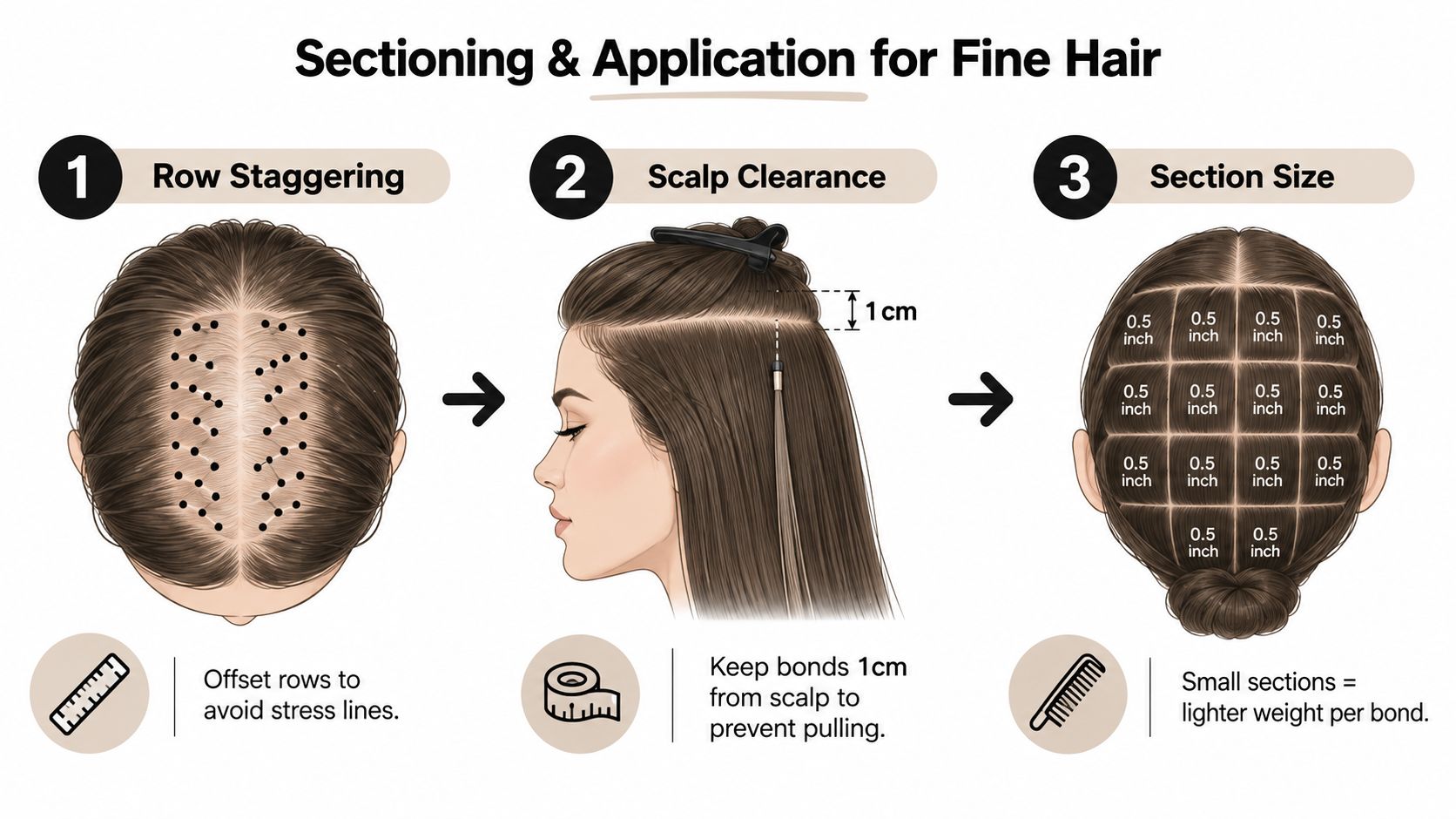
Start with the client's natural fall and the way the hair is worn. Establish clean sections, then leave the hairline, temples, fragile perimeter, and visibly compromised zones out of the load plan. Bonds need enough scalp clearance to move with the hair without pulling directly at the root.
Stagger rows rather than creating a single horizontal stress line. A staggered layout spreads visual density and reduces the chance that brushing or movement will load one continuous band. Bonds should also be aligned with the hair's fall. Rotated or projecting attachments create unnecessary strain and can catch during comb-out.
Use the smallest bond that gives a secure, neat hold. Don't place several strands into one sparse section to make the install faster. Stacking bonds vertically can increase friction and make the comb pass work harder through a concentrated area.
Conde Professional's K-Tip line uses flat keratin-tipped strands for hot fusion application. A consistent bond shape helps the stylist keep placement predictable, but the natural section still determines how much extension hair belongs there. The K-Tip collection provides the product reference point, while the service plan must be built from the client's hair.
A fusion iron that's too hot can soften the keratin excessively and allow migration toward the scalp. A tool that's too cold can leave a brittle bond that cracks under tension. There isn't one universal temperature for every hair condition, smoothing history, or attachment system. The applicable system guidance should govern, and thermal tools should stay away from the finished bond during styling.
The American Academy of Dermatology recommends short wear periods and immediate removal if extensions cause pain or irritation. A review of traction alopecia similarly identifies extensions among hairstyles that create prolonged tension on the follicle, supporting conservative sectioning and regular reassessment. The clinical review of traction alopecia
K-tips earn their place when the client needs precise, discreet, strand-level placement. They lose ground when the natural hair can't safely carry concentrated loads or when the desired result depends on substantial overall fullness.
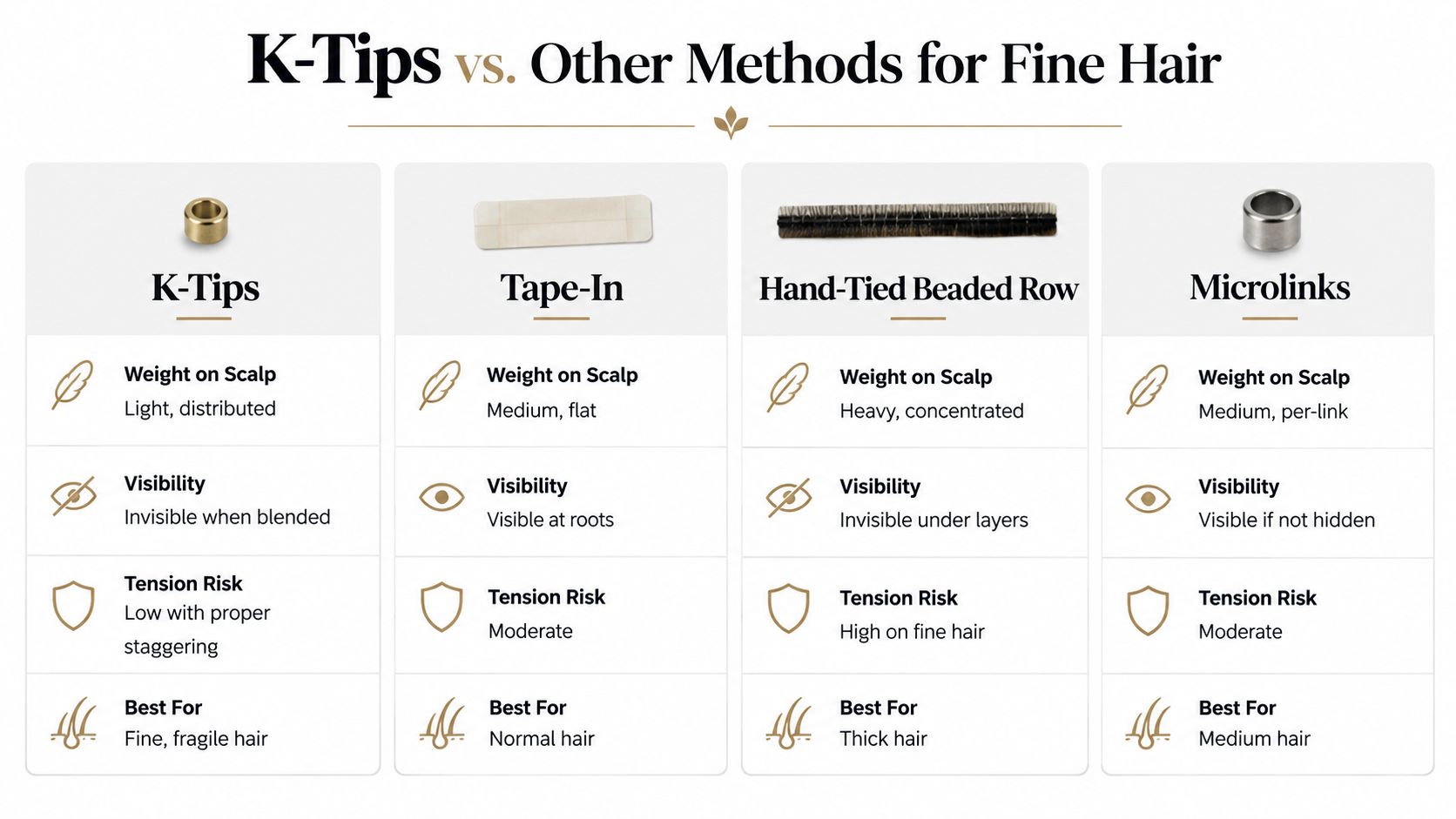
Tape-ins distribute attachment across a wider, flatter surface. That can suit very fine hair that can't support many concentrated points, although placement at the root may be more noticeable in some partings and the method can be less flexible for isolated density corrections.
Hand-tied beaded rows spread the extension across many natural hairs in a row. They can create broad fullness efficiently, but a row may be too concentrated or heavy for very fine density, especially near the perimeter or on a client requesting substantial length.
Microlinks also use point attachments, so they share some of the section-loading concerns of K-tips. They may be useful for clients who need a non-fusion approach, but bead size, slippage, visibility, and the amount of natural hair assigned to each link still require careful control.
K-tips provide individual movement, targeted placement, and useful parting versatility. They can add discreet density in a specific zone without committing the whole head to a continuous attachment. That precision is the reason to choose them, not a belief that individual bonds are automatically lighter.
| Method | Fine-hair advantage | Main limitation |
|---|---|---|
| K-tip | Targeted placement and discreet movement | Concentrated load at each bond |
| Tape-in | Wider, flatter load distribution | Less flexible around certain partings |
| Hand-tied beaded row | Broad row-based fullness | Can concentrate weight across a fine row |
| Microlinks | No fusion heat and individual placement | Point-loading, bead visibility, and slippage |
Conde Professional's overview of extension methods can help a salon compare the available formats within one professional range. The final recommendation should still follow the client's density and goal.
Redirect the request when the client has extremely sparse density, active breakage, a recent chemical service that has reduced resistance, or a demand for full-head, longest-length fullness. Chemically treated hair is more vulnerable to traction and mechanical forces, so a recent service changes the risk calculation rather than merely the color formula.
A fine-hair install looks natural when the added hair respects the density the client's haircut can support. The stylist shouldn't hide bonds. The stylist should control the visual weight from the perimeter through the interior so the extension hair reads as growth rather than a separate layer.
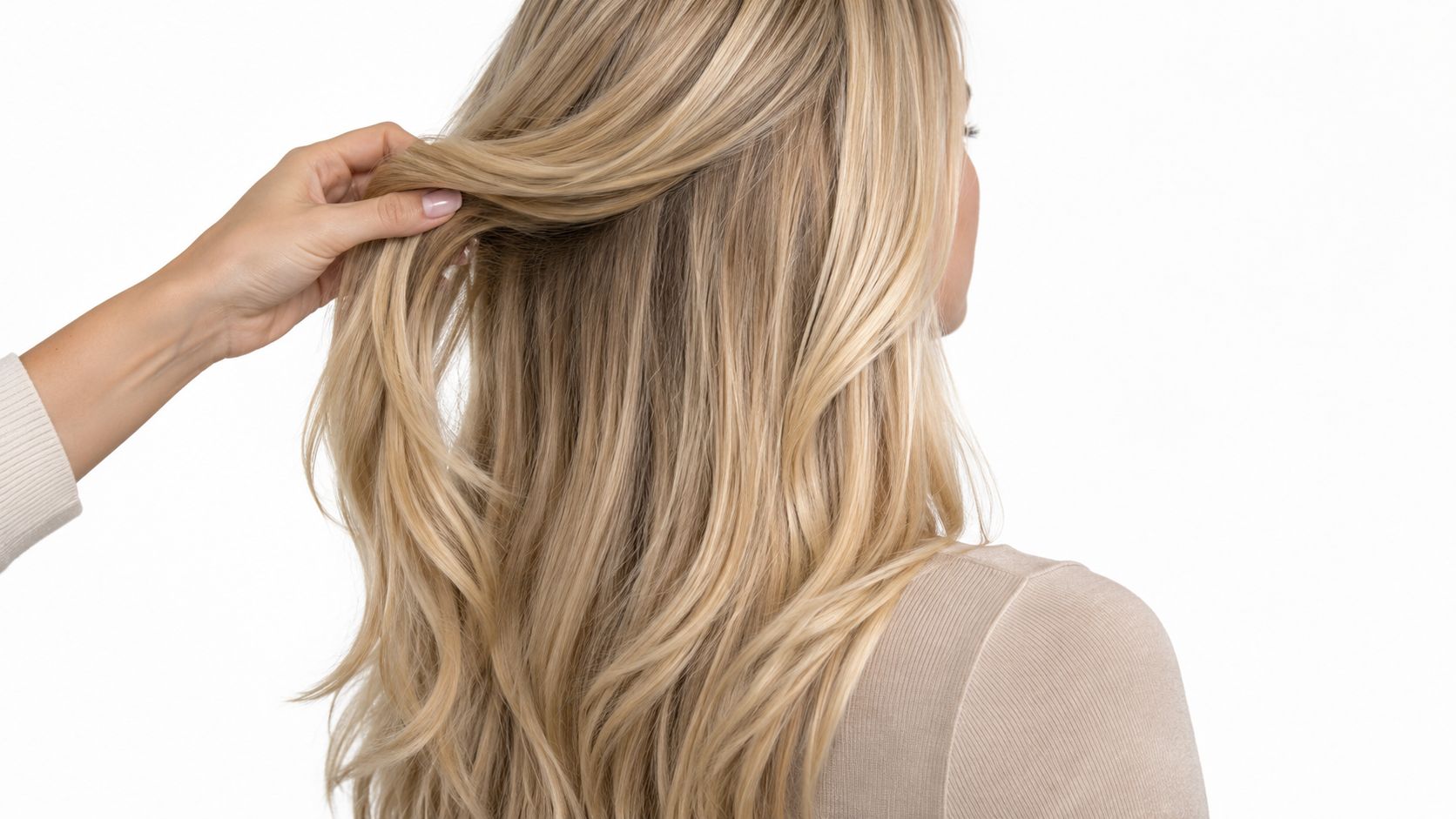
Start with the client's natural fall. Straight extensions on a naturally wavy head can expose the difference at the ends, while a wave mismatch can make a fine perimeter look separated. The extension texture should support the client's regular styling pattern, not only the finish created in the salon.
Length needs restraint. Longer extensions create more torque at the bond, and a fine-haired client may not have enough perimeter density to carry a blunt, heavy endpoint. A graduated shape, controlled layering, and preserved breathing room around the face can make the result look fuller without adding unsupported mass.
Leave visual and mechanical space around the hairline, crown, and part. Those areas often reveal overbuilding first. If the natural hair can't cover the attachment or support the fullness, adding more bonds will not solve the problem.
Color selection should follow the client's depth, reflected tones, and movement. Conde Professional's K-Tip range includes Solid, Balayage, Bronde, Highlights, Superblend, Rooted, and Fantasy families, which gives the stylist more than a single flat shade to work with.
Amber Glow #7/10 Superblend is a practical example of a multi-tone option for a dimensional blonde result. Jet Black #1 Solid illustrates the opposite need, a clean single-color foundation when tonal variation would make fine ends look busier. Shade choice won't correct an overloaded installation, but the right family can reduce the visual contrast between natural hair and extension hair.
Blending should finish with a dry movement check, not only a curled photo. Examine the part, the perimeter, the crown, and the client's usual styling direction. A successful cut makes the density transition believable while preserving enough natural hair to conceal and support each attachment.
A fine-hair removal appointment is where the original load calculation gets audited. If the bond was too large for the section, or the section weakened during wear, removal shows it fast. K-tips start as compact keratin bonds placed with heat fusion, then migrate away from the scalp as natural hair grows and sheds. As the attachment moves away from the scalp, the longer lever arm increases torque, matting, and comb-out friction.
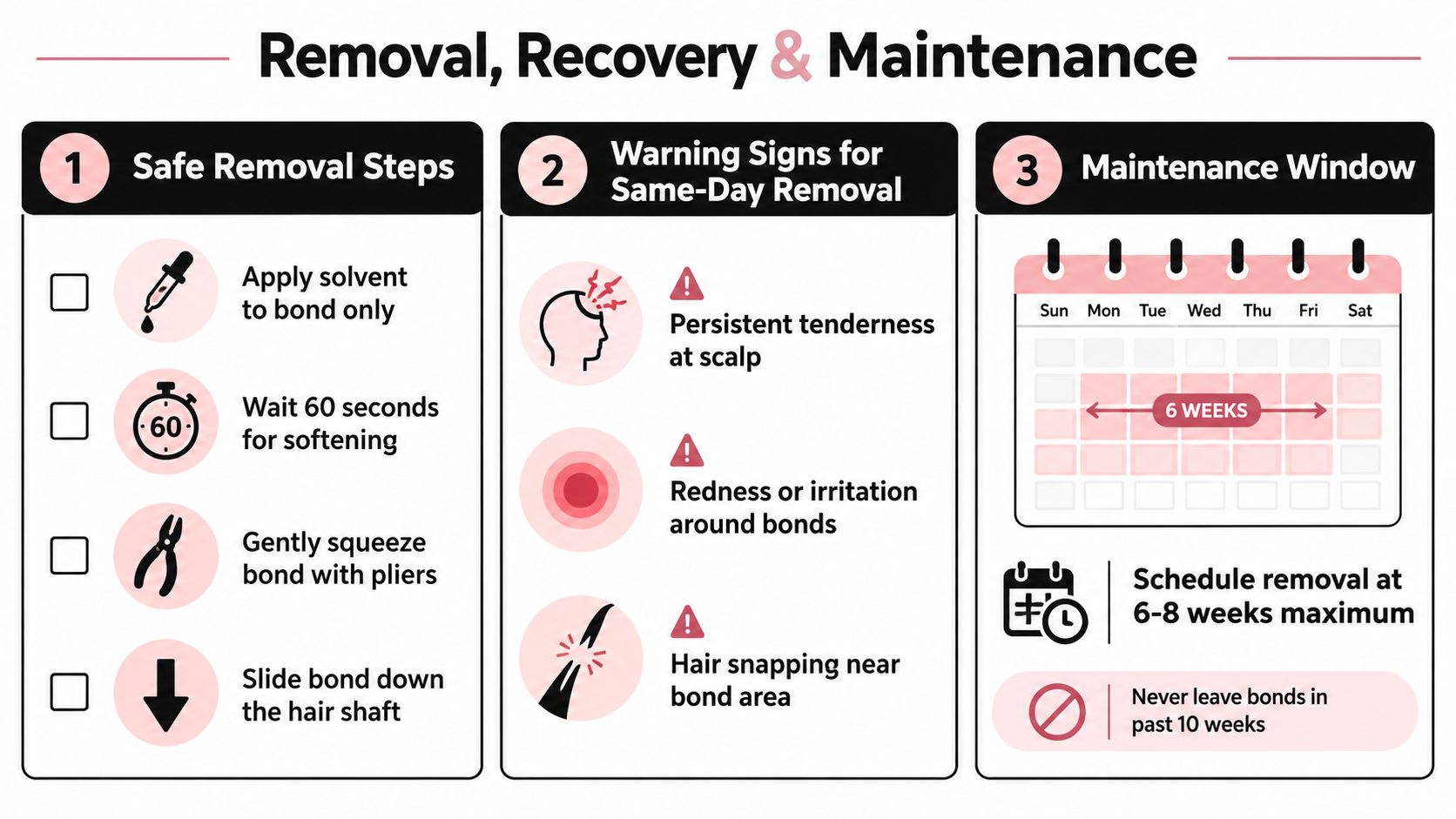
Many keratin systems cite a three-to-six-month wear window. Fine hair still should not be managed by the calendar alone. Bond integrity, slippage, matting, comfort, shed accumulation, and the condition of the natural hair should decide whether the client needs maintenance, early removal, or a full reset. Follow the bond system's professional instructions and Conde Professional's K-tip removal guidance.
Do not wait out persistent tenderness.
Same-day adjustment or removal is warranted when a client reports ongoing headache, scalp bumps, tightness, widening part lines, broken perimeter hairs, or slipping bonds caused by weakening support hair. Those signs point to a section-to-bond mismatch, a placement problem, or wear that has gone too far. Pain, irritation, and heavy shedding are not acceptable trade-offs for retention.
During removal, separate normal released shed from traction-related breakage. Shed hairs are usually full-length strands with the bulb released from the follicle. Short snapped pieces, frayed perimeter hairs, and concentrated breakage near the bond indicate mechanical stress instead. If inflammation persists or hair loss continues, a dermatology referral makes more sense than reinstalling over the problem.
Apply the correct solvent, give it time to soften the keratin under the system's instructions, then use controlled pressure to fracture the bond. The bond should release from the natural hair. It should not be peeled, yanked, or crushed down the strand.
After the bond is off, clear the released shed carefully and detangle without forcing compacted hair through fragile lengths. Document what you see. Fine hair that showed tenderness, inflammation, or visible weakening needs a tension-free recovery window before another install, and that window gets longer when breakage or scalp irritation were present. There is no universal rest period that overrides the client's condition.
Track baseline density, chemical history, scalp status, planned extension weight, placement map, and any symptoms at each maintenance visit. A good first install does not prove long-term suitability. Repeated tension, rushed removal, and immediate reapplication can change the result across wears.
Choose the hair by how it performs in the chair, then set the installation load. A supplier grade is not a technical standard. 6A through 10A language has no governing body and no fixed criteria, so a higher letter does not reliably predict how the hair will behave once bonded to fine natural hair.
Inspect the properties that affect blending and wear. Check whether the cuticle is aligned, whether the hair combs cleanly, and whether it sheds during normal handling. Wash and style a sample to see whether it retains useful behavior. Confirm consistent color and enough uniformity for the planned blend. These observations give you more practical information than the printed grade.
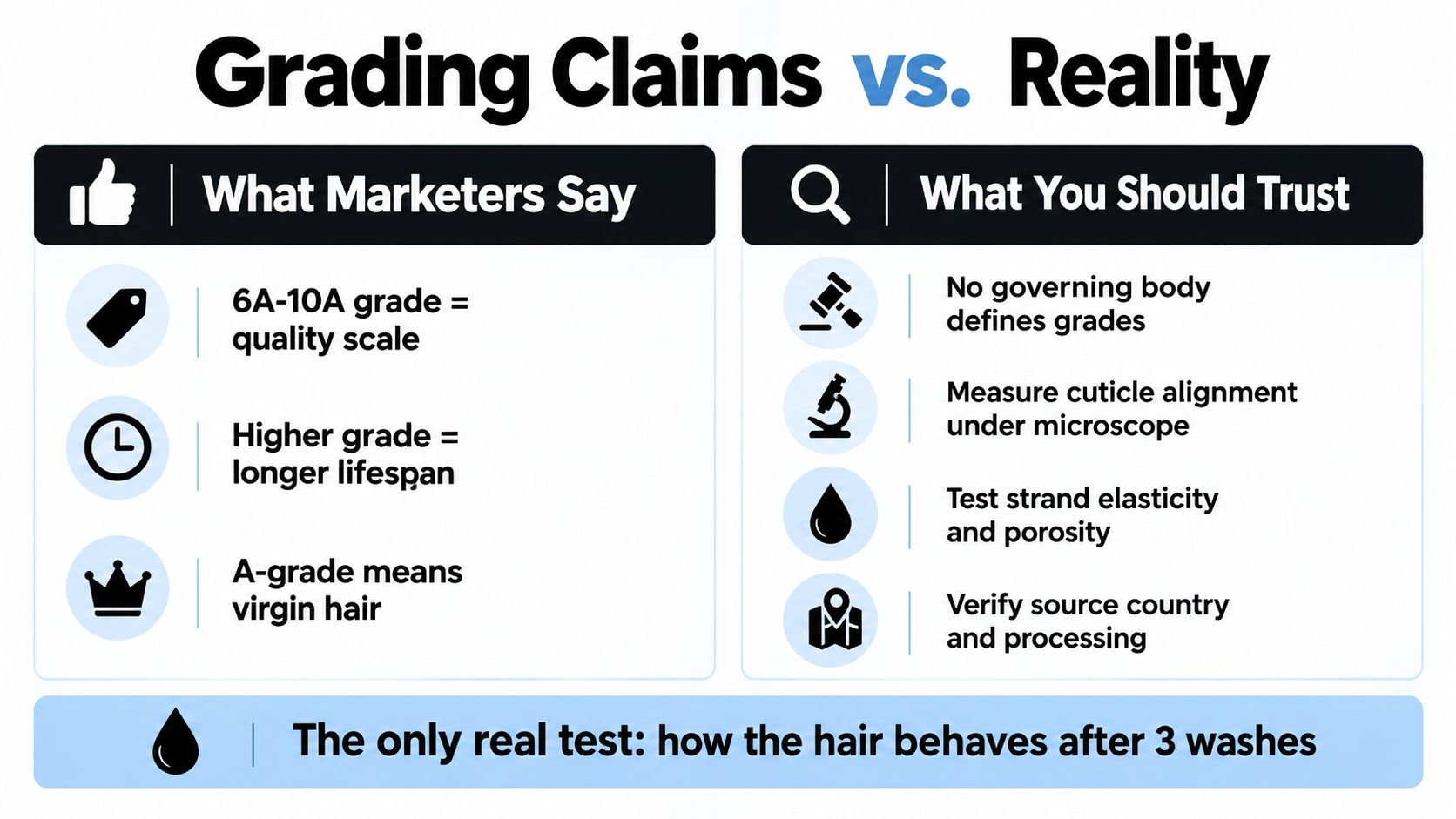
A supplier conversation should cover:
Chemically treated hair resists traction and mechanical force less reliably, and longer extension lengths amplify torque at every bond. Those factors affect the load plan for fine hair, regardless of the letter printed on the package.
For fragile density, partial volume is generally easier to defend than a full-head installation with maximum length. The professional advantage lies in translating observable hair behavior into a conservative section ratio; the marketing scale contributes nothing to that calculation.
At the next fine-hair K-tip consultation, the stylist can run this checklist before selecting a shade or counting bonds:
A salon owner can then open a professional wholesale account with Conde Professional to access the K-Tip collection alongside Volume Weft, Thin Weft, Tape Weft, Tape-In, Bulk, and Clip-In options. Shade guidance and method support are available by text, phone, or email, which gives the team a practical route for comparing methods before committing a fine-haired client to a load plan.
Conde Professional supplies licensed professionals with extension methods including K-Tips, Tape-Ins, Volume Weft, Thin Weft, Tape Weft, Bulk, and Clip-Ins, plus shade guidance and education for salon applications. Visit Conde Professional to open a professional wholesale relationship and build a fine-hair extension plan around the right method, weight, and placement.


