Your cart is empty
Tax included and shipping calculated at checkout

Drawer menu
Tax included and shipping calculated at checkout
A professional account gives you stylist pricing, priority support, early access to new releases, and education developed by working stylists.


The safest tape-in choice for fine hair is the narrowest panel that still provides full coverage, paired with conservative total weight and a strict eight-week move-up rhythm, not the strongest adhesive on the shelf. That verdict reverses most buying advice, which ranks hold time first and treats a flat bond as proof of safety.
For fine density, hold is the easiest problem to solve. Traction is the harder one. A panel can stay perfectly sealed for weeks and still overload the strand group carrying it, especially once brushing, ponytails, and sleep friction add pull. The practical question for the best tape-in extensions for fine hair isn't which tape sticks hardest. It's which combination of panel geometry, total load, placement, and removal behavior keeps sustained tension below what the client's available hair mass can tolerate.
Thinner tape isn't automatically safer. A low-profile panel installed on a thin veil of natural hair, stacked too densely through the sides, or loaded with excessive length still concentrates force at the follicle. Conversely, a slightly broader panel can perform more conservatively when the section underneath carries enough mass to distribute the load. Attachment geometry and total weight determine the mechanical outcome more than the visual thinness of the bond.
The strongest clinical concern behind extension selection is sustained pulling, not adhesive branding. A Johns Hopkins School of Medicine analysis on traction alopecia risk identified extensions, weaves, braids, and dreadlocks among hairstyles associated with traction alopecia, estimating that approximately one-third of African-American women experience this form of hair loss, with chemically treated hair noted as especially vulnerable to combined processing and tension damage.
That estimate doesn't prove tape-ins are safer or riskier than every alternative. It does establish why fine-hair work needs a conservative bias. Chemical processing can weaken the shaft before extension weight is added, so a client with lightened, relaxed, or repeatedly colored hair starts the install with less margin than the density alone suggests.
Two clients can present with similar ponytail circumference and tolerate very different installs. One has stable, evenly distributed fine density and an intact cuticle. The other has temple recession, postpartum shedding, and breakage through the front. Treating both as a standard fine-hair tape-in case ignores the variables that drive failure, including density distribution, shaft fragility, chemical history, and active shedding.
A tape panel doesn't become low risk because it sits flat. It becomes lower risk when section size, panel count, length, and placement keep daily leverage off fragile follicles.
Short-to-medium length goals usually fit fine hair better than dramatic transformations for a mechanical reason. Longer hair increases pull at the attachment during brushing and styling. Stylists who control length and total added mass first, then select tape, make the decision in the right order. Stylists who start with adhesive strength solve the last problem first.
Screening should happen before shade matching, ordering, or quoting a move-up package. The purpose isn't paperwork. It's deciding whether tape-in work proceeds, gets staged conservatively, or stops pending referral. A structured hair extensions consultation framework gives that decision a repeatable form that junior stylists can also follow.
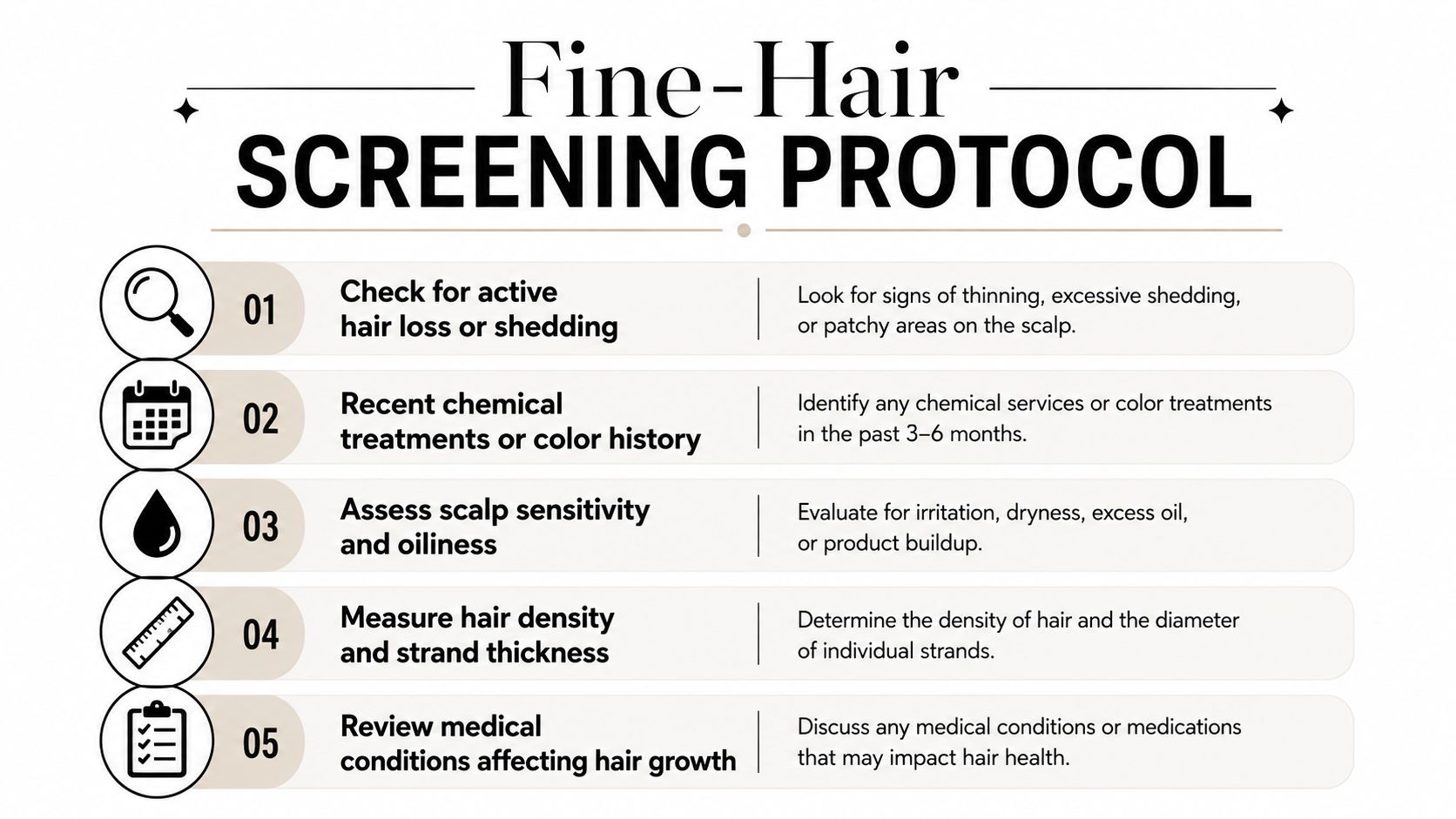
Answers need follow-up, not checkboxes alone. A client reporting normal shedding but showing temple breakage presents a different risk picture than the form suggests.
Part through the temples, front hairline, sides, crown, and occipital zone under consistent light. Look for erythema, scale, broken hairs, visible thinning at prior attachment sites, and uneven density that would force panels onto unsupported sections. Check elasticity and porosity on chemically treated lengths, and note where natural hair can realistically cover a panel from above without relying on a fragile surface layer.
The urgency isn't theoretical. A dermatology case series documenting patchy loss at attachment sites found patchy hair loss developing within 7 to 20 days, with traction causing the hair shaft to loosen from the follicle, and noted that persistent traction can progress from initially nonscarring loss to potentially permanent scarring alopecia.
Unexplained shedding, visible scalp lesions, or localized thinning shouldn't be managed with a lighter panel and optimism. Those findings call for postponement and dermatology referral. Protecting that boundary protects the client's remaining density and the stylist's credibility far better than completing a marginal install.
Tape systems should be compared as engineering variables, not ranked by maximum hold. The relevant properties are panel dimensions, backing flexibility, adhesive film behavior, and what happens during removal and re-bonding. A system that holds aggressively but requires forceful separation transfers its cost to the natural hair at the end of the cycle.
| Variable | What to evaluate | Fine-hair target |
|---|---|---|
| Panel width | Coverage per attachment and number of attachment points | Narrow enough to distribute load, wide enough to avoid gaps |
| Panel height | Vertical footprint and visibility through fine density | Low profile without forcing placement onto weak perimeter hair |
| Backing flexibility | Conformity to head shape and movement at the bond | Flexible backing that doesn't create rigid edge pressure |
| Adhesive film | Initial tack, creep under load, residue | Stable tack with clean release and minimal residue |
| Re-bond behavior | Consistency after cleaning and retaping | Predictable seal without escalating solvent or pulling |
Narrower panels allow load to spread across more attachment points and give the stylist finer control in low-density zones. The trade-off is practical. Too many small panels can leave coverage gaps, increase install complexity, and tempt placement too close to the hairline to chase fullness. Width selection has to follow the density map created during screening, and supplier guidance on replacement tape for hair extensions should be checked before assuming any tape is interchangeable across panels.
Backing material matters for the same reason. A flexible backing moves with the head and sits more discreetly through fine hair. A stiff edge can lift, show, or create a pressure point that the client feels every time hair is gathered up.
Highly plasticized adhesive films can stretch or creep under sustained load, shifting stress within the sandwich. Aggressive films create the opposite problem during removal, where resistance turns into tensile force on a small strand group. The fine-hair target sits between those failures, with controlled initial tack, stable wear, and painless release.
Chemistry also affects the operator. A 2024 dermatology review on acrylates in cosmetic glues notes that acrylates are used in cosmetic glues for hair extensions and identifies HEMA and ethyl cyanoacrylate among relevant compounds, while reporting a ninefold higher risk of HEMA contact allergy among hairdressers than the general population.
Documented ingredient information, patch-test policy, glove use, and clean-removal behavior therefore belong in purchasing criteria beside tack. Hold time alone doesn't describe a tape system that's fit for repeated professional use.
Tape-in earns its place on fine hair when density is stable and reasonably even through the mid-shaft and occipital zone. Distributed panels lie flat, installs stay efficient, and move-ups don't require rebuilding an entire foundation. For a client needing moderate length or fullness with predictable maintenance, that combination is difficult to beat.
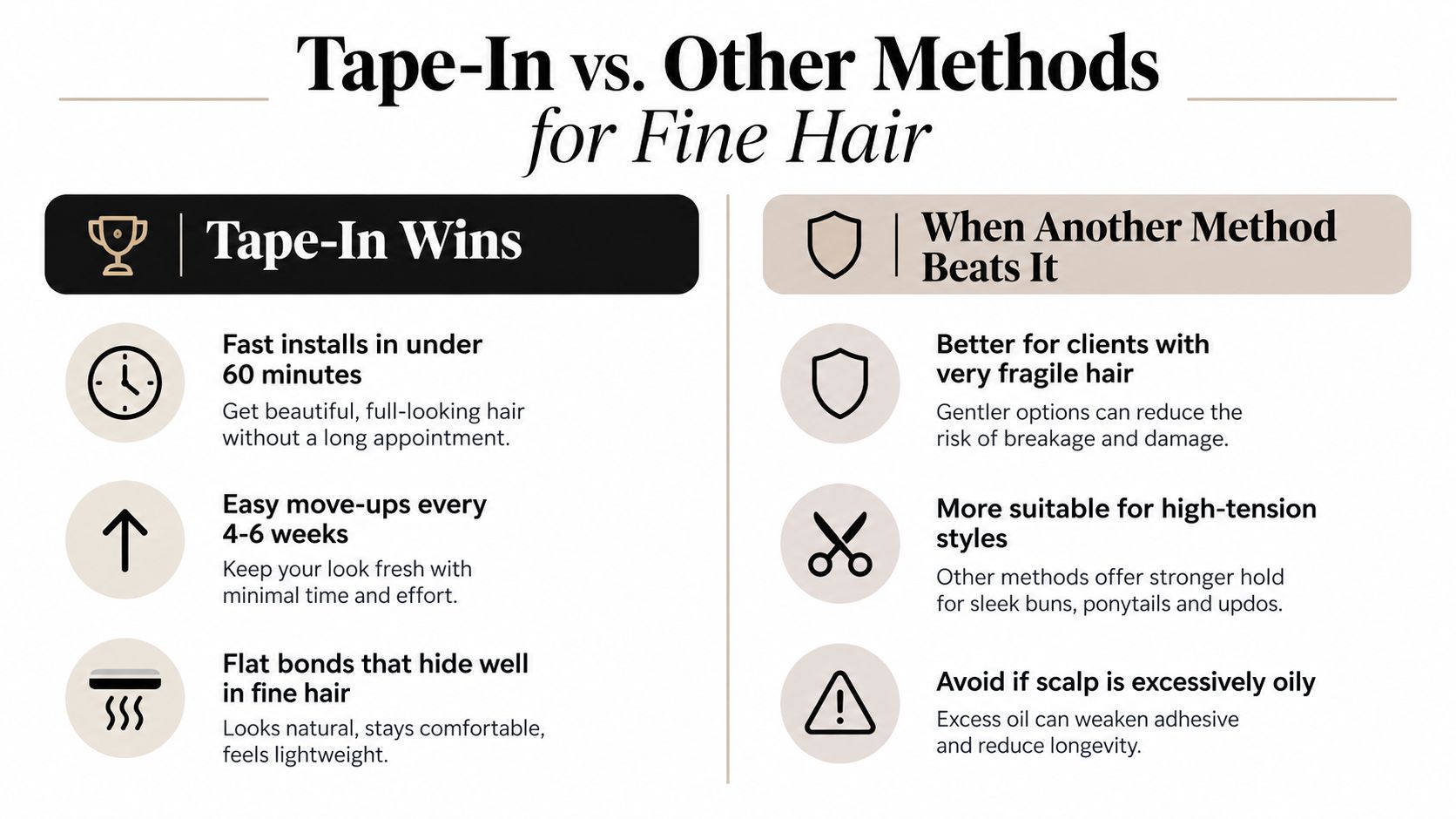
Tape-in works best where each sandwich can sit on a section with enough natural mass above and below it. Clients who wear hair down, accept regular move-ups, and don't need extreme length usually tolerate the system well. Panels can also fill a sparse side zone more evenly than isolated bonds, provided placement stays off the fragile temple and front perimeter.
Speed is a real salon advantage, but it shouldn't drive method selection by itself. A fast install that places adhesive panels where density can't support them creates slower, more expensive correction work later.
Hand-tied work and a beaded row can suit a client with stronger occipital density, weaker sides, and a preference for fewer, more consolidated attachment zones. Those methods still create tension points at the foundation, so they are not a default escape for fragile hair. They shift the load architecture, which helps only when the foundation area is stronger.
Individual bonds require equal caution. Guidance on K-tip hair extensions for fine hair is relevant because strand-by-strand placement offers precision for short transitions and targeted filling, yet each fusion bond or microlink concentrates load on a smaller strand group. That concentration makes widespread fine density a poor match for heavy individual work.
Practical rule: Choose tape-in when density supports distributed panels. Route the case elsewhere when coverage requires panels on hair that screening already flagged as fragile.
Clip-In pieces also deserve honest consideration for event-driven clients. Temporary wear removes sustained traction between occasions, although repeated clipping on the same fine sections still needs supervision. Method loyalty doesn't serve the client. Load placement does.
Installation converts the screening map into mechanical reality. Clean sectioning, conservative placement, and pressure sealing matter more than speed. A panel placed a few millimeters too close to a weak perimeter can undo careful product selection.
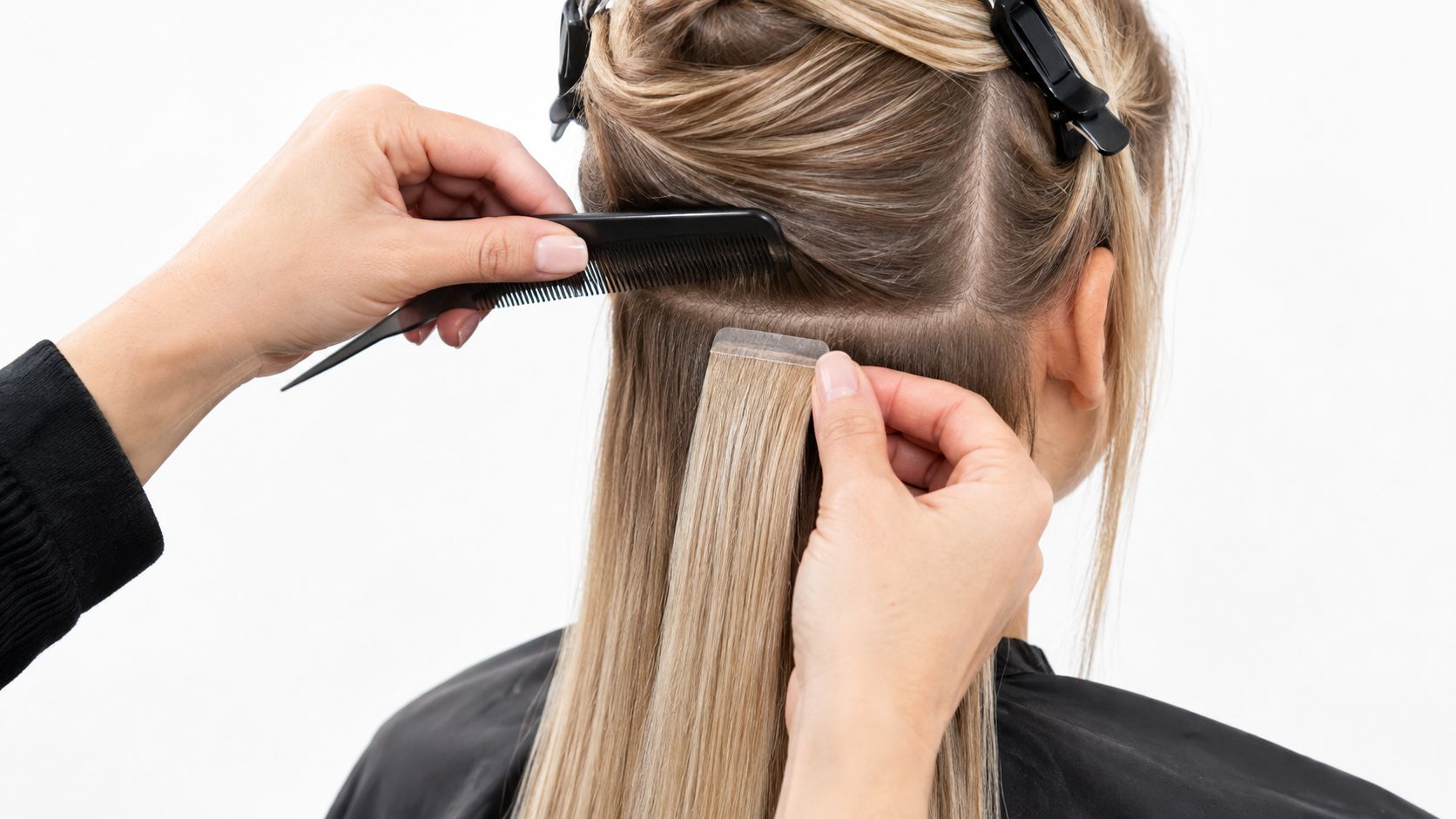
Work in thin, even horizontal subsections with clean partings and no cross-hairs trapped in the bond. Each section needs enough natural hair to carry the panel without looking strained once sealed. If the sandwich depends on a translucent veil of strands, the section is too light or the panel is too wide for that zone.
Keep attachments away from the front hairline and temples, where density is commonly finer and visibility is higher. Leave sufficient natural coverage above the top row so panels stay concealed in motion, not only in the chair. Explain the reasoning plainly if the client requests fullness right up to the perimeter. Perimeter chasing is where many fine-hair installs become visible and uncomfortable.
A neutral hair extension guide describing standard tape-in construction defines the method as two adhesive-backed wefts sandwiching a thin section of natural hair, with repositioning commonly occurring every four to eight weeks and adhesive removal identified as the primary damage point. Further background on whether tape extensions damage hair reinforces why install decisions should anticipate removal from the first panel.
After each zone, check comfort before continuing. Scalp tenderness, headache, stinging, visible root displacement, or a pulling sensation means the load or angle is wrong. Reposition immediately rather than expecting the client to adapt. Fine hair doesn't toughen up under sustained tension.
Finish with a cut that removes unnecessary weight from the ends and blends density transitions. Leaving maximum length untouched because the client paid for it adds pull without improving the result.
Removal is the highest-risk mechanical moment in the tape-in cycle. Adhesive resistance becomes direct pulling force when a stylist rushes, peels dry, or separates panels before the film has released. Fine strands tolerate that mistake poorly because fewer hairs share the force.
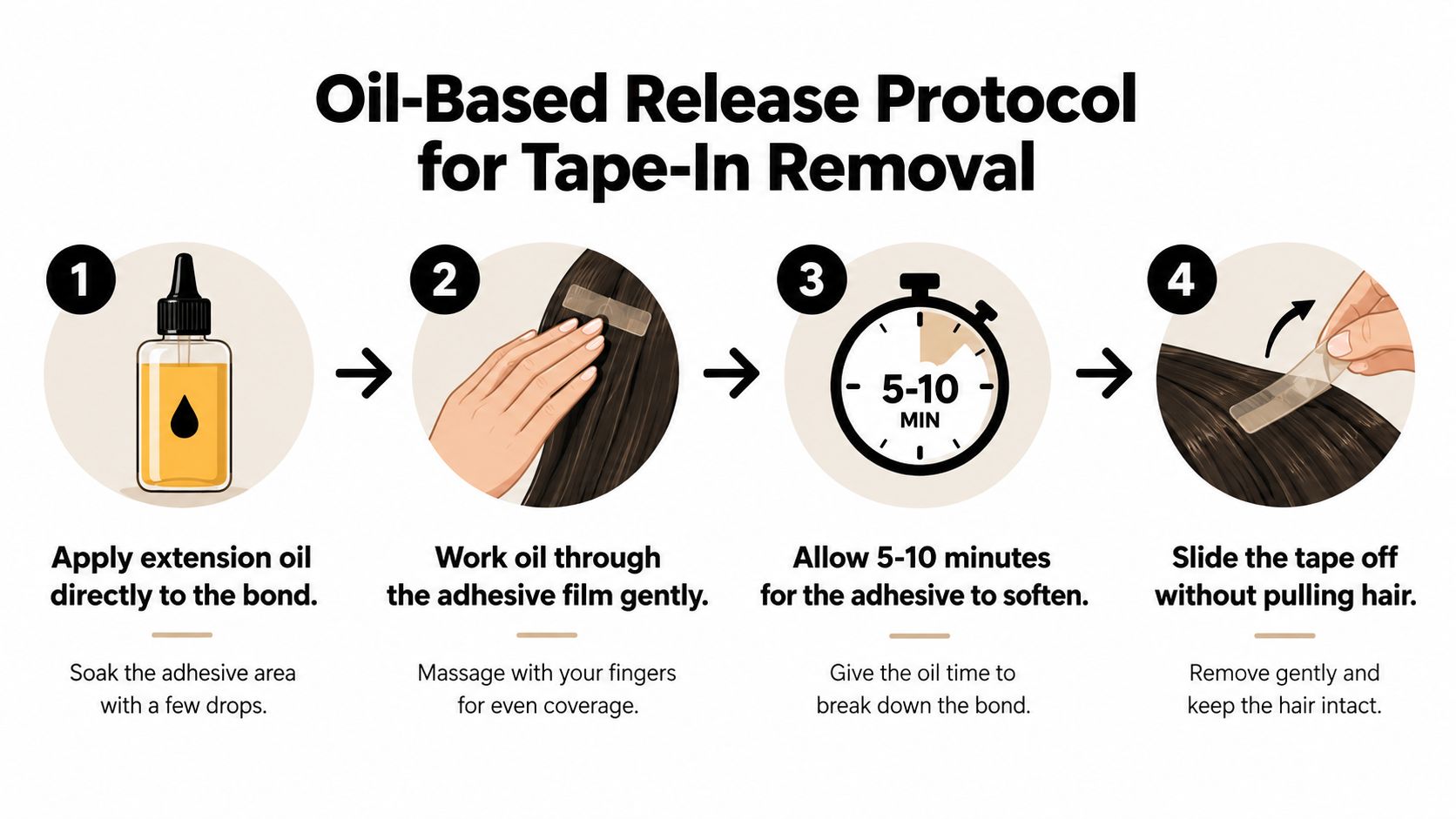
That sequence aligns with Allure professional guidance on extension removal timing, which describes an approximately eight-week removal schedule and recommends applying oil to the extension band, working it through the adhesive, and allowing tape to release gradually so it slides away from the hair cuticle rather than being peeled.
Before any reinstall, inspect every prior attachment zone under clean partings. Look for tenderness, redness, broken hairs, excessive shedding in the removed sandwich, and visible thinning where panels sat. One irritated zone may need relocation. A pattern across multiple zones calls for a break, a lighter plan, or referral rather than routine retaping.
Schedule discipline is part of that control. As new growth accumulates, panels hang farther from the scalp, twist more easily, and become harder to remove cleanly. Background on how long tape-in extensions last helps frame the appointment as risk management, not salon upselling.
Home care should stay specific. Clients need gentle detangling from ends upward, support at the bond while brushing, no conditioner or oils worked into the tape, and a loose braid for sleep. High, tight ponytails deserve a direct warning because they concentrate tension across the top row. A client unwilling to change that habit may not be a sound tape-in candidate.
Shade strategy affects perceived density on fine hair, so color selection belongs inside the technical plan. A flat, mismatched solid exposes the transition between natural hair and panel hair. The right tonal structure can soften that transition without adding extra panels to force fullness.
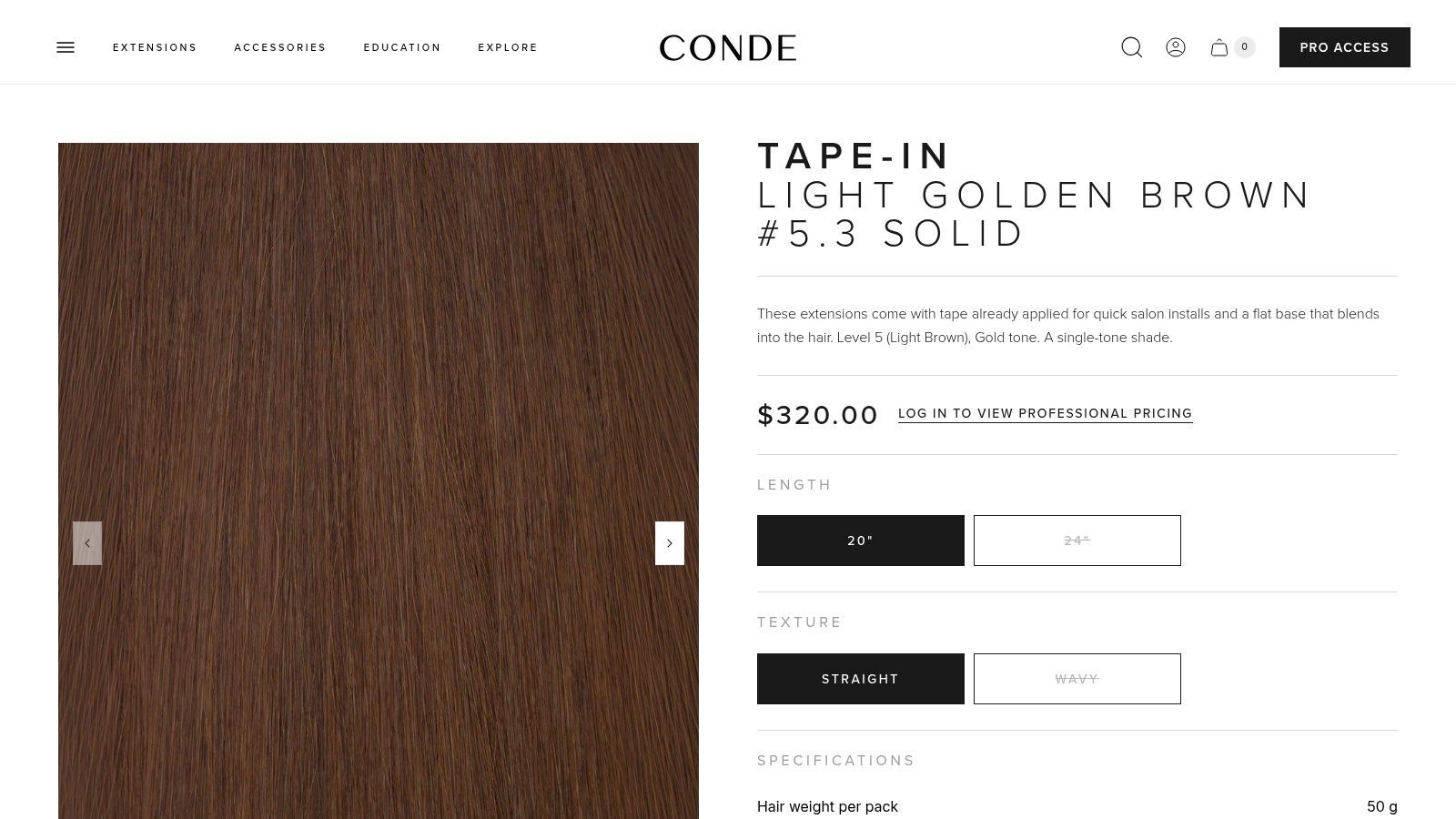
For a warm, single-tone client needing full volume, Tape-In Light Golden Brown #5.3 Solid is documented as a Level 5 warm-toned solid designed for adhesive-backed weft application in 20 inch, 24 inch, and 28 inch lengths, with wear time of 6 to 8 weeks per application. On fine hair, the shorter end of that range will often serve the tension plan better, even when the client initially asks for maximum length.
Solid shades suit clients whose natural color is uniform from root to end and who want shine and density without introducing dimension. Color rings should confirm the match under salon and daylight conditions before ordering, because warm Level 5 hair reads differently against fine, light-transmitting natural strands.
A balayage option such as Tape-In Brunette #6/7/10 Balayage solves a different problem. Multi-tonal blending can make density transitions less obvious on a darker root with lighter ends, reducing pressure to over-panel the sides for visual fullness. Dimension gives movement and depth, which fine hair often lacks even after length is added.
Accessories should follow the case, not habit. Extension tapes support planned re-bonding, color rings prevent shade guesswork, and silicone-lined beads only enter the appointment when a hybrid method has a clear mechanical purpose. Names like Volume Weft, Thin Weft, Tape Weft, K-Tip, Clip-In, and Bulk describe formats, not interchangeable substitutes. Cuticle-intact, Remy, and double-drawn descriptors also need measurable follow-up on alignment, shedding, combability, and wash durability during supplier conversations. Letter-number hair grades carry no governing standard and shouldn't replace those checks.
A lighter tape-in doesn't make an unsuitable case suitable. Some presentations require no adhesive panels at all until the underlying problem is understood. Naming that boundary in consultation is professional judgment, not lost revenue.
The evidence behind that caution is consistent. A review of 19 studies on scalp tension and traction alopecia found a strong association between prolonged or repeated scalp tension and traction alopecia, identifying extensions, weaves, braids, and dreadlocks among higher-risk styles, particularly on chemically straightened hair, and noting that adhesive placed directly on the scalp can cause damage during removal.
Medical questions belong with a dermatologist, especially where shedding is unexplained or scalp disease is visible. Stylists shouldn't diagnose the cause, promise regrowth, or use extensions to conceal an active condition so thoroughly that monitoring becomes difficult. Documentation of the consultation, photographs with consent, and a clear postponement note keep the record clean.
Where the scalp is healthy but tape geometry doesn't fit, redirection stays inside method selection. Volume Weft or Thin Weft work may suit stronger foundation zones, Tape Weft offers another weft architecture, and K-Tip placement can solve targeted areas where panels won't hide. Each alternative still needs the same tension assessment. Changing format doesn't erase load.
The concrete next step for a licensed professional is opening a wholesale account before the next fine-hair consultation, then ordering color rings and conservative lengths against an actual density map rather than buying from a photograph. That sequence puts screening first, product second, and adhesive last, which is exactly where each belongs.
Licensed professionals can source Tape-In, Tape Weft, Volume Weft, Thin Weft, K-Tip, Clip-In, and Bulk formats with shade support and re-bonding supplies through a professional account, keeping fine-hair installs matched to density rather than guesswork. Open that account and review the full catalog at Conde Professional before booking the next consultation.


