Your cart is empty
Tax included and shipping calculated at checkout

Drawer menu
Tax included and shipping calculated at checkout
A professional account gives you stylist pricing, priority support, early access to new releases, and education developed by working stylists.


Flat tip hair extensions are pre-bonded strands with a flat keratin paddle, the same application family as a K-tip, and that flat shape improves concealment but doesn't by itself reduce follicle load. The popular advice to reach for a flat bond because it's flatter, therefore gentler, gets the mechanics backward. A paddle can disappear under fine hair and still hang too much weight on too few natural strands. The install decision has to come from section density, tension, and early symptoms, not from how the bond photographs on day one.
A flat tip is a pre-bonded strand with a thin, wide keratin paddle at the top. A hot tool softens the keratin so the stylist can fuse it around a small natural section. The paddle lies parallel to the head, which can make it less visible than a round bond.
That profile helps in a fine side part or an updo, where a cylindrical bond may show as the hair shifts. It also lets a stylist add individual strands in a targeted panel instead of covering the back with a full row. The trade-off is that a low-profile bond still depends on a suitable natural section and careful placement.
A fine side part can conceal the paddle while a ponytail repeatedly pulls on the same attached section. The bond may look discreet, yet styling tension still travels through the hair carrying it. A flat tip is a poor choice if the client's usual styling puts persistent strain on those points.
At the chair, assess whether the desired zones have enough hair to support individual fused strands and whether the client can return for removal and rebonding before regrowth makes each bond pull away from its section. If the answer is no, a tape, weft row, or another system may suit the client better. A flat tip cannot compensate for unsuitable placement or delayed maintenance.
Choose a flat tip when the client wants individual strand work, a low profile, and will return for a full removal and rebond. Don't choose it because a bond looks discreet in a photo. Discretion is one variable. Chair time, move-up method, scalp tolerance, and how much continuous tension each attachment creates matter just as much, and they separate these systems faster than marketing language does.
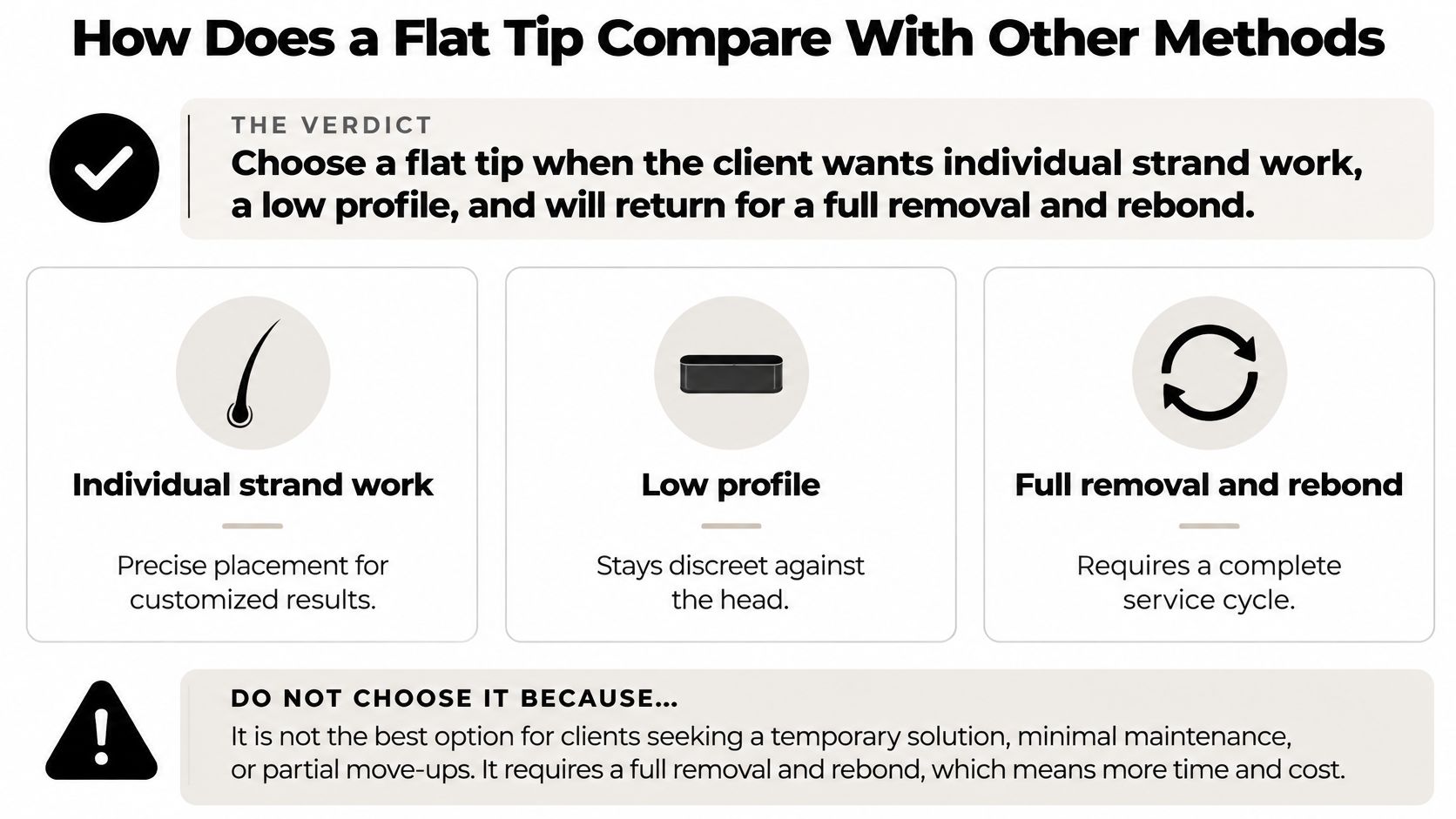
| Method | Attachment | Profile and move-up | Choose it when | Skip it when |
|---|---|---|---|---|
| Flat tip (K-tip keratin) | Hot fusion of a flat keratin paddle onto a small natural section | Low profile; full removal and rebond at move-up | Individual strand work and a client who will keep fusion aftercare | Fragile or low density, high-tension styling, or a client who won't return for removal |
| I-tip | Cold strand held with a bead or microlink; no keratin melt | Small point; beads can be shifted up | A no-heat install with adjustable placement | Hair too slippery to hold a bead, or a scalp that can't tolerate the bead |
| Tape-in | Adhesive sandwich on a weft panel | Flat but wider; retape at move-up | Fast density and a client who keeps a tape cycle | Oily scalp, heavy oil routines, or tapes that won't stay dry |
| Volume Weft or Thin Weft | Beaded row or tracked foundation | One row covers width; the row shifts up | A lot of density with fewer attachment points | Hairline work or a tiny custom piece where a row would show |
| Clip-in | Pressure clips on a weft; removed by the client | No bond left in the hair | Events, trials, and clients not ready for a semi-permanent install | Anyone expecting daily wear to behave like fusion |
| Bulk | Loose hair the stylist tips, braids, or vents | Profile depends on the finish the stylist builds | Custom keratin, microlink refills, or a one-off color | A stylist who doesn't want to build bonds in-house |
Flat tip and I-tip both place hair strand by strand, but they diverge at maintenance. A fused paddle has to come out and be rebonded, while a bead can be opened and shifted, provided the hair holds it and the scalp tolerates metal contact. Slippery, freshly softened hair that sheds beads in the first week isn't a flat tip argument by default. It's a sign the whole strand-by-strand plan needs a second look.
Tape installs faster and retapes cleanly, but the adhesive sandwich is wider than a paddle and loses grip on an oily scalp or under heavy oil routines. Volume Weft and Thin Weft cover width from a beaded row, putting substantial density on fewer foundation points. That's often the better density play when dozens of individual bonds would pepper a fine panel and leave the stylist chasing visibility at every point.
Category pricing puts chair time in perspective. The Dataintelo global hair extension market report estimated fusion and pre-bonded services at $400 to $800 per application, while tape-in services were estimated at $150 to $300 per session. It also placed professional salons at 56.2% of revenue, or approximately $2.248 billion in 2025, which frames flat tips as salon work bought on expertise and repeat visits, not as a retail add-on.
Clip-ins earn their place as a trial. A client unsure about length, weight on the head, or daily styling commitment can test the look without sleeping in bonds, and the stylist learns plenty from that trial before fusing anything. Bulk serves the opposite end, the stylist who wants to tip custom strands, refill microlinks, or build a fantasy piece no pre-tipped strand matches. Neither is a substitute for fusion, and neither should be sold as one.
For a fine side-part brunette with sound density who parts left on Monday and right on Friday, the paddle wins on concealment. For a client who needs maximum density fast and has the panel width to hide a row, Thin Weft or tape gets there with less chair time and a simpler move-up. A fuller breakdown in the guide to types of hair extension methods helps match each system to the client in the chair rather than to habit.
A flat keratin paddle can hide more easily than a round bond, but concealment does not reduce the load on the natural hair. Start by checking the strand's construction and hair quality; assess whether the client's hair can support the install separately.
A flat tip arrives as a finished strand with a pre-formed keratin paddle. Bulk hair is loose and still needs to be tipped before installation. The paddle forms the attachment, while the hair below it must blend, comb cleanly, and hold color.
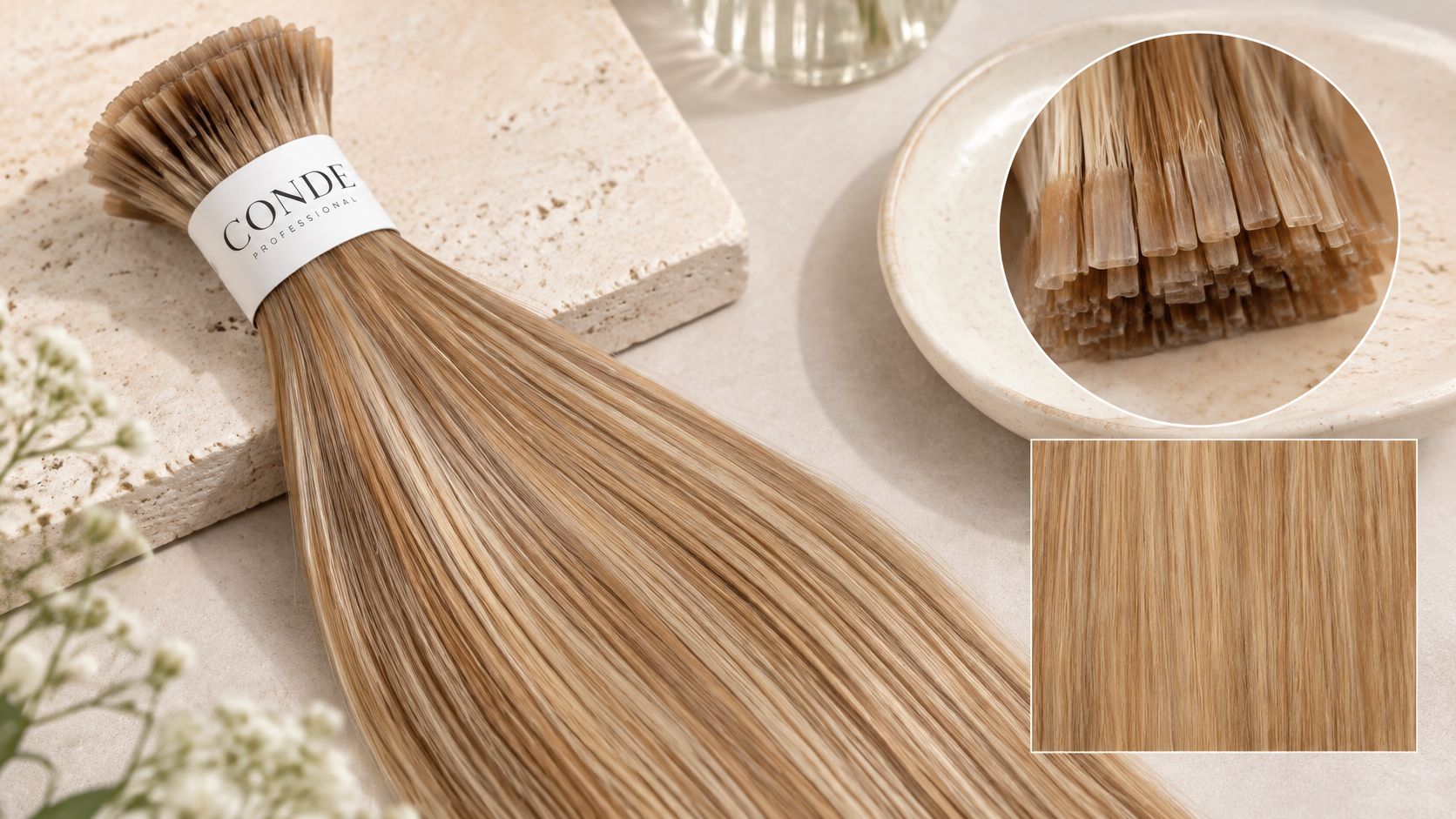
Treat 6A through 10A as marketing labels, not quality standards. Measurable criteria are more useful: cuticle integrity, alignment, shedding, combability, and wash durability. Ask the supplier to explain each criterion so you can assess the sample rather than relying on a grade number.
The background on Remy human hair extensions explains how cuticle direction and alignment differ from marketing shorthand. Remy describes alignment, but it does not guarantee that a batch will comb cleanly after washing or retain fullness through the ends. Handle a sample strand before choosing it.
Shade matching uses defined families: Solid, Balayage, Bronde, Highlights, Superblend, Rooted, and Fantasy. A dimensional client matched to a flat solid can show a visible seam; a solid base matched to a superblend can read as striping. Check the ring against the client in the light where the color needs to work.
Keep clinical questions outside the extension consultation. If a client asks about thinning or treatment options, direct them to a medical provider; understanding PRP hair treatment costs can provide context for that conversation. A suitable strand does not make every install appropriate, and early discomfort or changes in the hairline call for reassessment.
| Screen finding | Decision | Next step |
|---|---|---|
| Active patches, redness, or traction loss at attachment sites | Refuse | Recommend medical guidance before adding weight |
| Fragile, chemically compromised, or recently shedding hair | Postpone | Re-screen once the hair is stable |
| Thinning at prior attachment sites | Refuse flat tip | Consider a method with less continuous tension, such as tape-in, thin weft, or clip-in |
| Stable but borderline density | Proceed conservatively | Use the lightest suitable density, keep length conservative past the shoulders, and rule out high-tension styling |
| Stable, sound density, no traction history | Proceed | Schedule a check-in within the first month |
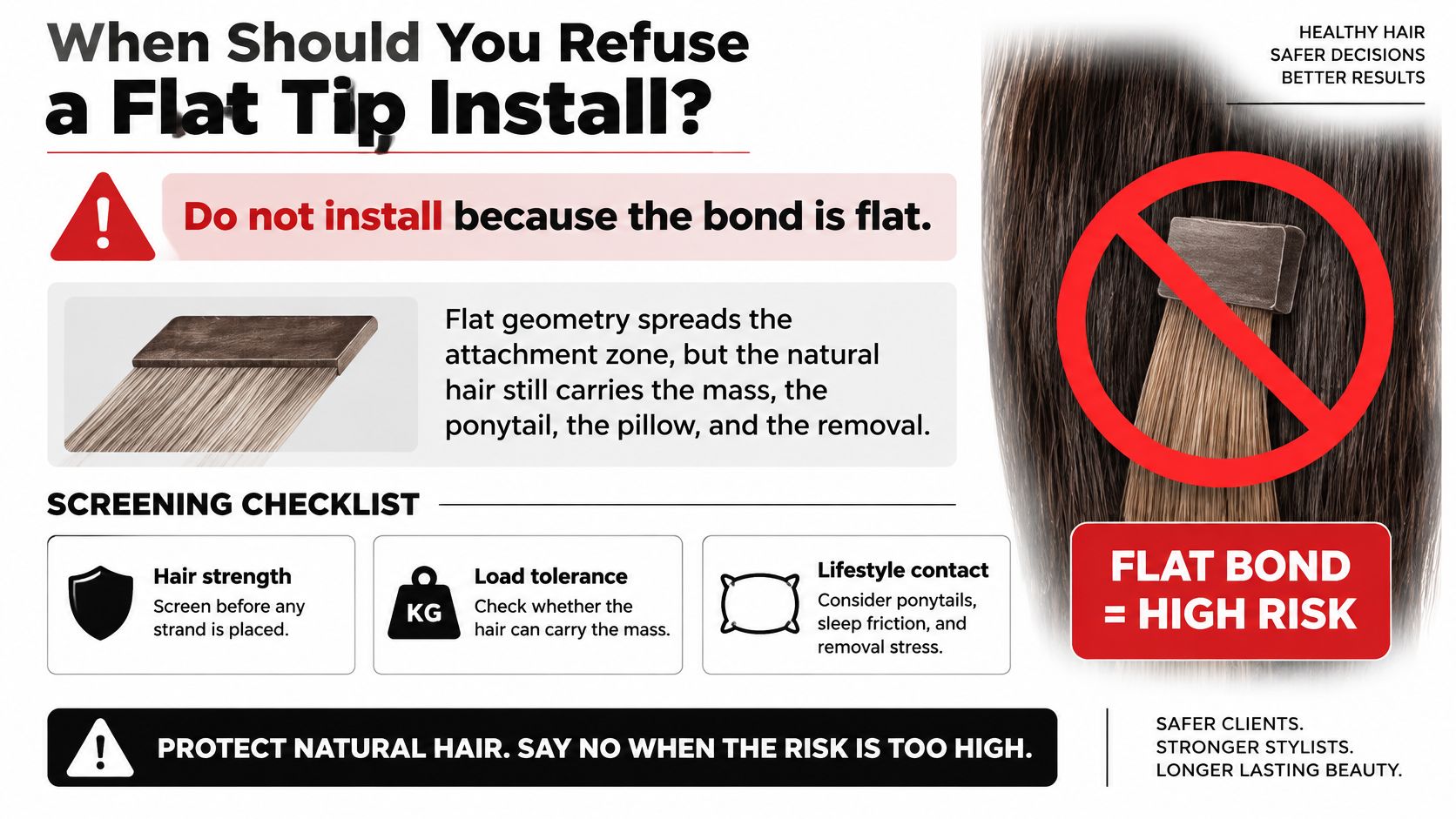
The JAMA Dermatology review of traction alopecia identifies extensions, weaves, tight ponytails, and braids as higher-risk practices, with risk rising as pulling force and duration increase. Chemical relaxing can add to that vulnerability. Early traction-related hair loss may reverse when tension stops; chronic traction can lead to permanent scarring and follicle loss. That makes the condition of the attachment zones, not the bond's shape, the deciding factor.
Postpone or refuse service if the hair is fragile, chemically compromised, recently shedding, or thinning at previous attachment sites. Active traction loss is a reason to avoid adding weight or concealing patches with strands anchored nearby. Recommend medical guidance before proceeding.
Stable but borderline density calls for a conservative plan. Choose the lightest density that looks finished, keep length and total weight conservative past the shoulders, and agree on avoiding high-tension styling. If the client plans to keep wearing a slicked high ponytail, the install is a poor fit even when the hair looks stable in the salon.
Screening rule: Soreness, headache, stinging, scalp bumps, or new shedding after installation warrants a return visit. These symptoms are not a break-in period.
Schedule a check-in within the first month so you can assess discomfort, shedding, and the attachment areas before the next move-up. If symptoms appear, reassess promptly and discuss adjustment or removal rather than waiting for the regular maintenance appointment.
Refusing a flat tip does not mean refusing every extension option. Tape-in, thin weft, or clip-in methods may place less continuous tension on zones that failed the screen. Explain the reason for declining the flat tip and discuss whether another method suits the client's hair and styling habits.
A flat tip can sit discreetly against the head, but its shape does not make an overloaded section safe. Begin only after the screening clears the head, then match each extension to the density of the section carrying it. Placement depends on clean separation, controlled heat, and a bond that moves without pulling.
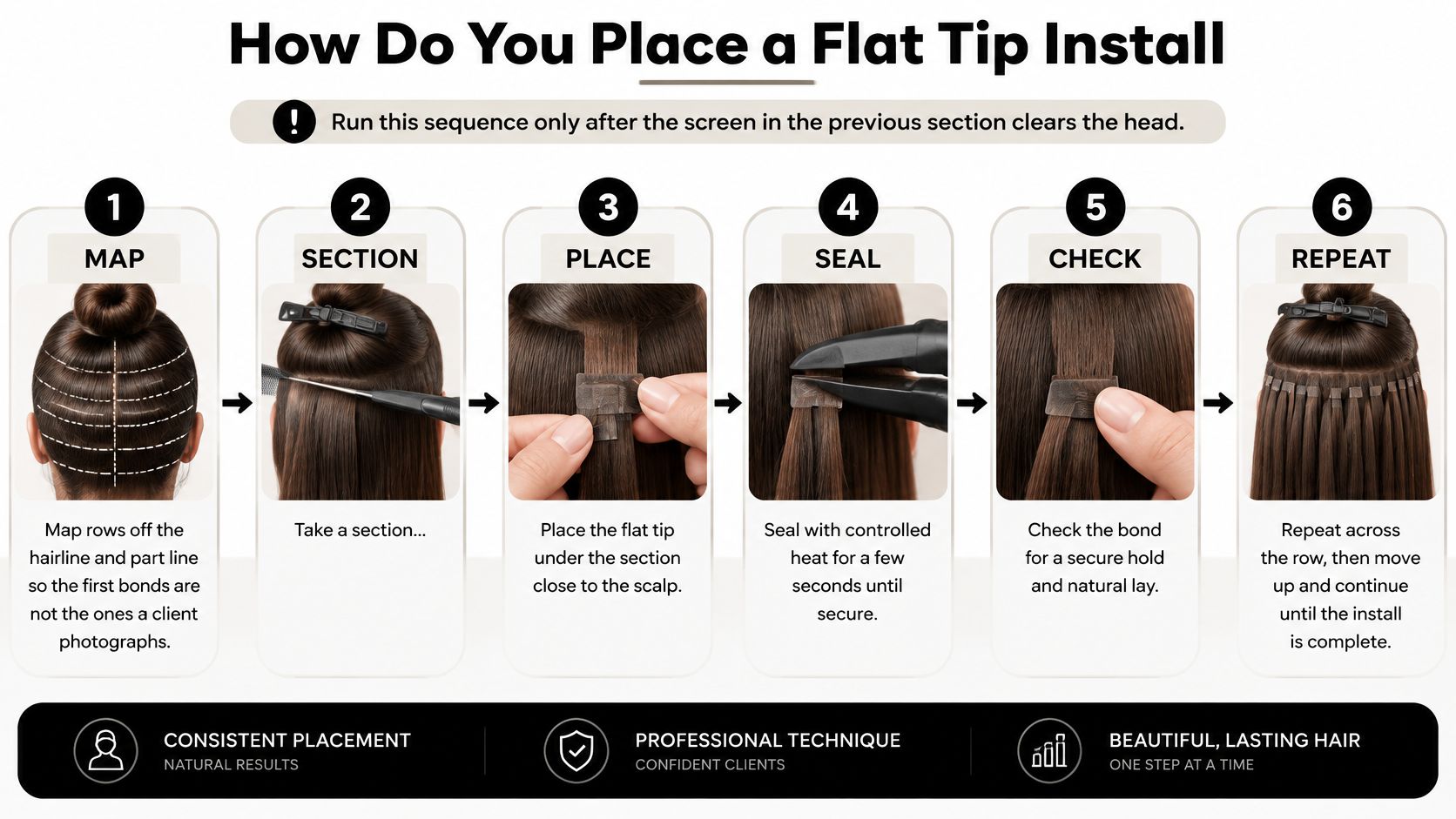
A section that looks substantial in your fingers can still be too small for the attached strand. The Meyers Group paper on the mechanical properties of human hair reports hair diameters of about 50 to 100 micrometers and tensile strength of approximately 150 to 270 MPa, with strength varying substantially by strain rate and humidity. Use the section's density and the extension's weight to judge the match, not the bond's appearance alone.
For placement fundamentals, use this guide to extension placement. It pairs placement decisions with weight, section size, and the client's styling habits.
Conde K-Tips are flat keratin-tipped 100% human hair in a straight texture. Confirm available lengths on the collection page, and set wear expectations during the consult rather than promising a duration at booking. For dimensional blonde work, K-Tip Amber Glow #7/10 Superblend blends Level 7 to Level 10 and is listed at $330. Apply it by hot fusion as a salon professional, and choose it when the client's natural color already carries that range.
Keep a working fusion iron and spare keratin tips in the kit. If a bond fails, rebuild it with proper keratin rather than patching it with an unrelated adhesive. Some points may need a reset; the swing check catches the issue during placement, while spare tips let you address a failed bond later.
Color-match before installation. Do the lifting, root melt, or other color work that requires chemicals before attaching the hair, since lightener and sustained heat can soften keratin. After installation, keep toner on the mid-lengths and ends and off the bond.
Match in the client's real lighting, then use a glaze for a small correction rather than reaching for another full lift. The hair extension color-matching guide explains how to use the color ring to choose the right shade family. Superblend and Rooted shades suit dimensional canvases; a solid such as K-Tip Jet Black #1 Solid suits a true Level 1 canvas and is listed at $280. Keratin resists dye, so color the hair length and keep the paddle out of the formula.
| What you see | Usual cause | What to do |
|---|---|---|
| Bond flips up | Section too small or oily, or paddle seated on the scalp | Remove the bond and reset it lower with a clean perimeter |
| Color won't move on the bond | Keratin resists dye | Color the length and keep lightener off the paddle |
| Bonds slip after a color service | Heat or chemicals softened the keratin | Rebond or remove the point; don't stack product over a soft tip |
| Matting at the nape | Late move-up or high-tension styling | Assess the matting and plan removal or a move-up |
| Line shows in fine hair | Too much hair per point for that density | Reduce strands per section or choose Thin Weft or tape |
Keep spare keratin tips and a working fusion iron for repairs. A flipped bond comes out and gets reset; a softened tip needs rebonding or removal, not another layer of product. Find the cause before adding hair. If a line shows in fine hair, extra strands can increase the load instead of hiding the attachment.
A flat paddle can hide beneath the hair without reducing the load on the follicles. Set home-care rules and a return appointment before the client leaves, then use early symptoms to decide whether the install can stay in place.
Detangle dry hair from the ends upward. Avoid brushing across wet bonds, keep oils off the keratin, and wear ponytails or buns below the bond line to limit tension at the attachments.
The chart should capture the install date, density by zone, shade, and section size. At the return visit, compare those notes with the current hair. If a previously dense zone now has fewer strands or less coverage, reassess the load there before repeating the same placement.
A flat tip can be the right choice only after the density screen clears. Order through a Conde Professional account, then confirm the strand before booking the install. Conde sells wholesale to licensed professionals, so the account gives you a channel to check product and shade selection with support.
Text, call, or email support with those details before confirming the appointment. Keep the shade choice consistent with the color-matching decision already made during consultation. The goal here is to confirm the actual strand, not to create dimension through an unsuitable blend.
If the density screen ruled out flat tips, order the method selected for that client instead. Use the consult notes to guide the order, rather than changing methods to fit the product already in your cart.
Confirm account terms, shipping timing, and return conditions with the account team before making promises to the client. The next message can be simple: send the client photo, selected method, and length, then wait for strand and shade confirmation before booking the install.
Open a professional account with Conde Professional to order K-Tip flat keratin strands. Send a daylight client photo and the color ring code under consideration, and support can help confirm the strand, length, and shade family before the install goes on the book.


