Your cart is empty
Tax included and shipping calculated at checkout

Drawer menu
Tax included and shipping calculated at checkout
A professional account gives you stylist pricing, priority support, early access to new releases, and education developed by working stylists.


The usual advice to brush curly extensions twice daily misses the first decision: whether the natural hair can carry the install without persistent pull. Curly K-tip extensions should be planned as a tension-and-texture service, not judged by how securely the fusion bonds hold.
Curly K-tip extensions are pre-bonded human-hair strands with flat keratin tips, fused strand by strand to subsections of natural hair. The curl is a blending problem as much as an attachment problem: a discreet bond won't correct incompatible shrinkage, curl width, or density.
Each attachment should disappear into its subsection without stopping neighboring curls from separating. The finished result needs independent movement, not a stiff attachment surrounded by hair that has been styled to conceal it.
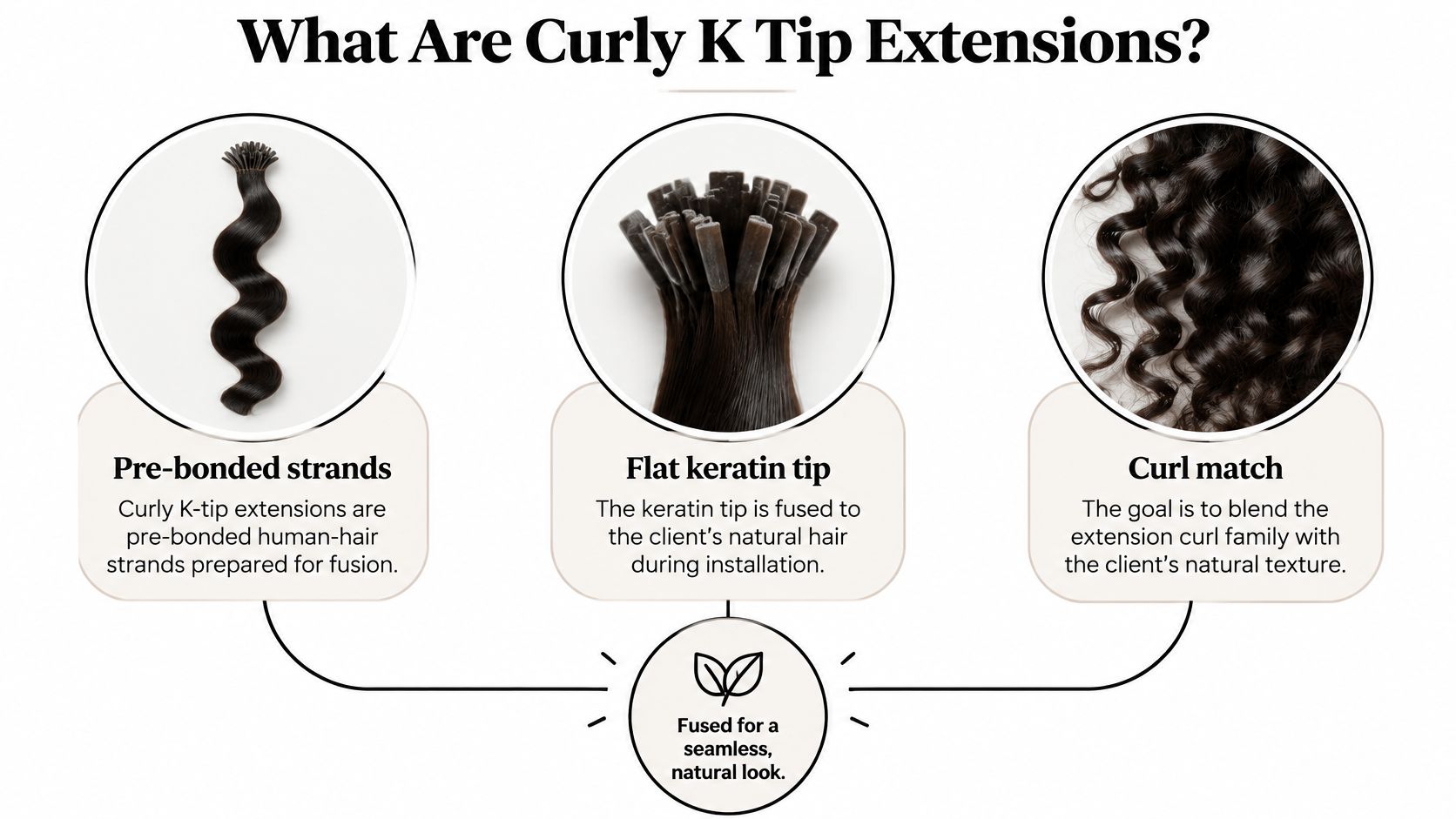
The Conde K-Tip technical guide describes a useful finish standard: the bond should be small enough to conceal, smooth enough for adjacent hair to glide over, compressed enough to retain its shape, and flexible enough to rotate with its subsection. Excess keratin or uneven heat can leave a bulbous attachment instead.
A chair hinge provides a useful analogy. Each tip acts like a small hinge, allowing its subsection to turn. A curly head needs appropriately distributed, freely moving attachments, not a few heavy junctions that force neighboring curls around them.
Finish standard: A bond that disappears visually but catches neighboring hair still needs correction.
Hair selection deserves the same scrutiny as bond construction. Cuticle-intact, aligned hair and double-drawn fullness are separate purchasing criteria, not interchangeable quality promises.
A Remy description should start a supplier conversation, not end it. The stylist still needs to assess how the hair separates, feels, and behaves under the intended routine.
The purchase is controlled placement, a low-profile fusion point, and a texture that can live alongside the client's shrinkage. None of those qualities can be confirmed from a polished installation photograph alone.
Decline K-tips when the requested result puts more load on the natural hair than it can carry. Make the decision from a same-day assessment of density, scalp comfort, chemical history, and the client's target, not from how securely a test bond holds.
A client with consistent density, a comfortable scalp, and a routine suited to the proposed texture may be a candidate. Fine perimeter hair, recent bleach or relaxer history, tenderness, or sparse coverage paired with a request for maximum length points toward reducing the service or declining fusion.
Those consultations call for different decisions before hair is ordered.
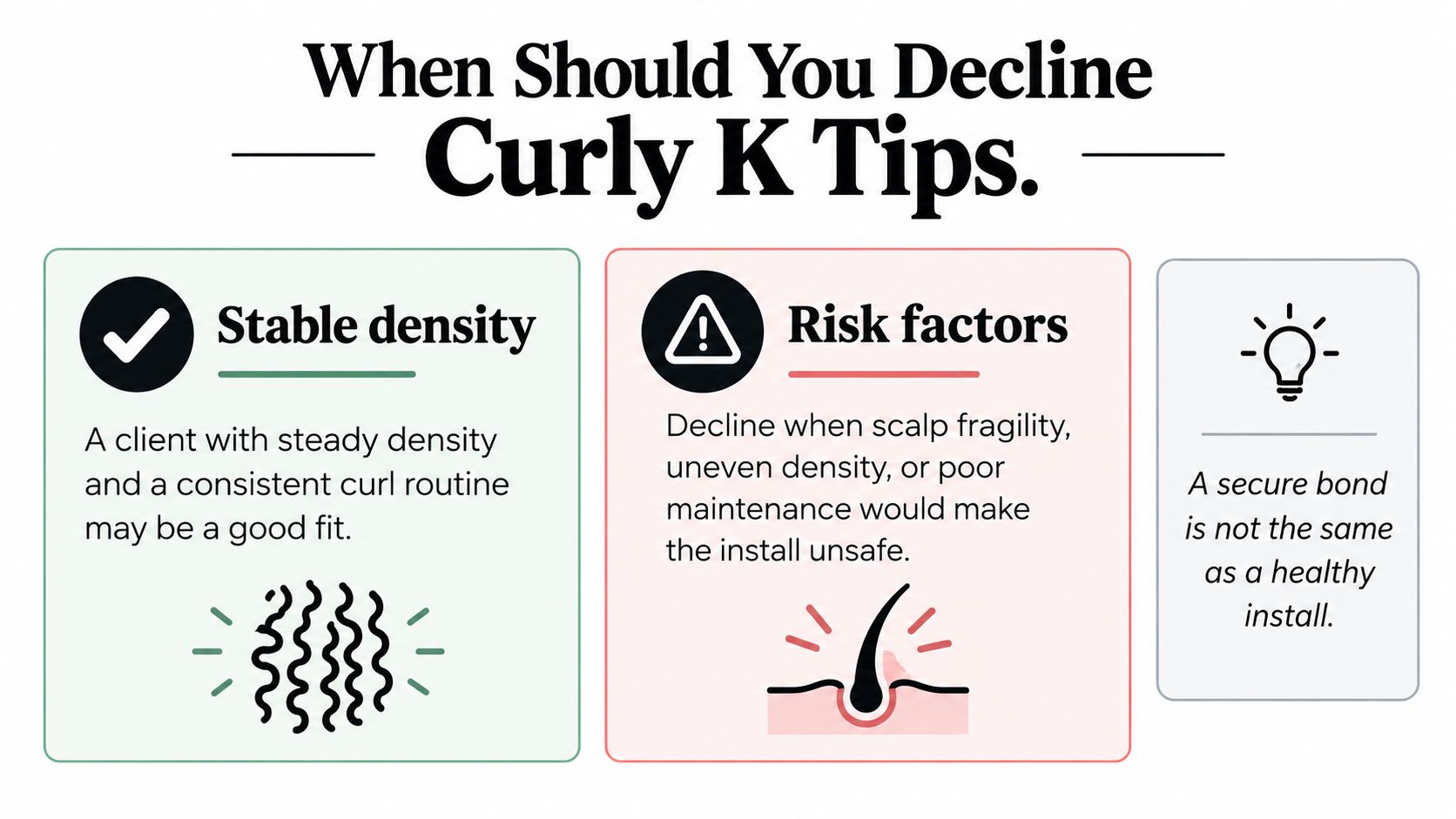
Curl pattern does not determine carrying capacity. Assess strand diameter, local density, chemical history, and how the proposed weight will be distributed.
For a suitable client with limited support in certain areas, reduce the result: use fewer attachments, add less length, and schedule an earlier reassessment. Smaller subsections are appropriate only if each extension portion is lighter. Putting the same load on less natural hair is not a conservative adjustment.
Research on traction-related hair loss identifies extensions on chemically treated hair as a higher-risk combination, and it separates scalp-applied adhesive from other attachment practices. Use the fine-hair K-tip consultation guide to support method screening, then base the decision on the hair and scalp in the chair.
Pain, headache, itching, persistent tenderness, broken edges, or visible thinning calls for reassessment. Don't reassure the client that they will get used to the install, diagnose the cause, or promise recovery.
Stop the pulling practice first, then arrange a dermatology referral if scalp symptoms are already present. Don't replace a painful installation with another salon experiment.
A service that photographs well can still be the wrong service.
A secure bond is not a finish win if the curl match adds tension. Match the client's curl family, shrinkage, and density first, then choose a stretched length that blends when the hair is worn in its usual state.
Compare a physical sample beside the client's hair. A stretched consultation photo can hide differences that show after washing, including curl width, end density, surface shine, and how far each fiber recoils. If the sample behaves differently, change the match before ordering.
Solid, Balayage, Bronde, Highlights, Superblend, Rooted, and Fantasy describe color arrangements, not curl compatibility. A single-tone Solid may suit a consistent base. A multi-tone Superblend can distribute dimension through highlighted hair, while Rooted placement may address color at the attachment area without resolving a mismatch through the mids and ends.
| Matching reference | Catalog information | Professional limitation |
|---|---|---|
| K-Tip Jet Black #1 Solid | Level 1 single-tone black, straight texture, priced at 280 | A shade reference, not confirmation of a curly option |
| Amber Glow #7/10 Superblend | Level 7 to level 10 multi-tone reference | Dimensional color does not establish curl behavior. Confirm current price and available lengths on the product page before ordering. |
Both shade names refer to straight-texture examples. Neither implies curl compatibility. Set the expected wear period during the consultation according to the client's growth rate and maintenance schedule, not a catalog figure.
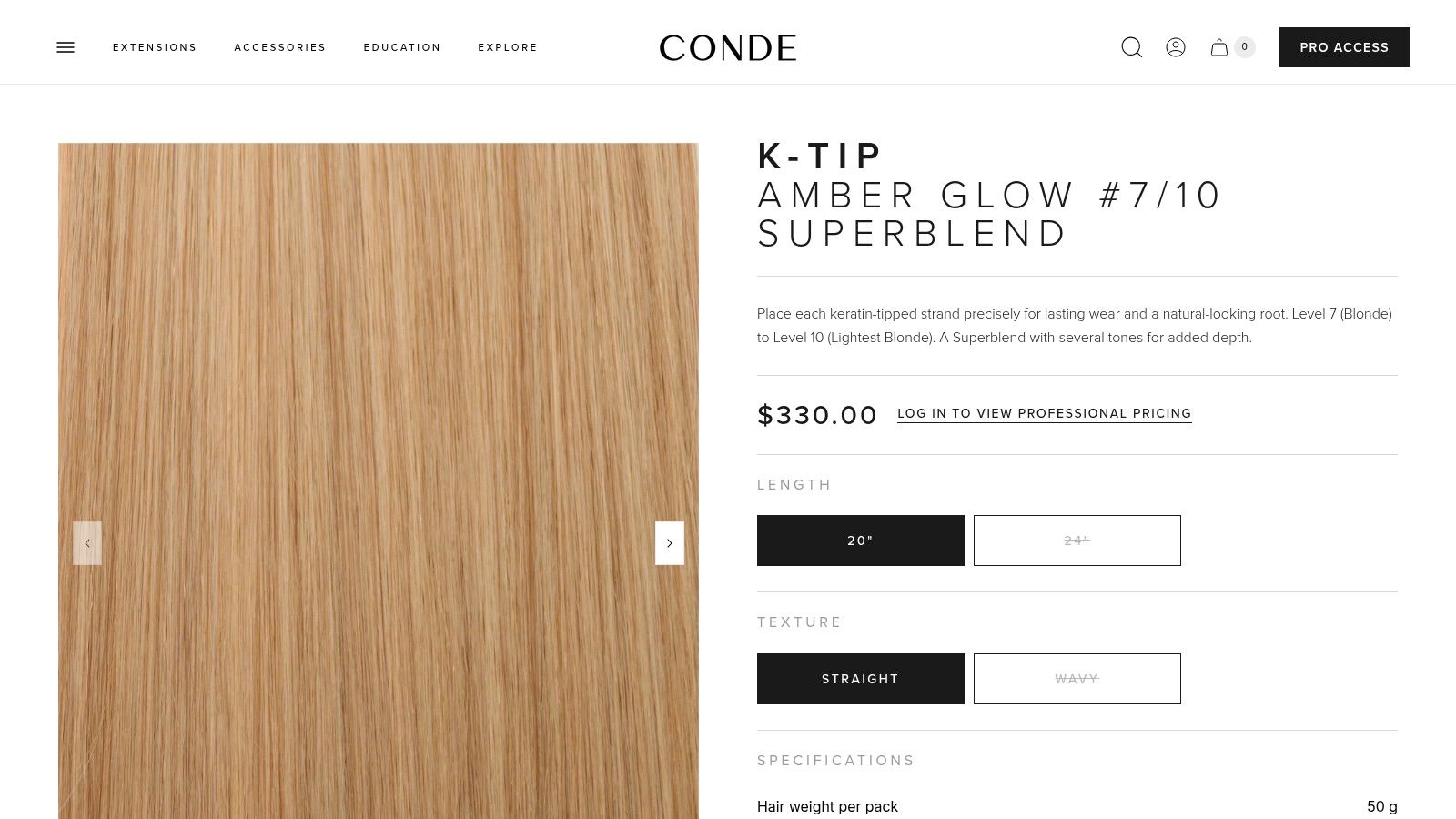
Use the professional color-matching guide to prepare for the matching appointment, then compare the actual batch with the client's hair and the current color ring. Ask for curl or wave options directly; don't infer texture from a product photo.
Before committing, ask about cuticle integrity, alignment, shedding, combability, and wash durability. Confirm the supplied hair matches the ring before booking the appointment. If texture, density, or shade remains uncertain, pause the order and resolve the mismatch first.
For consultation graphics or salon posts, hair color previews for social content can show a proposed color direction. Use them to discuss shade, not to approve a match. A digital preview cannot confirm the physical shade, curl behavior, or suitability of the attachment for the client.
A secure bond is not a finish win if the placement restricts curl movement. Build the install around low tension, then assess whether the bond can hold without pulling on the natural hair. If the proposed pairing feels tight during the strand test, decline K-tips for that area and choose a more suitable Conde method.
The sequence is consultation and strand test, then preparation, placement, fusion, and a movement check. Before the first bond, check the fusion tool's temperature setting against the manufacturer's sheet for this specific keratin tip, then record the setting in the service notes.
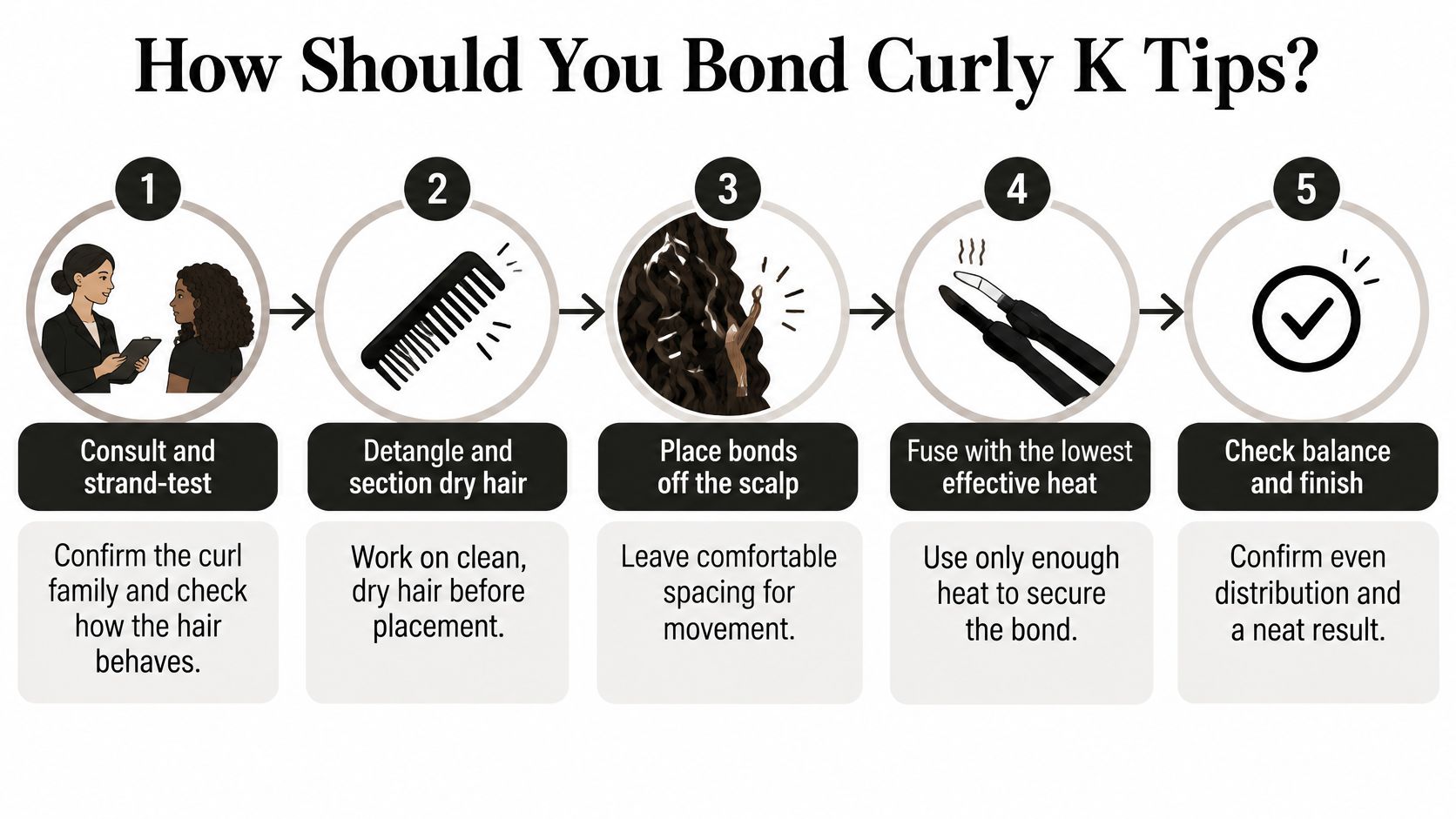
Start with clean, dry, detangled hair. Map subsections to the client's density instead of repeating identical sections across the head. The hot fusion tool softens the flat keratin tip so it can be formed around the selected subsection. Place it off the scalp, with enough room to turn without pinching or pulling in one fixed direction.
Use a heat barrier between the tool and natural hair. Never keep the tool against the bond longer than the product instructions allow.
Published hair-fiber research reports keratin degradation at high temperatures, so treat any heat figure as a warning, not a setting. The research describes degradation at approximately 220°C and possible denaturation around 130–150°C, depending on material and heating rate. Curling-iron testing at 130–164°C found that combing force increased with longer exposure.
These figures are not fusion-tool recommendations. Use the lowest effective heat allowed by the instructions for the specific system, and avoid lingering contact or repeated passes to flatten the curl for easier sectioning. The keratin glue-stick application guide can inform adhesive-technique education, but the specific pre-bonded system's instructions govern its application.
Chairside check: Ask the client to move the hair through its intended styling directions. The attachments should allow movement without tightness.
Before release, check that each bond glides and rotates, inspect the distribution, and record the client's home heat habits. Set the removal plan during the original service: soften and separate each bond with the appropriate professional system, never pull it through attached natural hair.
A secure bond does not make rough detangling safe. Manage tension at the curl, because brushing through an interlocked section can pull directly on the attachment. Treat the natural hair and extension hair as separate fibers, then teach a routine that protects both.
Natural curls may recoil differently after washing, while the extension hair may need another styling sequence to blend. Set that sequence before installation. An incompatible texture blend will not be fixed at the shampoo bowl.
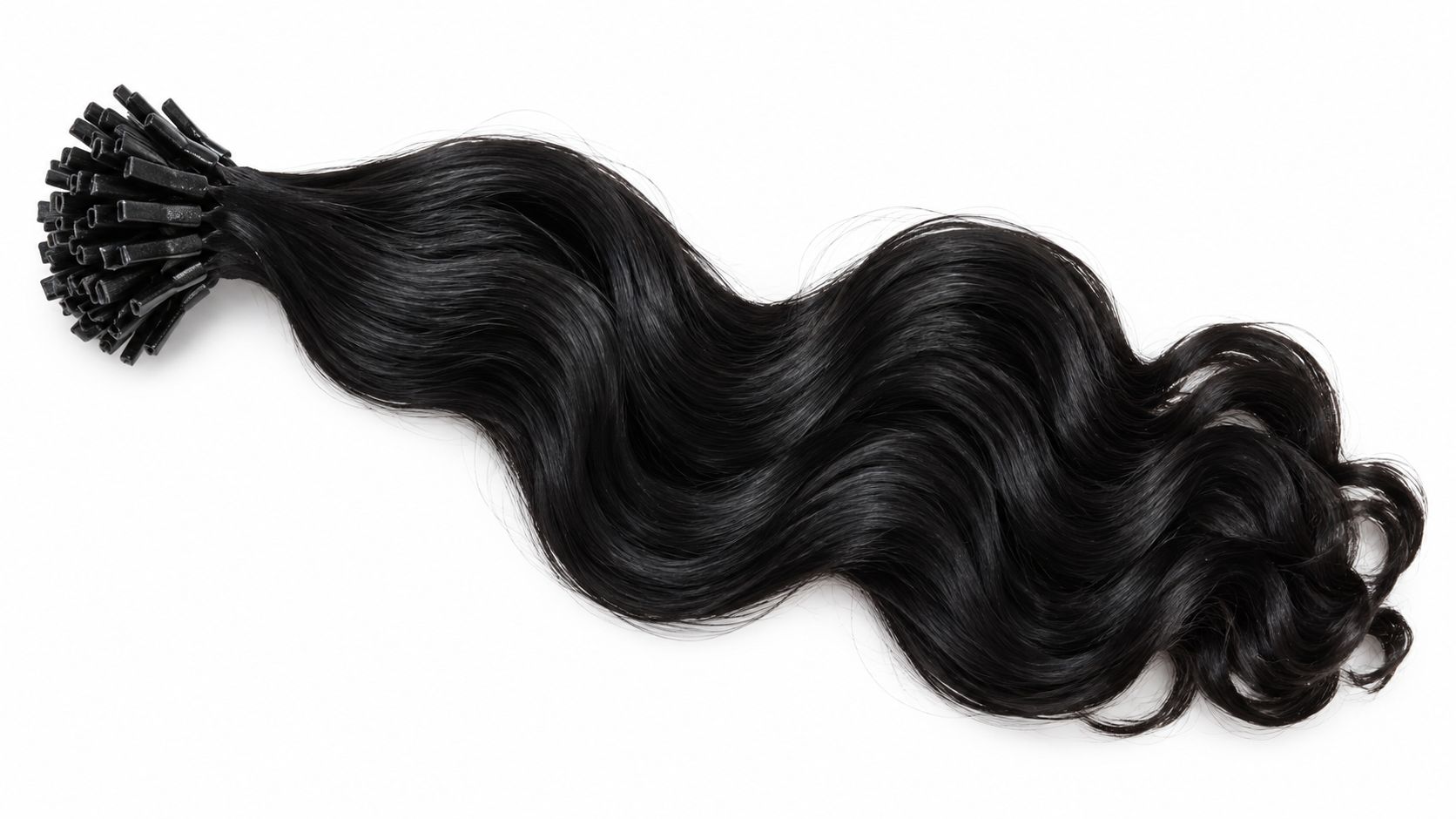
Detangle curly extensions with fingers before any brush touches them, because brushing a dry, interlocked curl pulls on the bond. Ask the client to show their current detangling routine, then mark where the brush touches the bond.
“Brush gently” is too vague for home care. Name the hair's state and demonstrate the method:
Use the extension detangling-spray guide to inform product selection, then confirm compatibility with the installed adhesive system.
For moisture-focused curl education, the ArtNaturals guide to dry curly hair offers useful context. Do not treat general curl-care advice as approval to apply every product near keratin bonds.
The home-care card should map product zones: scalp cleansing, attachment care, and conditioning through the lengths. Specify how to dry the roots and bonds, then show how to contain the hair loosely at night without adding tension.
Detangling frequency should follow how the hair interlocks and styles. A client who wears protective updos needs a different maintenance demonstration from one who wears loose curls in humidity.
At follow-up, assess bond separation and hair condition. K-tips do not follow the routine move-up process used for beaded rows; removal and any reinstall require their own professional evaluation.
Choose K-tips for controlled individual placement, not because fusion is assumed to be the premium answer. A row-based service, removable style, or another attachment may better fit the client's density and routine.
The comparison of extension methods is a useful starting point for method selection. The following chairside framework is a recommendation, not a guarantee that a particular method suits fragile hair.
| Method | Best client job | Curl blend | Skip it when |
|---|---|---|---|
| K-Tip | Targeted placement with independent subsections | Distribute compatible texture through selected zones | Supporting hair or maintenance habits are unsuitable |
| Volume Weft | Building fullness through a planned row service | Blend the row silhouette into natural density | The foundation can't support the proposed result |
| Thin Weft | A row plan requiring a less bulky profile | Refine coverage around the row | Low density prevents adequate concealment |
| Tape Weft | A weft-format option within the stylist's trained system | Confirm texture and attachment compatibility first | The proposed system doesn't fit the density map |
| Tape-In | Broader attachment placement where coverage permits | Match texture across the panel and natural overlay | Product habits or coverage make the attachment unsuitable |
| Clip-In | Temporary styling or an event | Style removable sections into the finished shape | Clips would load fragile areas |
| Bulk | Custom work within the stylist's training | Select texture before building the attachment | The custom method lacks a suitable support plan |
A hand-tied or beaded-row approach isn't automatically gentler, and microlinks aren't a default escape from fusion-related concerns. Every attachment still needs an appropriate foundation.
A method swap won't correct an unresolved texture mismatch. Nor should a stylist install a larger attachment just because an individual bond slipped.
A different attachment method won't make incompatible hair behave like the client's natural curl.
A temporary Clip-In service may answer an event brief better than permanent fusion. A suitable weft or tape plan may answer a distribution problem better than adding individual tips, but declining all attachments remains a valid outcome when the supporting hair isn't appropriate.
A secure bond is not a finish win if it puts too much tension on the client's hair. Before reserving the slot, confirm that the consultation findings, selected method, target silhouette, and wholesale order still agree. If they do not, revise the plan or decline the install.
Keep the same-day screen practical. Every unchecked item should lead to an action: request a sample, adjust the target, arrange assessment, or postpone booking.
| Checkpoint | What belongs in the record |
|---|---|
| Client assessment | Density map, strand diameter, chemical history, scalp comfort, and edge condition |
| Routine | Heat habits, normal styling state, nighttime containment, and willingness to finger-detangle |
| Installation plan | Selected method, excluded areas, proposed silhouette, and strand-test observations |
| Finish review | Subsection balance, off-scalp placement, glide, rotation, and any unresolved tightness complaint |
| Follow-up | Individual reassessment and a removal plan, not a promised maximum wear window |
Record what changed after the strand test. If the test points to less length or another attachment, update both the consultation notes and the order before booking.
Texture must be confirmed alongside shade, especially when the supplier offers a familiar shade in a different texture from the planned service. Ask for a washed sample from the exact batch, comb it dry, and record any shedding in the service file. Record the batch number and shade-ring match before placing the order.
Treat accessories as method-specific. A bead-based pivot requires the appropriate installation system and training; fusion requires its own application and removal equipment. If the required kit or method-specific training is missing, postpone the appointment.
The booking decision follows these checks. A missing texture confirmation means delay the order, not substitute straight hair and rely on repeated heat styling to alter the match.
Conde Professional supplies licensed professionals with extension methods, color-matching resources, and installation accessories for services such as curly fusion work. Visit Conde Professional, open a professional account, and confirm the shade, available texture, and method with the wholesale team before locking the appointment.


