Your cart is empty
Tax included and shipping calculated at checkout

Drawer menu
Tax included and shipping calculated at checkout
A professional account gives you stylist pricing, priority support, early access to new releases, and education developed by working stylists.


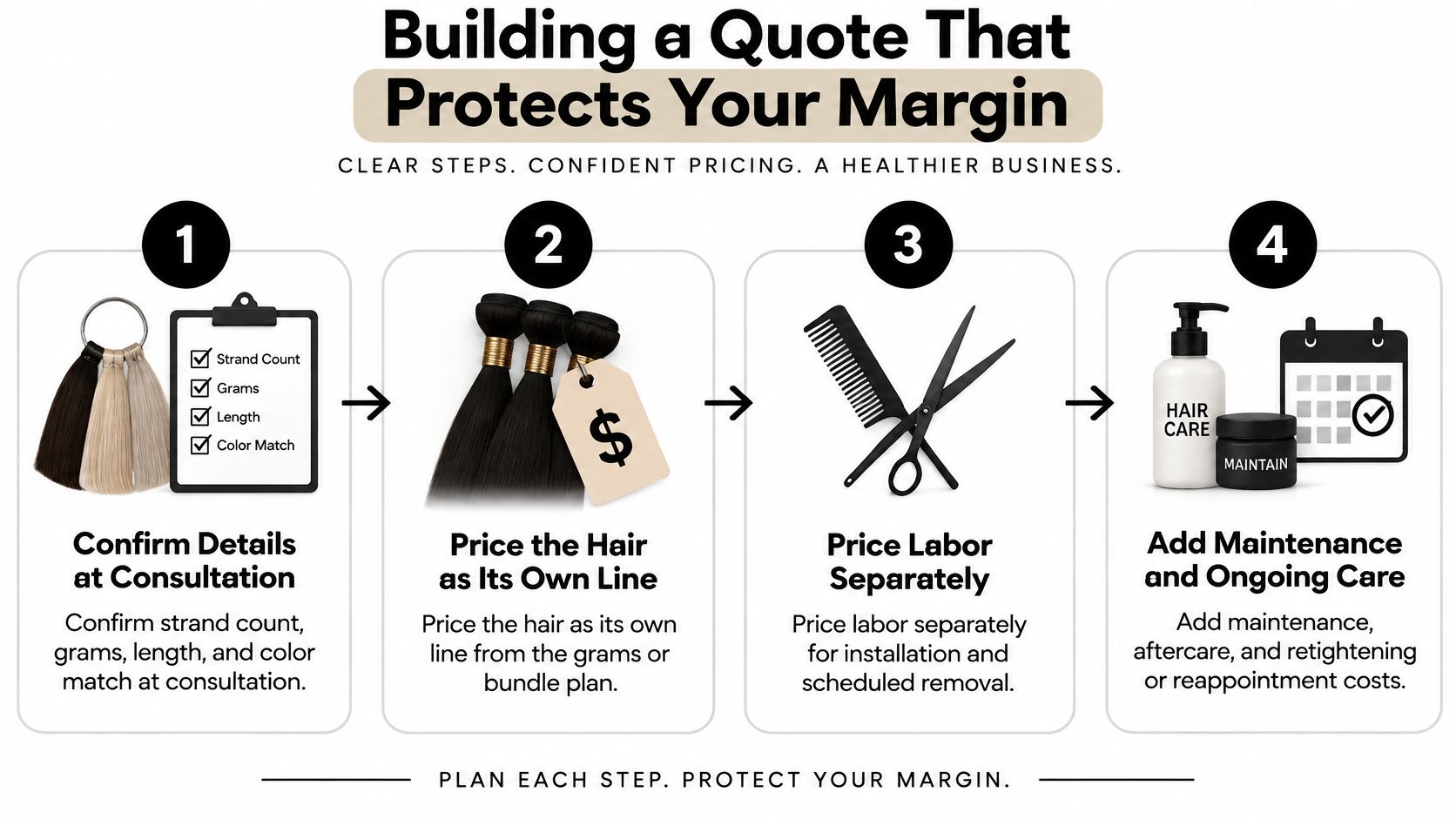
A K-Tip quote earns its value across the full wear cycle: installation, maintenance, removal, and any move-up service. The first appointment sets only part of the cost. Hair quantity, application labor, blending, and the client's ability to follow the maintenance schedule all affect the service's value per wear.
For a salon, K-Tip extensions cost is a service-cycle calculation. Quote hair and labor separately, then account for the time required at each stage. Published prices can help frame the conversation, but a timed service plan is what protects the margin.
The first-install quote depends on what the price includes. Hair plus application, labor-only pricing, and a per-extension charge represent different services, so compare the line items before comparing totals.
| Source | Hair | Installation | Initial total |
|---|---|---|---|
| Keratin or fusion-bond pricing guide | $500–$1,200 | $600–$1,200 | $1,100–$2,400 |
| K-tip and I-tip pricing guide | $300–$700 or more | $400–$1,000 or more | $700–$1,500 or more |
| Salon example, hair plus installation | Included, not itemized | Included, not itemized | $1,100–$1,800 |
| Salon example, full-head installation | Excluded | $650 for about 3 hours | $650 labor, plus hair |
| Salon menu, regular K-Tip application | Excluded | From $200, $100 minimum or $8 per extension | Application charge, plus hair |
These published examples show how salons price components differently. The keratin/fusion guide lists hair and labor separately; the K-tip/I-tip guide combines two attachment methods, so its figures are not a K-Tip-only average. A package total hides the split between hair and labor, while an application-only price leaves the hair cost to add.
The J. Joseph Salon pricing reference also lists a hair-plus-installation example of $1,100–$1,800. Use that as a consultation reference, not as a rate to copy.
A package may include preparation and finishing that another salon charges separately. A low starting price may exclude the quantity needed for blending, color work, or final shaping.
Confirm the scope before quoting:
Comparison rule: A labor-only starting price and an all-inclusive install are different purchases.
If density or shade selection is unresolved, the service is not fully specified. Mark the quote as an estimate until those choices are settled.
Density determines the material requirement, but it also determines how long the stylist occupies the chair. Pricing hair without adjusting the labor allowance is a common way to sell a technically demanding install at an unprofitable service rate.
The FTG Salon K-Tip menu lists full-head requirements of 100–250 g, installation times of approximately 5–12 hours, and packages rising from $2,500 for 100 g to $3,500 for 250 g. That salon-specific benchmark demonstrates the relationship between quantity and labor exposure; it doesn't establish a universal full-head prescription.
The stylist should assess natural density, existing length, the haircut's weight line, and the intended finished silhouette before selecting quantity. A client requesting length through a blunt perimeter presents a different blending problem from a client who already has length and needs targeted fullness.
Length selection also needs a consistent measurement method. The professional guide to measuring for hair extensions can support the consultation record, particularly when the client's reference image and actual placement plan don't describe the same finished length.
The order should record:
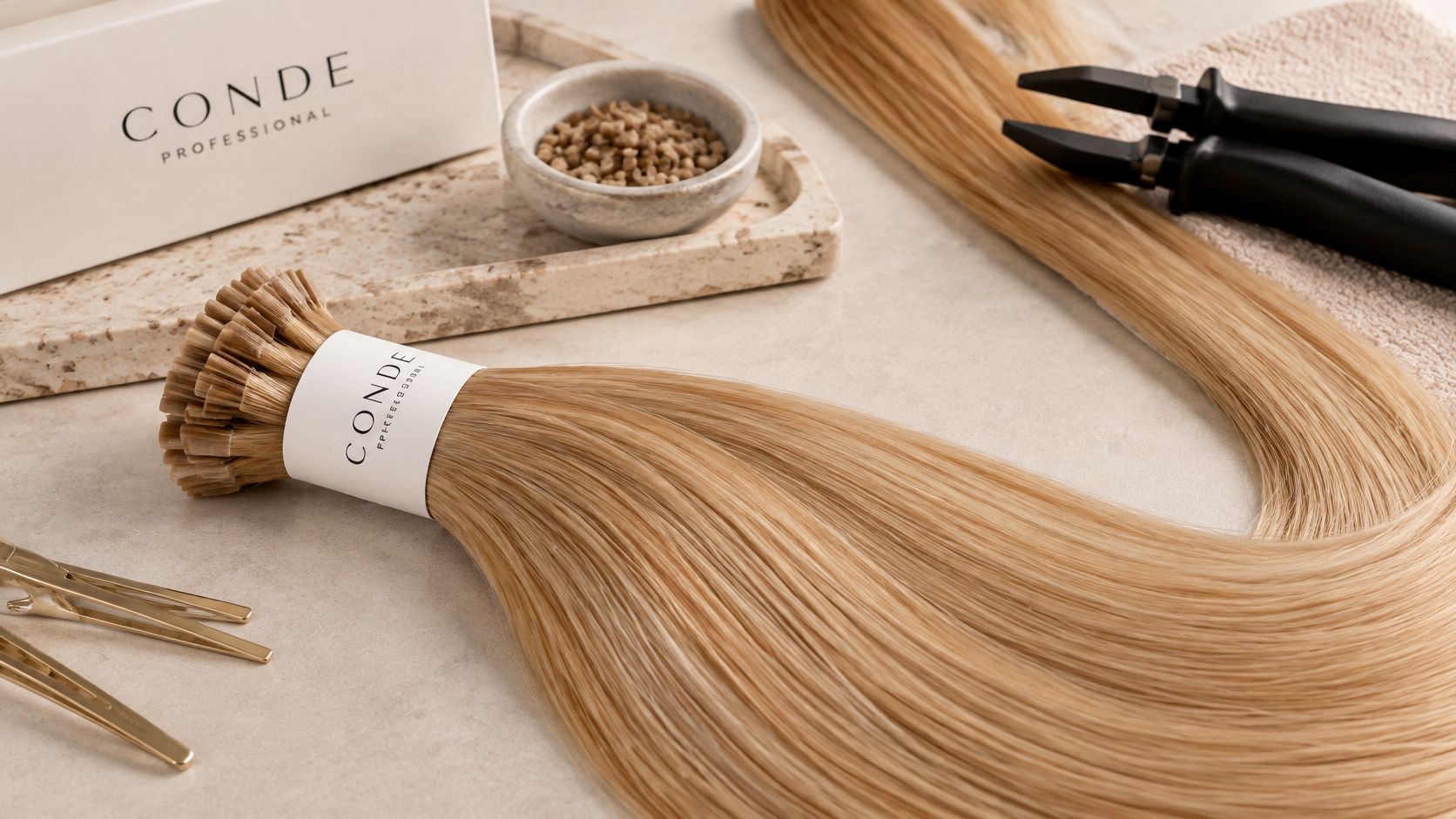
For a multi-tone option, K-Tip Amber Glow #7/10 Superblend uses flat keratin-tipped strands for hot fusion application. Its relevance to the quote is the shade distribution and attachment format, not permission to assume an unspecified bundle weight or strand count.
The Network Salon extension menu provides a $100-per-hour labor reference alongside listed application totals of $200–$800, excluding hair; the cited salon examples also include a $650 full-head install for approximately three hours and $225–$275 partial services. These are menu examples, not a consistent equation from which another salon should reverse-engineer its rate.
A minimum service charge, package allowance, or booking structure can prevent the advertised hourly figure from matching a simple multiplication. The stylist should confirm which rule governs the appointment rather than combining incompatible menu entries.
The Marcia's Looks service menu lists regular K-Tip application from $200, with a $100 minimum or $8 per extension, and micro K-Tip application from $300, with $6 per extension and the same minimum. Per-extension pricing can make quantity changes transparent, but it still needs a realistic chair-time check.
Effective service revenue per chair hour = service revenue, excluding separately tracked resale hair, ÷ booked service hours.
This is a capacity check, not a profit calculation. Payroll, occupancy, consumables, consultation time, and administration still have to be covered.
A dense install that expands beyond its booked allowance reduces the revenue available from that chair, even if the hair markup remains healthy. The correction isn't automatically a higher product margin. It may require a revised application allowance, a more accurate placement plan, or a method that better fits the client's desired result.
A low hair cost doesn't rescue an install whose labor was underestimated.
Record actual preparation, application, and finishing time separately. That record gives the next quote a stronger basis than another salon's starting price.
A K-tip quote covers more than the first installation. The full cost depends on how long the attachment cycle lasts, what care it requires, and whether the hair can be reused after professional removal.
Published guidance gives different planning ranges. A guide to K-tip extension wear and aftercare can help set care expectations, but the client's appointment plan should reflect the salon's removal procedure and the condition of the hair.
| Care level or source | Wear or interval | Upkeep cost | Budget note |
|---|---|---|---|
| Excellent care, salon estimate | 5–6 months | No separate care-level figure published | Longest estimated cycle, with fewer removals |
| Average care, salon estimate | 4–5 months | No separate care-level figure published | Useful as a planning scenario |
| Poor care, salon estimate | 2–3 months | No separate care-level figure published | A shorter cycle brings removal and replacement decisions forward |
| K-tip and I-tip pricing guide | Removal every 3–4 months | Labor may approach a fresh install | Include removal and reinstallation in the cycle budget |
| Keratin or fusion-bond pricing guide | Move-up every 6–10 weeks | $200–$500 per move-up | Schedule the next appointment at the initial visit |
| Fusion or keratin salon guidance | Reposition every 8–12 weeks | Confirm the quoted labor charge | Define the procedure and labor before quoting |
| All care levels, salon estimate | Monthly view | $200–$700 per month | Use as a broad planning range, not a care-level price |
The SalonsRated guidance on fusion and keratin maintenance places maintenance at approximately 8–12 weeks. Published guides use “removal,” “repositioning,” and “move-up” differently, so the service name alone does not tell the client what work is included.
A fusion removal and fresh application is not the same service as a beaded-row move-up. State whether the existing hair can be prepared for reuse, whether rebonding is offered, and when replacement hair is needed.
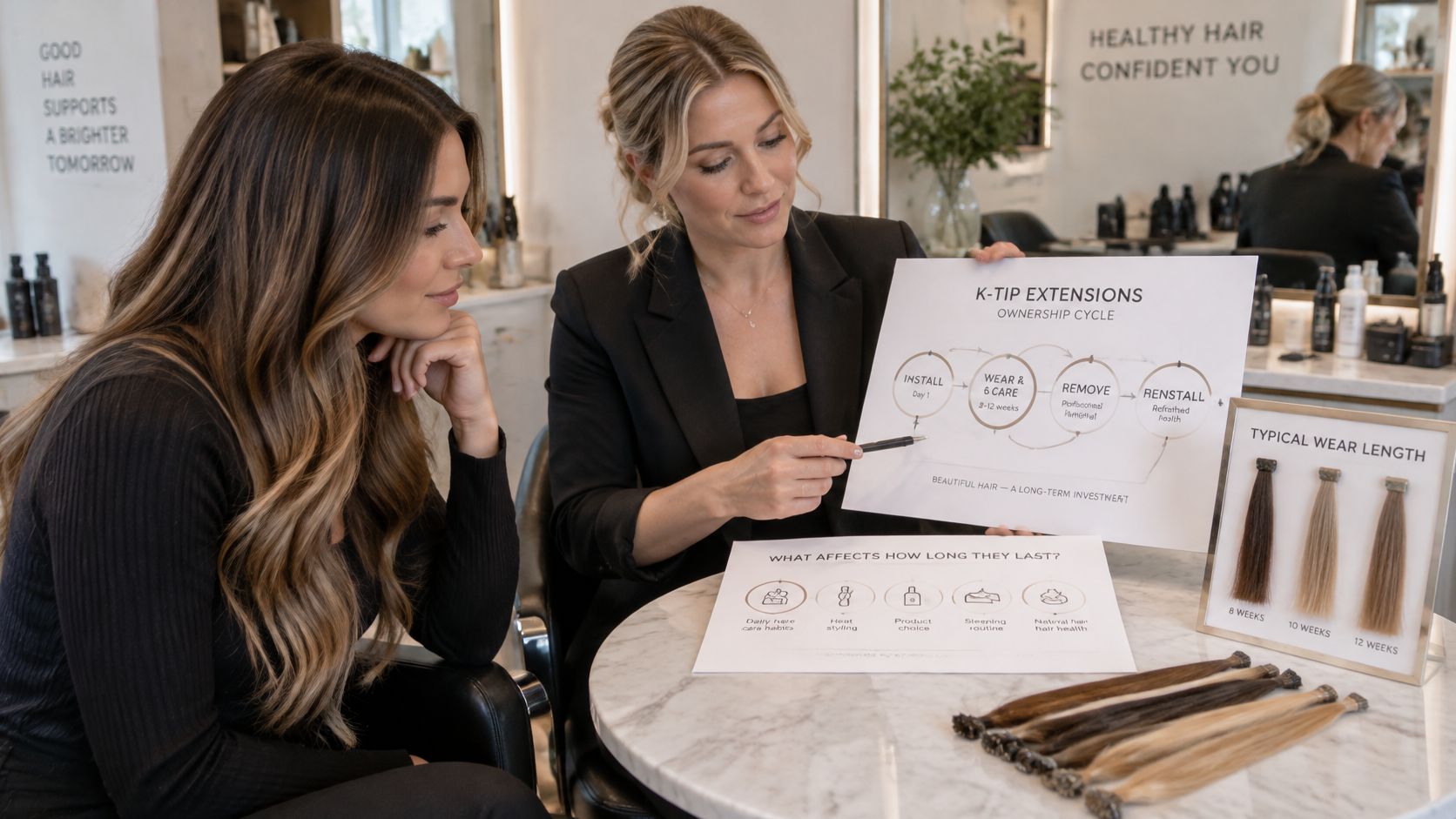
A six-month or twelve-month forecast should list initial installation, professional removal, reinstallation, replacement hair, home-care products, color maintenance, and any separately assessed correction work. Use the salon's own pricing and planned appointment calendar for each line.
Compare packages only after matching quantity, included services, and replacement policy. A higher initial total may suit a longer commitment; a lower one may fit a shorter cycle.
Cost per wear = total cycle expenditure ÷ actual wearing occasions. A monthly view can make options easier to compare, but it should not encourage extending an attachment beyond the stylist's removal plan.
A profitable K-Tip quote accounts for the full service cycle, not just the first install. Document the agreed result, booked labor, and expected follow-up so the client understands what the price covers and what requires a separate charge.
The Beauty Playbook salon-pricing guide frames pricing around installation and subsequent maintenance appointments, and recommends booking maintenance in advance. Use that install-plus-maintenance approach alongside the pricing ranges covered earlier, then apply your salon's own costs and service terms.
For overhead allocation and service-rate decisions, Stewart Accounting Services pricing advice offers a business reference. Set the final rate using your salon's costs and booking records.
| Quote line | Worked example |
|---|---|
| Hair specification | 120 g, 18-inch, Balayage #7/10, quoted at the salon's hair markup |
| Hair charge | Professional cost basis with the salon's markup applied |
| Application | Booked installation time, priced under the salon's hourly rule |
| Preparation and color | Color work listed separately unless included in the service |
| Blending and finish | Included in the service price |
| Professional removal | Removal procedure and separate service charge |
| Next appointment | Follow-up procedure and estimated charge confirmed at consultation |
| Replacement hair | Assessed at removal if new hair is required |
| Aftercare | Recommended products listed with their charges |
| Exclusions | Additional services require separate authorization |
The professional guide to selecting salon hair extensions can inform purchasing criteria. Keep the quote specific enough that another team member can identify what was sold and what remains separately chargeable.
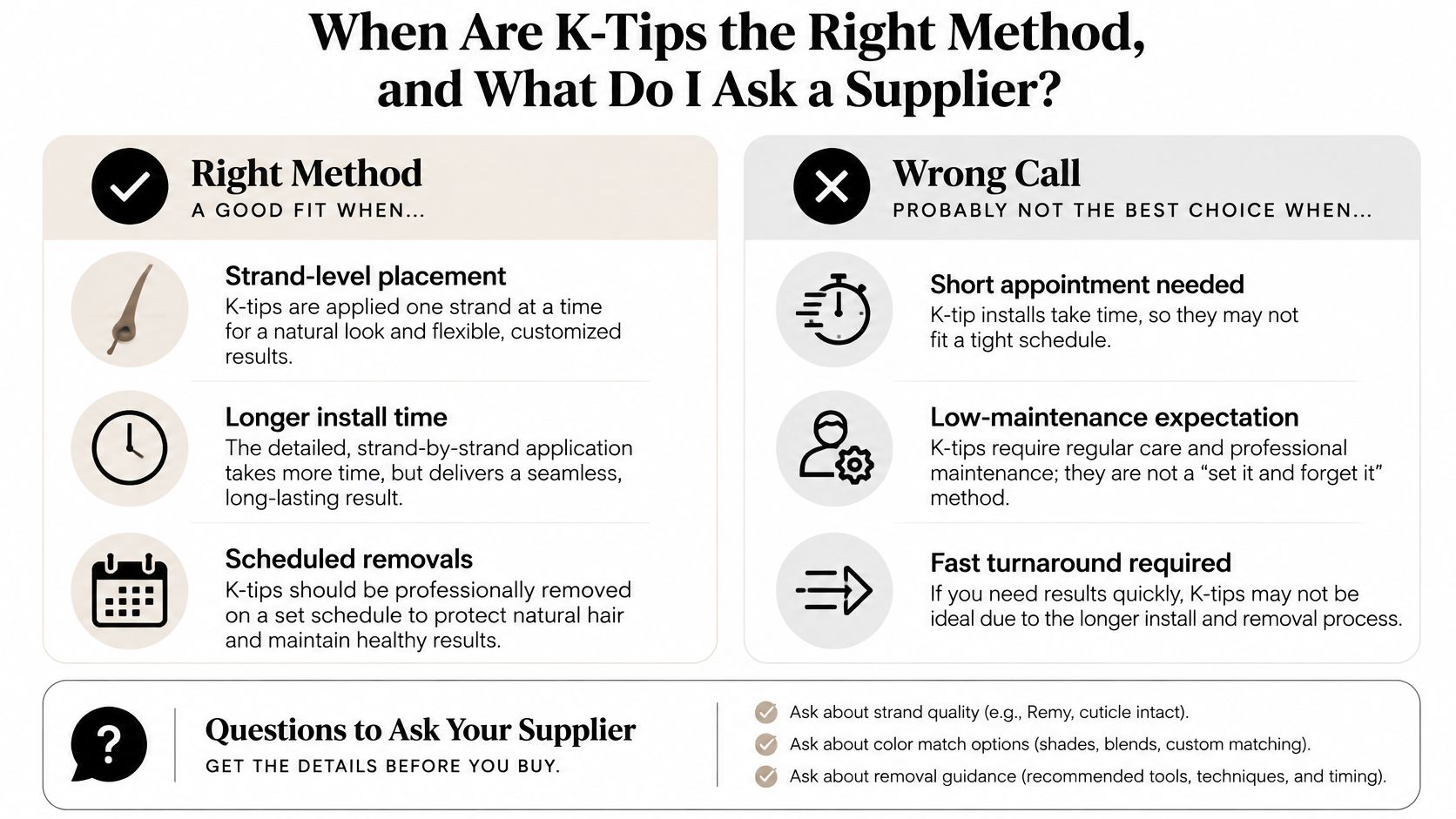
K-Tips suit clients who need strand-level placement and accept the application time, home-care responsibilities, and scheduled removal. They're not the right choice when a short appointment, minimal upkeep commitment, or tight recurring-service budget is essential.
| Strength | Cost to the salon |
|---|---|
| Strand-level placement and flexible sectioning | Application labor grows with strand count and time |
| Suits dense and long-haired clients who need precise placement | Dense full-head sets can require extended installation appointments |
| Placement can be revised at a planned reapplication | Professional removal and fresh placement must be budgeted |
Precise placement isn't permission to add unlimited density. The stylist still needs suitable sections, adequate coverage, and a finished result that the client can maintain.
For a shorter application workflow, Tape-In Brunette #6/7/10 Balayage provides an alternative within a method described as suited to quick installations, straightforward maintenance appointments, and fine-to-medium hair. Tape-In isn't maintenance-free, and tab coverage or placement restrictions may make it unsuitable for the intended hairstyle.
A hand-tied or beaded row approach can be more efficient for broad density distribution, while microlinks offer a different strand-service workflow. The comparison of hair extension methods helps frame that decision without assuming that every attachment supports the same placement pattern or maintenance plan.
Supplier letter-and-number grades aren't a governing quality standard. Measurable product criteria and clear written specifications are more useful than a higher-sounding grade.
The correct method is the one the stylist can place appropriately and the client can realistically maintain.
If the client can fund the install but can't commit to professional removal or the next service, K-Tips are the wrong recommendation for that appointment.
Start with the consultation records you already have. Pull the last three K-Tip consultations and check whether each records the client's grams, target length, shade plan, and appointment notes. Missing details show what to add to the consultation form before the next order.
Use the wholesale human hair extensions guide to support your purchasing review. For product or shade questions, use the contact options provided through Conde Professional.
For the next two weeks, record actual appointment timing alongside the original estimate for each completed service. Compare the results with your salon's chair-hour revenue target.
When timing runs over, identify the cause before adjusting future estimates. Slow preparation, underestimated density, extensive finishing, and unclear service boundaries call for different fixes.
Before sending the next quote, update the consultation form with the missing details and confirm any unresolved product questions. Conde Professional offers extensions and professional education for licensed stylists. Visit Conde Professional to open a professional account and confirm product details for the next K-Tip consultation.


