Your cart is empty
Tax included and shipping calculated at checkout

Drawer menu
Tax included and shipping calculated at checkout
A professional account gives you stylist pricing, priority support, early access to new releases, and education developed by working stylists.


The advice to choose the thinnest weft misses the installation decision that matters most: the supporting hair must carry the planned load without excessive tension. Hybrid weft hair extensions should be selected by construction, attachment map and maintenance requirements, not by how discreet the seam looks on a display stand.
A flat panel can still be installed badly. For licensed stylists, the useful question isn't just which weft looks smallest, but which configuration can deliver the intended result on that client's actual foundation.
A hybrid weft's construction affects how a stylist handles and installs it, so assess the build before choosing the method. The term generally describes a weft with a sewn or machine-formed base and an added stabilizing or bonded element. Specifications vary by product, including cutting, attachment and removal requirements.
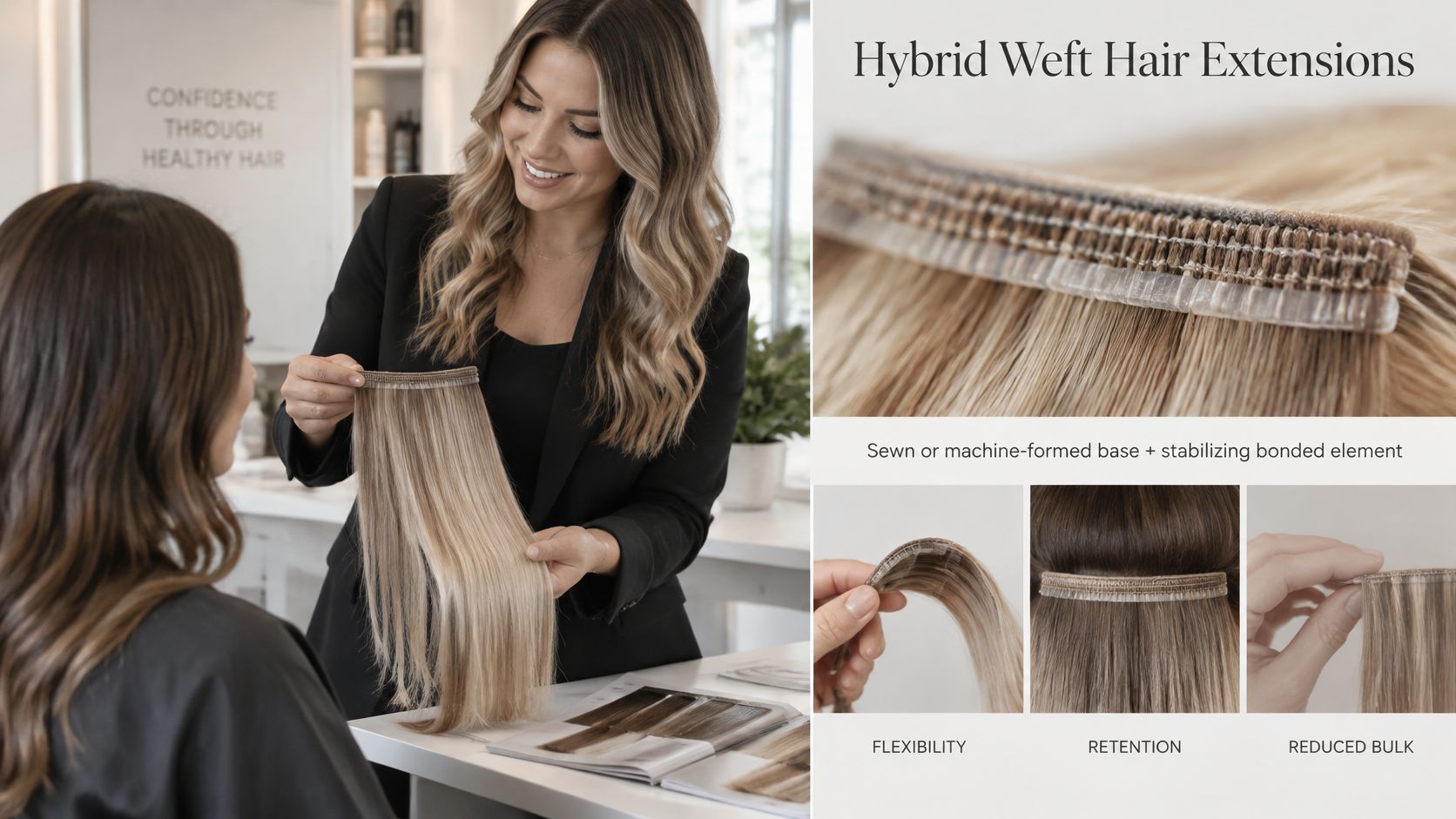
The construction principle has a long history. Dazed's history of hair extensions describes how Christina Jenkins, an African American inventor in Cleveland, patented a weaving technique in 1951 that attached hair to netting so it could be sewn onto the scalp. For a stylist today, that history points to the practical question: what carries the hair, and how does that structure affect fitting and securing the panel?
A weft is a prefabricated installation panel. Its carrier determines how the panel is handled, fitted and secured.
Read the specification as three separate parts:
Keep construction and installation terminology distinct. Hybrid describes a panel build; hand-tied describes a construction technique; beaded row describes an installation approach. Treating them as interchangeable can leave a stylist without the handling instructions needed for the actual product.
Specification test: Identify the hair, carrier and stabilizing element before approving an order.
If the product sheet leaves any of those components unclear, resolve that before customization. Ask which element stabilizes the seam and what handling restrictions follow from that construction.
| Method | Construction or attachment | Profile | Best fit |
|---|---|---|---|
| Hybrid weft | Sewn weft base plus stabilizing or bonded element | Depends on the specific build and foundation | A row service where the panel's construction suits the client's scalp load |
| Thin Weft | Thin weft panel | A flatter profile may support discreet placement | Fine or thin hair where concealment is a priority |
| Volume Weft | Weft-based | Assess the finished stack before placement | Added fullness distributed across sections |
| Tape Weft | Tape-backed weft | Assess the taped seam and overlap | Panel placement where tape attachment suits the foundation |
| Tape-In | Tape attachment | Flat attachment requiring adequate cover hair | Targeted placement where adhesive attachment suits the service plan |
| K-Tip | Keratin-bonded tip | Individual attachment points | Strand-level placement and blending |
| Clip-In | Removable clip-on weft | Clip hardware requires concealment | Temporary wear |
| Bulk | Loose Remy human hair bundles | Depends on how the stylist builds the weft | Custom weft building |
A hybrid weft's name does not determine how much hair a client's scalp can support. Compare its construction with other hair extension methods, then assess the client's density, strand fineness, coverage and tolerance for maintenance. Method labels help narrow the choice; they do not replace a tension check or product-specific handling instructions.
The attachment method changes how weight and tension reach the foundation. A row-based panel distributes hair along a track, while tape attachments and K-Tips place attachment points differently. Clip-Ins are removable, and Bulk hair is loose hair for stylist-built wefts. Choose based on the client's foundation and service plan, not profile alone.
For example, Thin Weft Dark Caramel #5/9 Bronde is a brown-to-blonde blend. The shade describes its color; it does not establish an application format.
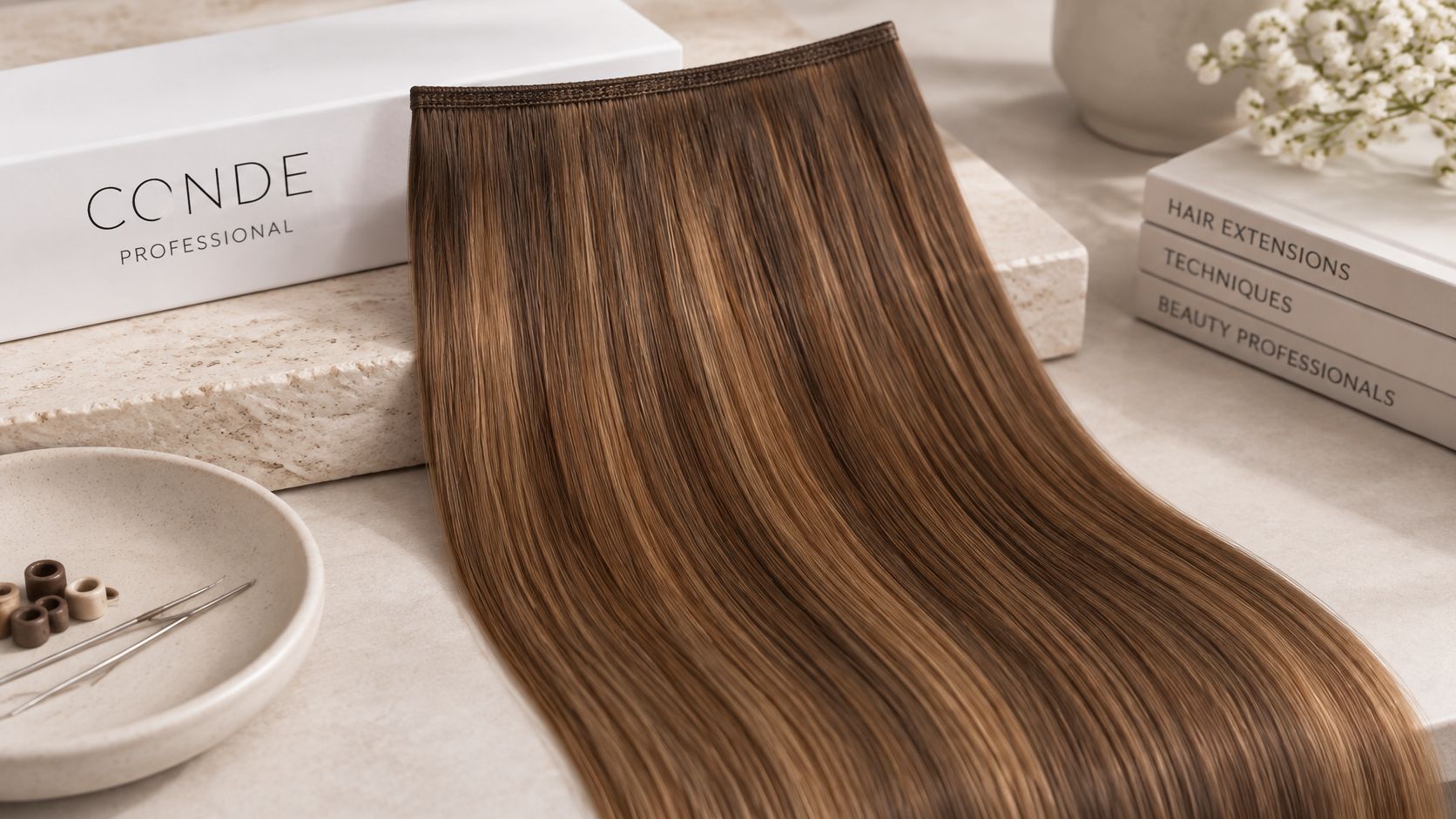
A flatter profile may help with concealment on fine hair, but concealment alone does not show whether the foundation can carry the planned load. For added fullness, consider distribution across sections before adding more hair to an existing row.
Confirm cutting permissions, attachment dimensions and customization limits in the product specification. Then check the installed rows for tension and plan move-up timing around the client's maintenance capacity. A panel that looks discreet but creates persistent tension or needs upkeep the client cannot maintain is a poor fit.
Supplier grades aren't quality standards. The hair-labeling discussion published by Transitions Hair explains that labels such as 6A, 7A, 8A, 9A and 10A have no governing industry body, so they don't independently establish cuticle integrity, shedding resistance, combability or wash durability.
A purchasing decision needs observable criteria instead. A glossy presentation bundle isn't enough to establish how the hair will behave after cleansing, detangling and salon processing.
The Brazilian Journal of Pharmaceutical Sciences study reported tensile values of approximately 3.2 ± 0.7 for virgin hair, 2.8 ± 0.6 after bleaching and 2.7 ± 0.7 after bleaching plus dyeing, corresponding to reductions of about 12.5% and 16.6%, although those differences weren't statistically significant in its sample. Its discussion of bleaching-related structural changes supports conservative handling, not a prediction of any particular bundle's lifespan.
Lightened and fantasy-color hair should therefore be treated as lower-margin material for additional processing. Minimize further alkaline work, control heat exposure and document color history before attempting correction.
Conde Professional checks every batch for weight, color accuracy and strand strength, and hair that falls short of its standards stays at the facility. For salon purchasing, that process should sit alongside a written receiving checklist, not replace one.
A same-day supplier checklist should establish:
The wholesale buying guide supports the purchasing workflow. The actionable next step is to obtain inspection criteria in writing before placing a stock order.
Start with the load each natural-hair section can support, then map the attachment around that foundation. A row that looks secure can still pull if the hair is fragile or the placement recruits the perimeter.
The consultation should turn the desired result into a documented mechanical plan. McGraw Hill's dermatology reference discusses prolonged extension tension as a clinical concern. Use that context to assess placement and the client's response, and refer health concerns beyond the salon's scope.
Persistent soreness, tenderness, redness or unusual shedding calls for prompt reassessment. Adjust or remove the installation as appropriate, and refer the client to a dermatologist if symptoms continue.
Clinical reports available through PubMed Central describe hair loss appearing as early as 7–20 days after extension application. That timing makes an early assessment important; persistent symptoms should not wait for a routine move-up.
A flatter panel does not justify tighter beads, closer spacing or a heavier row.
A fine-haired client with a receding hairline is a distinct placement case. If the consultation supports proceeding, use less material, place rows back from the perimeter and schedule an earlier check. If the available foundation cannot support the planned row, choose another service.
Record the installed weight, mapped placement and observed response together. A scale documents the load; the client's comfort and the foundation's response guide the decision to proceed.
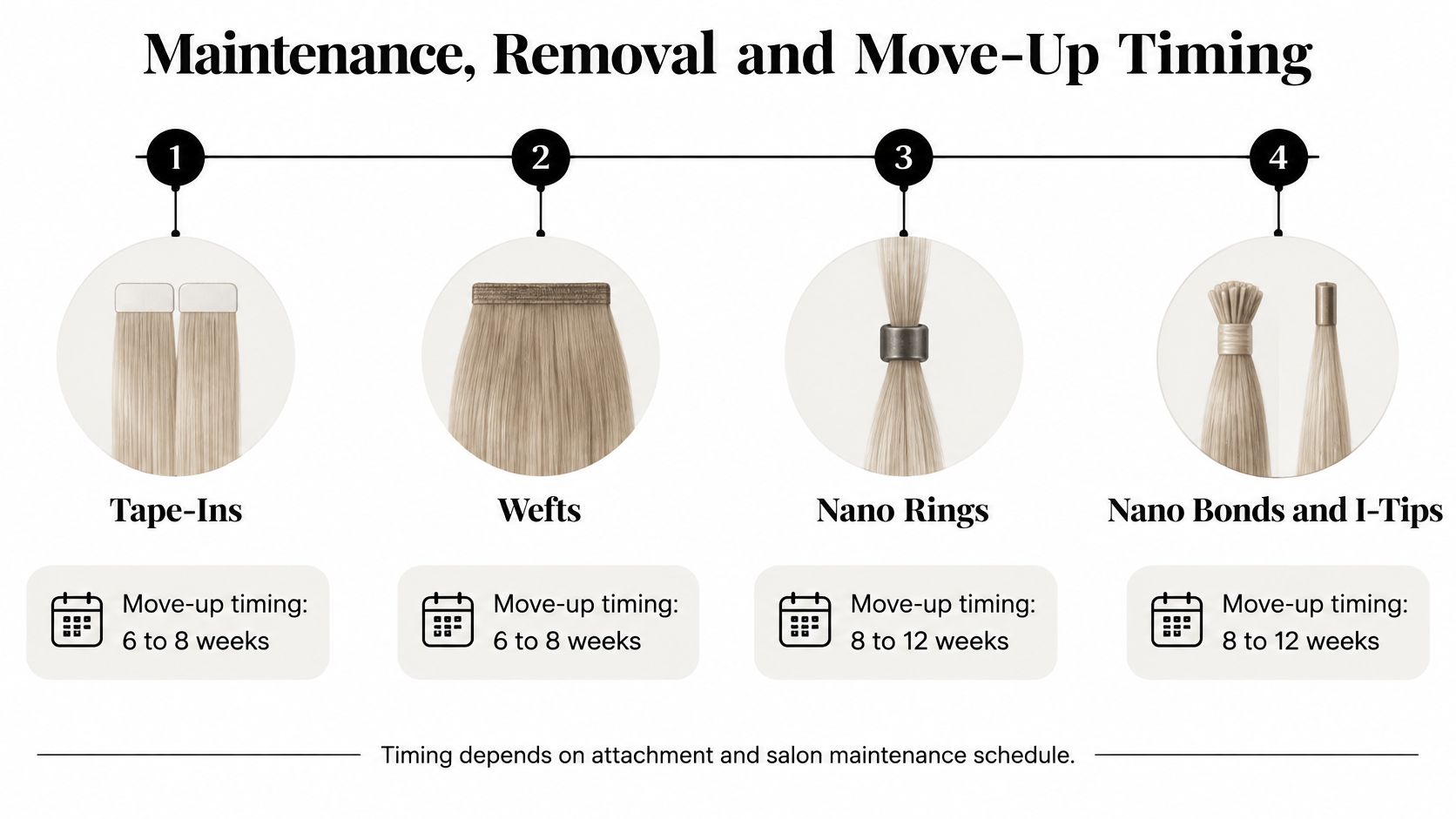
Plan hybrid-weft move-ups around the weft-category window, then adjust for the attachment's condition and the client's routine. Use 6–8 weeks for tape-ins and wefts and 8–12 weeks for nano rings, nano bonds and I-tips as planning guidance. These are starting points for scheduling, not a substitute for checking the foundation.
Move-up windows by attachment type
| Attachment | Move-up window | What to inspect at move-up |
|---|---|---|
| Tape-ins and wefts | 6–8 weeks as a planning guide | Attachment security, shed buildup, root direction |
| Hybrid weft with any beaded row or microlink | Use the weft-category window as a planning reference; assess the integrated attachment | Attachment map, slippage, tension, scalp comfort |
| Nano rings, nano bonds and I-tips | 8–12 weeks as a planning guide | Bond or ring condition, slippage, matting |
| K-Tip | Schedule assessment and removal according to the specific fusion-bond system | Bond condition and scalp comfort |
| Clip-In | Remove after temporary wear; no move-up appointment is needed | Clip condition and ease of removal |
Hybrid constructions can combine attachment elements, so inspect each part of the installation rather than assigning the whole service a separate interval. K-Tip timing should follow its fusion-bond system, not an I-tip schedule.
The American Academy of Dermatology recommends professional application, regular cleansing, loosening painful styles and taking a break after wearing weaves or extensions for two or three months. A routine repositioning appointment does not automatically provide that break.
Reassess the foundation at each service. Track root direction, matting, slippage and any change in attachment tension. Book sooner if the installation no longer sits comfortably or securely.
Workouts, swimming, travel and infrequent washing can affect cleansing and drying routines, so ask how the client manages them. For textured hair, consider root behavior and detangling needs when setting the next appointment.
Use the salon's written extension-care instructions to guide scalp cleansing, conditioning through mid-lengths and ends where the attachment permits, and complete drying before sleep. Detangle from the ends upward, supporting the hair near the attachment to limit pulling.
Remove attachments in a controlled sequence:
Shed hair can collect around the foundation even when the extensions still look acceptable. Remove buildup and assess the attachment before deciding whether to reset the panel or schedule the next move-up.
Hybrid wefts suit clients whose hair can support the planned panel and whose goals fit the method's maintenance demands. Make the decision by weighing the proposed scalp load against density, strand strength, edge condition, and the client's ability to keep appointments.
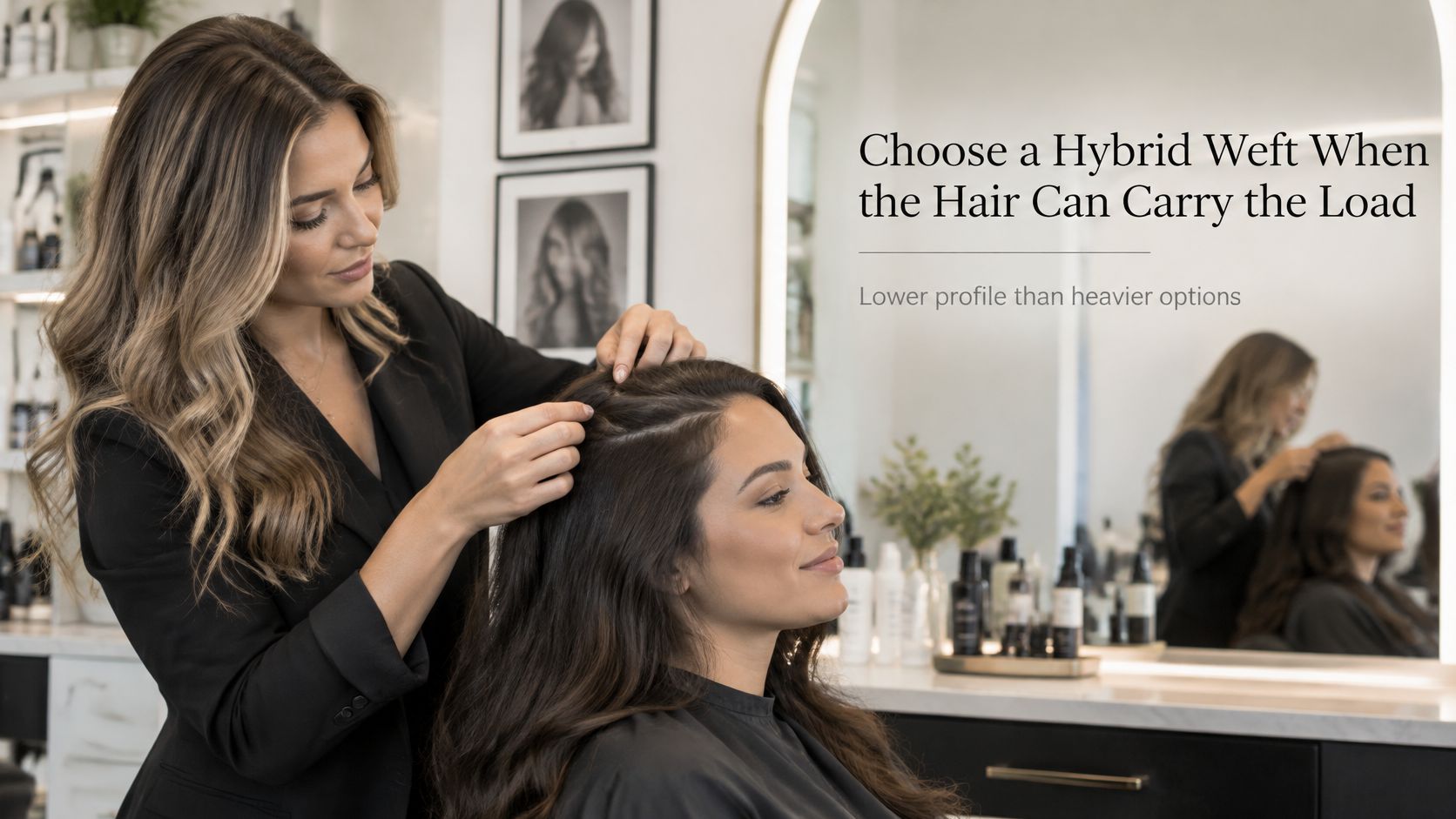
A discreet seam and section-based installation can make hybrid wefts a practical choice for clients seeking fuller-looking hair with a repeatable row plan. The fit depends on whether the blend works without excessive stacking or placement too close to exposed areas. Consultation, fit checks, maintenance, and removal all take time, so include those demands in the service discussion.
For a fine-haired client, assess whether the intended panel can be supported and concealed within the existing hair. The guide to extensions for fine and thin hair can help frame that consultation. Fine strands and low density are different findings, and each calls for an individual assessment.
Choose the method around the client's goal and the foundation available:
Conde Professional extensions are available in 18", 20", 22", 24", 26" and 28" lengths. Select a length that blends with the client's hair and fits the installation plan, then determine the amount of material the foundation can support.
Over 12 million strands have been installed with Conde hair. For each appointment, evaluate the foundation, document the service, and set a clear maintenance plan.
For salon owners, a repeatable service is one another qualified stylist can assess from the record. Attachment maps, receiving checks, and maintenance notes keep the plan clear beyond the consultation.
Conde Professional supplies wholesale professional hair extensions and offers stylist education, with shade and method guidance by text, phone, or email. Contact Conde Professional for product guidance and education, and bring the client's attachment map to the method-selection conversation.


