Your cart is empty
Tax included and shipping calculated at checkout

Drawer menu
Tax included and shipping calculated at checkout
A professional account gives you stylist pricing, priority support, early access to new releases, and education developed by working stylists.


Most suites still treat a Remy label as proof that tape extensions will wear cleanly. They won't, not on that evidence alone. Remy tape extensions are a fiber-and-adhesive system sitting on someone else's hair, and cuticle alignment says nothing about bond geometry, cortex strength, or whether that scalp can carry the load. The useful question is which presentations make tape-ins the wrong method before the first panel goes in.
Remy describes human hair whose cuticles remain intact and aligned in the same root-to-tip direction, but it does not describe the adhesive system or guarantee how the installation will wear. On a tape extension, the hair fiber and adhesive bond are separate parts of the service. The label speaks to cuticle condition, not bond performance.
Aligned cuticles lie in the same direction, reducing friction between strands and helping hair feel smoother and tangle less than hair with mixed cuticle direction. That surface feel does not reveal the full processing history or confirm strand strength.
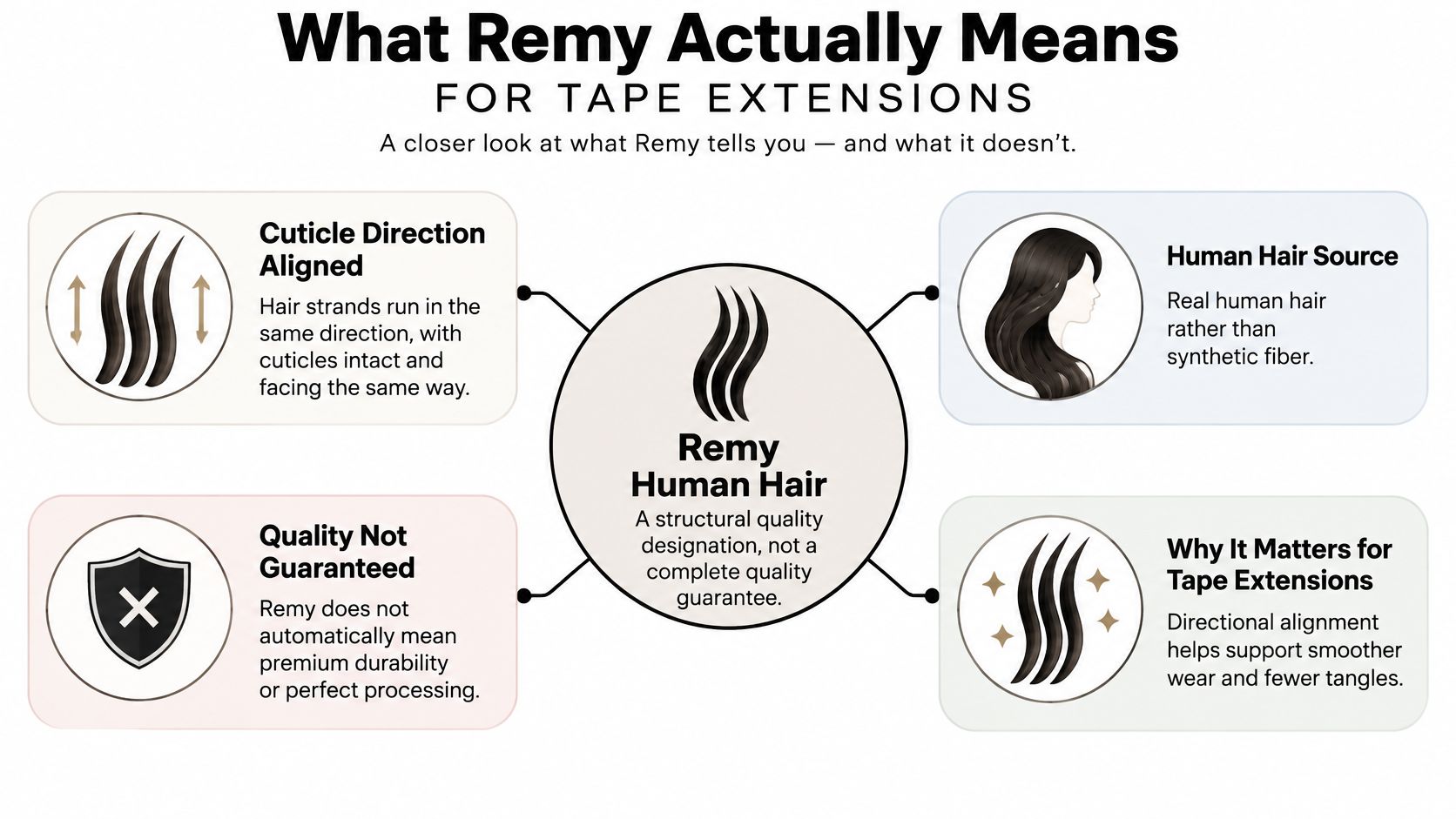
Remy and virgin describe different things. Hair can remain Remy after coloring or other chemical processing; virgin hair has not been chemically treated. Keep those labels distinct when assessing the hair, as explained in this guide to virgin hair versus Remy hair.
Practical rule: Assess cuticle alignment, chemical history, color processing, strand strength, and adhesive performance separately. Remy is not a universally audited certification.
Supplier paperwork and a batch-level inspection still matter before hair reaches the chair. Commercial use of Remy has come to signal premium human-hair performance, but the technical claim is narrower: preserved cuticle direction and integrity. It does not establish origin, texture, length, or an untreated state.
Tape-ins are already a salon service category, not a side retail add-on. Industry market research estimates the global tape-in hair-extension market at about $1.2 billion in 2025, with a projection to $2.2 billion by 2034 at a reported 7.8% compound annual growth rate. The same estimate puts human hair at $544 million and a 45.2% share in 2025, Remy hair at 28.4% share with 8.4% projected annual growth from 2025 to 2034, and professional or salon applications at 62.3%, about $747.6 million, in 2025.
Those figures are commercial estimates, not government statistics, and the report's method isn't independently detailed here. They still set scale. Professional distribution is the larger channel, and human-hair quality carries a large share of category value. Remy's faster projected growth is a reason to lock supplier relationships and batch consistency before demand outruns what you can inspect.
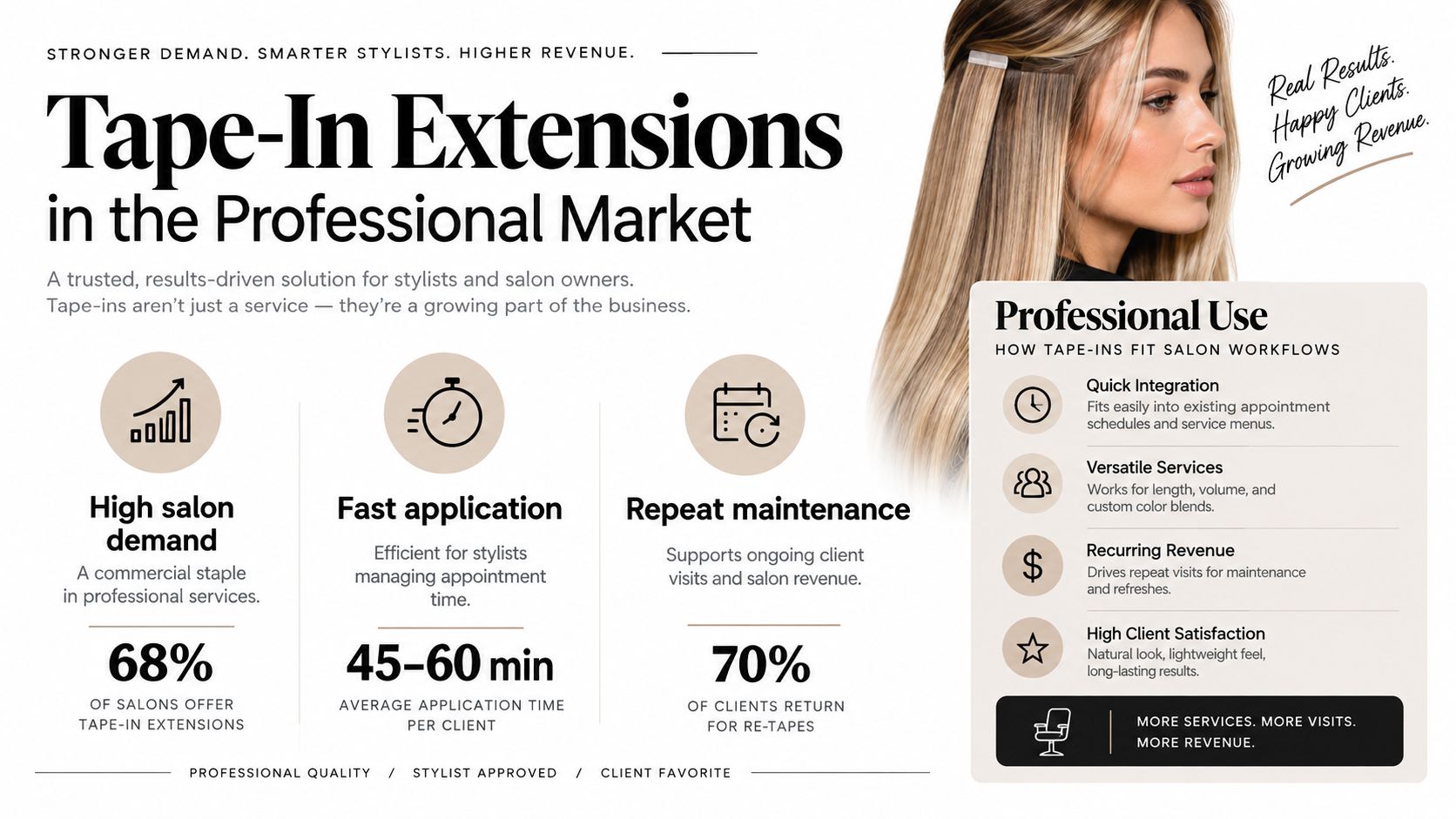
Tape work recurs. A guest who wears panels comes back for move-ups, so inventory, service pricing, and retention sit on the maintenance calendar, not on a one-time product sale.
A billion-dollar global category with high-single-digit projected growth through 2034 doesn't make every tape method right for every head. It does mean sloppy fiber choices get expensive across a book of recurring guests.
A sound install starts with the hair beneath the adhesive, not the adhesive itself. Remy alignment can reduce friction between fibers and help limit tangling, but it does not make the hair immune to stress. The cortex carries much of the fiber's mechanical strength. Published testing reports tensile strength of about 150–270 MPa, with results varying by strain rate and humidity, as summarized in this hair-fiber mechanics paper. Repeated brushing, wet detangling, heat, bleaching, or excessive extension weight can still weaken it.
Bleached donor hair needs closer inspection. Lightener may lift or remove cuticle cells, exposing the cortex; overprocessing can reduce elasticity and tensile strength. Before installation, check the client's density and the condition of the anchor sections. Match extension mass to the hair's capacity, leave fragile or highly miniaturized areas uncovered, and demonstrate brushing from ends upward with low tension.
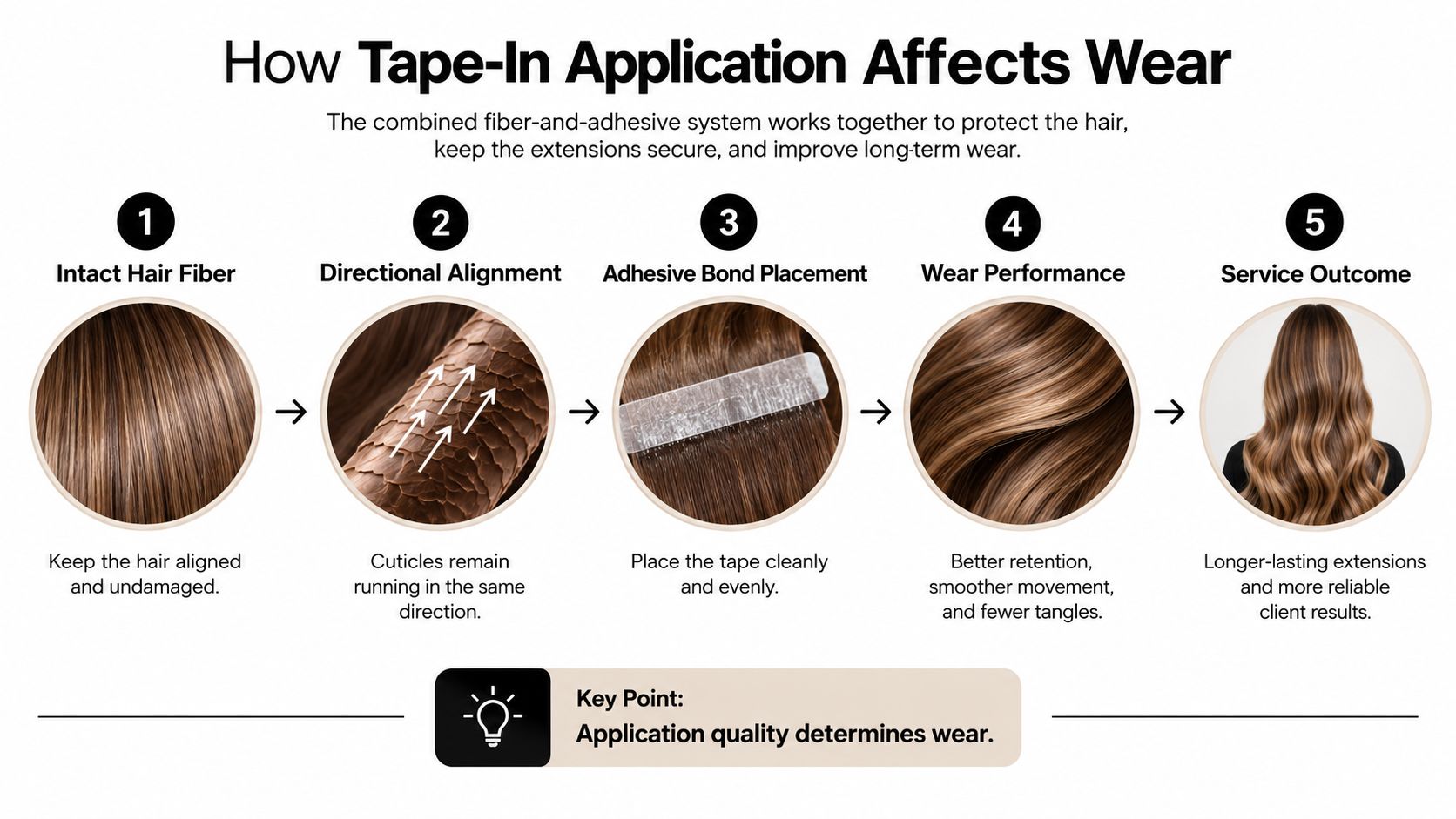
Follow a consistent tape-in installation sequence, then check the finished panels for uneven pull.
If hair beneath the tape is already miniaturized, choose a lighter method or decline the install. Adding panels cannot strengthen a weak anchor.
For purchasing, assess strand consistency, short-fiber content, cuticle condition, and strength after coloring. A “100% human hair” or “Remy” label alone cannot confirm those qualities.
Closest level isn't a blend. Dimension, reflect, and root shadow decide whether the extension disappears. A single-tone match wins when the client's color is even from root to tip. A multi-tonal gradient wins when the natural hair already shifts, or when a solid panel would read as a stripe beside lived-in pieces.
Check a color ring under the salon light, then again near a window and under the client's usual bathroom light. Note whether the natural color has warmed or faded since the last visit. Chemically processed Remy hair can take toner differently from virgin hair, so strand-test behavior before you commit the full head. The walkthrough in how to color match hair extensions is the chair-side sequence for that check.
| Shade Family | Blending Goal | Best For | Maintenance Note |
|---|---|---|---|
| Solid | Even level and reflect with little root contrast | Clients whose natural color is consistent, or a deliberate all-over refresh | Regrowth shows faster if the natural root is darker than the panel |
| Balayage | Soft, sunlit movement through the lengths | Clients who want dimension without a hard root line | Tone drift between tones needs a gloss check, not a full recolor |
| Rooted | A deeper root that melts into lighter lengths | Grown-out color and finer hair where a bright root would flash at the part | The root shade has to track the natural base, or the part line exposes the panel |
| Multi-tonal blend | Several levels in one piece so no single tone dominates | Hair with existing highlights, or fine hair that looks flat in a solid | More forgiving at the hairline, less forgiving if one tone sits far outside the natural range |
Fine hair usually disappears into a rooted or low-contrast balayage better than into a bright solid. Guests who want visible movement do better with a balayage or multi-tonal piece than with a perfect single-level match that photographs as one block. If the natural hair is a flat level and the guest wants that same flat result, stop at the solid. Adding ribbons of contrast there creates the mismatch you were trying to avoid.
Longevity fails at two places: bond geometry and chemical damage. Repeated oxidative treatment can produce progressive cuticle degradation, including lifting, fraying, intercellular voids, and localized drops in Young's modulus below 3 GPa, according to hair-fiber research on oxidative damage. Color-matched Remy tape hair that was aggressively lightened can feel smooth at first because conditioner or silicone sits on the surface while the fiber underneath is weaker.
That glossy hand-feel after a lightener isn't a strength test. Record the install date. At each maintenance visit, check slippage and matting, and replace compromised tape before tangles start pulling the client's own hair.
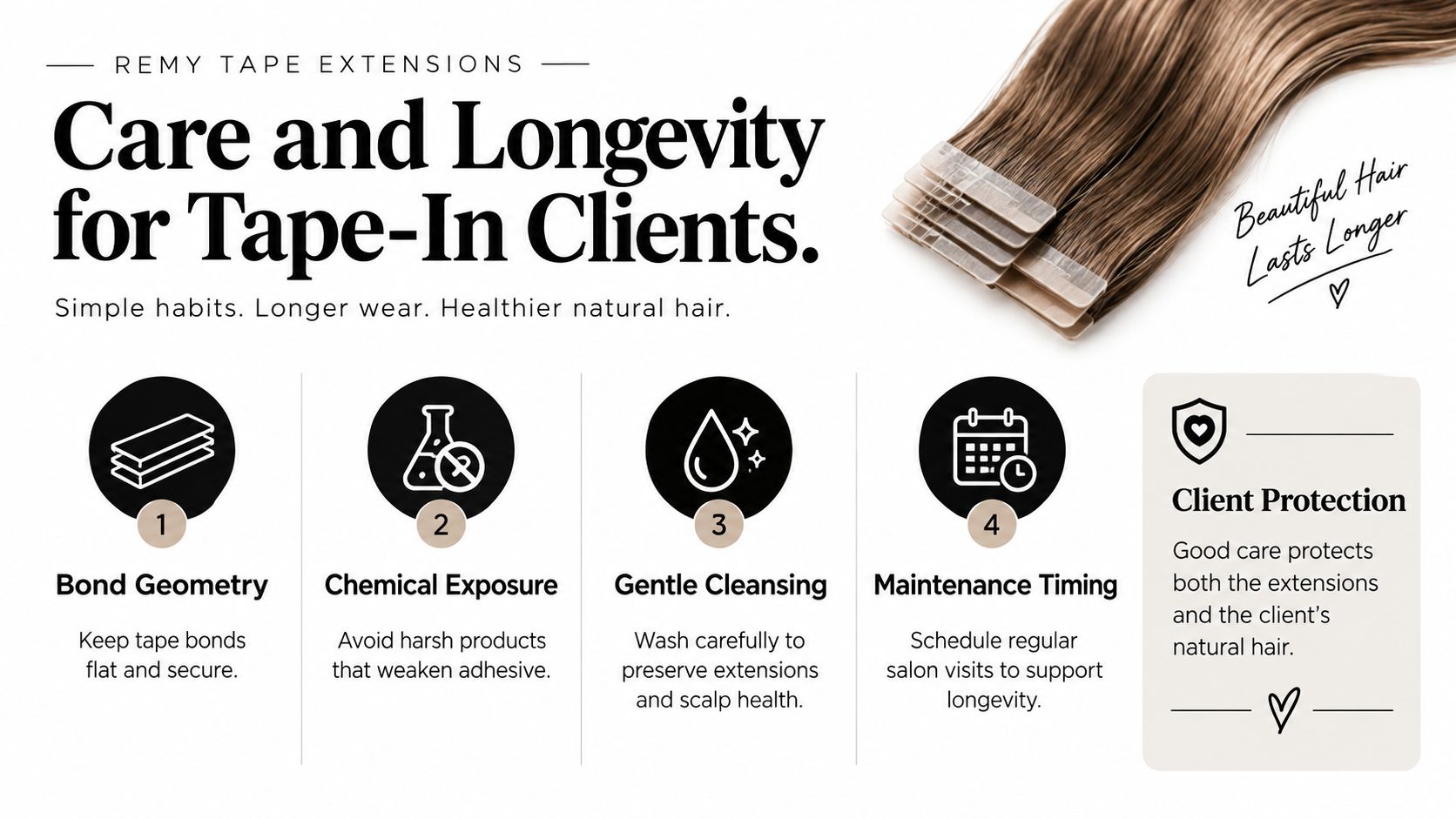
Removal is part of wear, not an afterthought. Adhesive systems damage natural hair when panels are peeled apart by force or when solvent is used too lightly. Keep adhesive off the scalp and separate the weft without yanking. Guests with prior bleach damage need less heat, gentler drying, and a more conservative extension weight.
Daily habits belong in the same conversation as the extension care routine you send home. If matting is already transferring stress into the natural hair, the tape comes off. Waiting for the scheduled week is how a maintenance miss becomes breakage.
A Remy tape extension is both a hair fiber and an adhesive system, so assess the client's natural hair and scalp before considering color or placement. Traction can begin with breakage or nonscarring loss, then progress to permanent scarring alopecia. A review reported trichoscopic signs of traction-related damage in all 12 women examined who wore extensions despite having no subjective hair-loss complaints (traction alopecia review). No pain does not mean the attachment is safe.
Longer extensions add weight and can increase tension. Extensions are discouraged when traction alopecia is already present, according to camouflage and extension considerations. A clinical review also identifies prolonged root tension, tight attachment, gluing or heating injury, and rough removal as risks associated with extensions and related systems (tractional hair-loss review).
Before installing, inspect the scalp and hair under good light, and document the baseline. Look for tenderness, redness, broken hairs, reduced density, active shedding, chemically weakened strands, or existing alopecia. Any of these calls for a pause and a closer assessment. Ask about tight styles and previous extensions, too. Past tension may matter even when the client feels comfortable today.
Keep the referral threshold clear. Ongoing traction can loosen hairs at the follicular opening and cause chronic inflammation; damage that begins without scarring may become permanent. Long-term extension use is not advised when underlying scalp disease is present, according to this British Journal of Dermatology report. Refer persistent scalp changes to a physician instead of installing over them. Record the findings and decision in the client's hair extension consultation.
A client may report that the previous set felt fine and still have broken hairs visible under the light. Comfort alone does not clear the scalp.
Reduced perimeter density or an active scalp condition makes tape-ins a poor choice. For an event, clip-ins may avoid sustained attachment, while no added hair may be the safest option. A suspected adhesive reaction requires a separate adhesive assessment, not just a traction screen.
A suitable tape-in depends on more than the shade or length the client wants. Assess the natural hair's density, fragility, chemical history, routine, and ability to return for maintenance. Tape-ins can work for fine-to-medium hair when the scalp is clear and the client can keep oils away from the bonds. Choose another method if there is pre-existing traction alopecia, active scalp disease, or a known adhesive reaction.
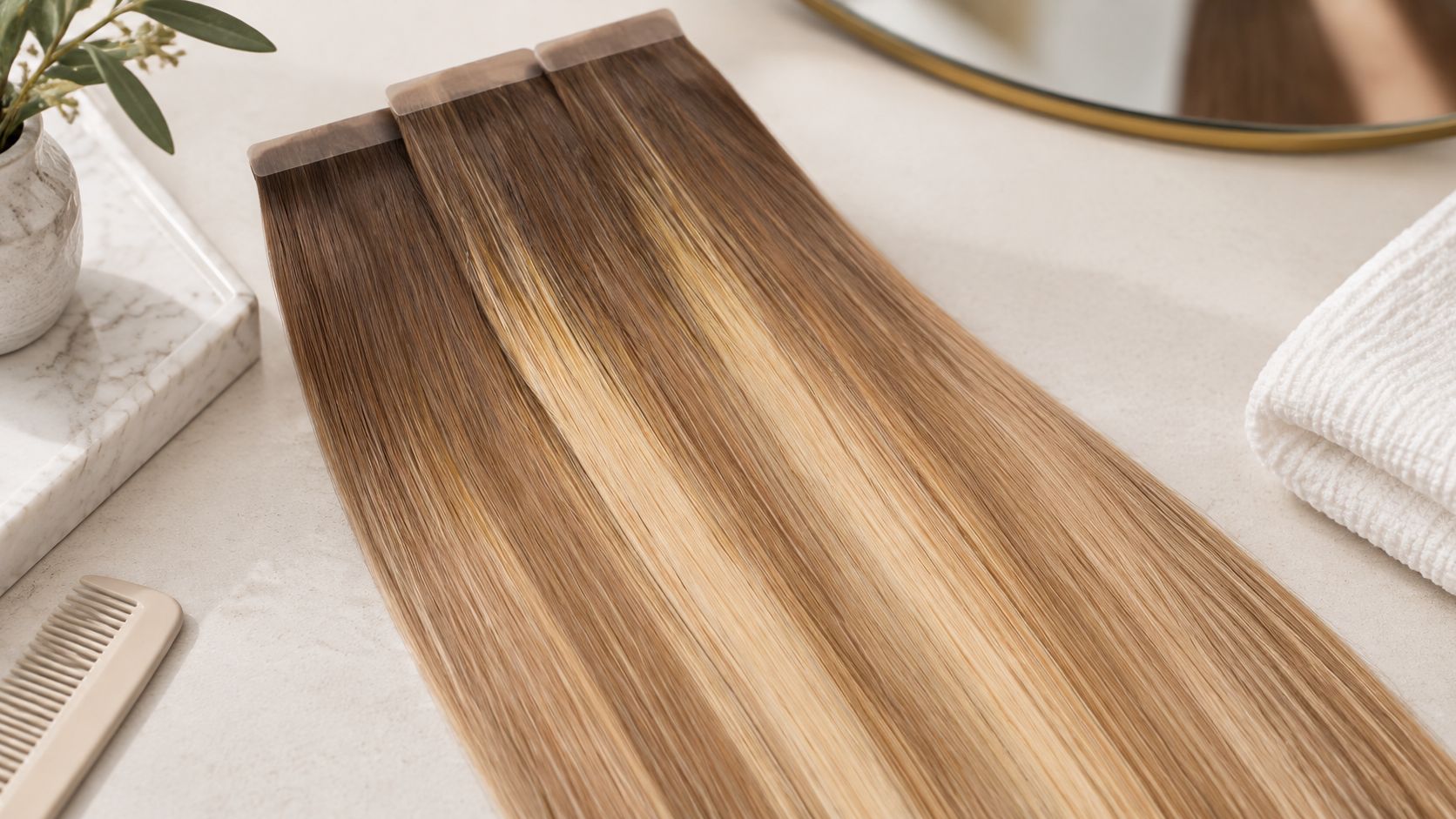
A multi-tonal option such as Tape-In Brunette #6/7/10 Balayage from Conde Professional may complement naturally dimensional hair. Confirm current length options, specifications, availability, and application guidance before ordering. A color gradient can support blending, but product selection does not make an unsuitable scalp or anchor safe for installation.
The method should match the head, not the other way around. Volume Weft and Tape Weft provide different density options, while Thin Weft reduces added weight. K-Tip and beaded rows avoid a full adhesive field; Clip-In and Bulk can suit temporary or custom work. Each method has its own trade-offs, and none removes the need to assess the client's hair and scalp.
Before ordering, ask the supplier for documentation tied to the specific batch. Grade labels such as 6A through 10A are marketing terms without a governing body. Judge the hair by cuticle integrity and alignment, shedding, combability, and how it behaves after washing. When possible, inspect a sample for consistent fiber diameter, few short fibers, aligned cuticles, and excessive slip that may indicate a coating.
Set a realistic weight and length. Fragile or heavily lightened hair calls for less added mass and often less length, or a different method altogether. Oil near the roots can weaken adhesive wear even when the hair itself is well aligned.
If a client requests maximum length on miniaturized hair, decline the tape install. Recommend a shorter, lighter plan that the natural hair can support through maintenance, or choose no added hair.
Remy is a structural designation, not a clearance to install. Before the next tape guest, print a one-page screen covering tenderness, erythema, broken hairs, density, shedding, chemical weakness, prior alopecia, and baseline photos, with a written stop or refer line. On the same day, ask the supplier for batch documentation on the lot you plan to use, and book a color-ring check under more than one light. Product choice and client suitability are the same decision.
Conde Professional supplies Tape-In, Tape Weft, Volume Weft, Thin Weft, K-Tip, Clip-In, and Bulk hair for licensed stylists, along with education and color-matching support built around salon installs. If Remy tape extensions are on your book this month, use that support to confirm shade and method before you section. Open a professional account or review the collection at Conde Professional.


