Your cart is empty
Tax included and shipping calculated at checkout

Drawer menu
Tax included and shipping calculated at checkout
A professional account gives you stylist pricing, priority support, early access to new releases, and education developed by working stylists.


The popular advice that keratin bonds are automatically safer or more discreet than other extensions misses the decision that matters: can this client's hair carry the added load without continuous tension? Choose a K-tip only when the wet strand assessment, placement plan, and maintenance commitment support it. If they don't, use another method or decline the install.
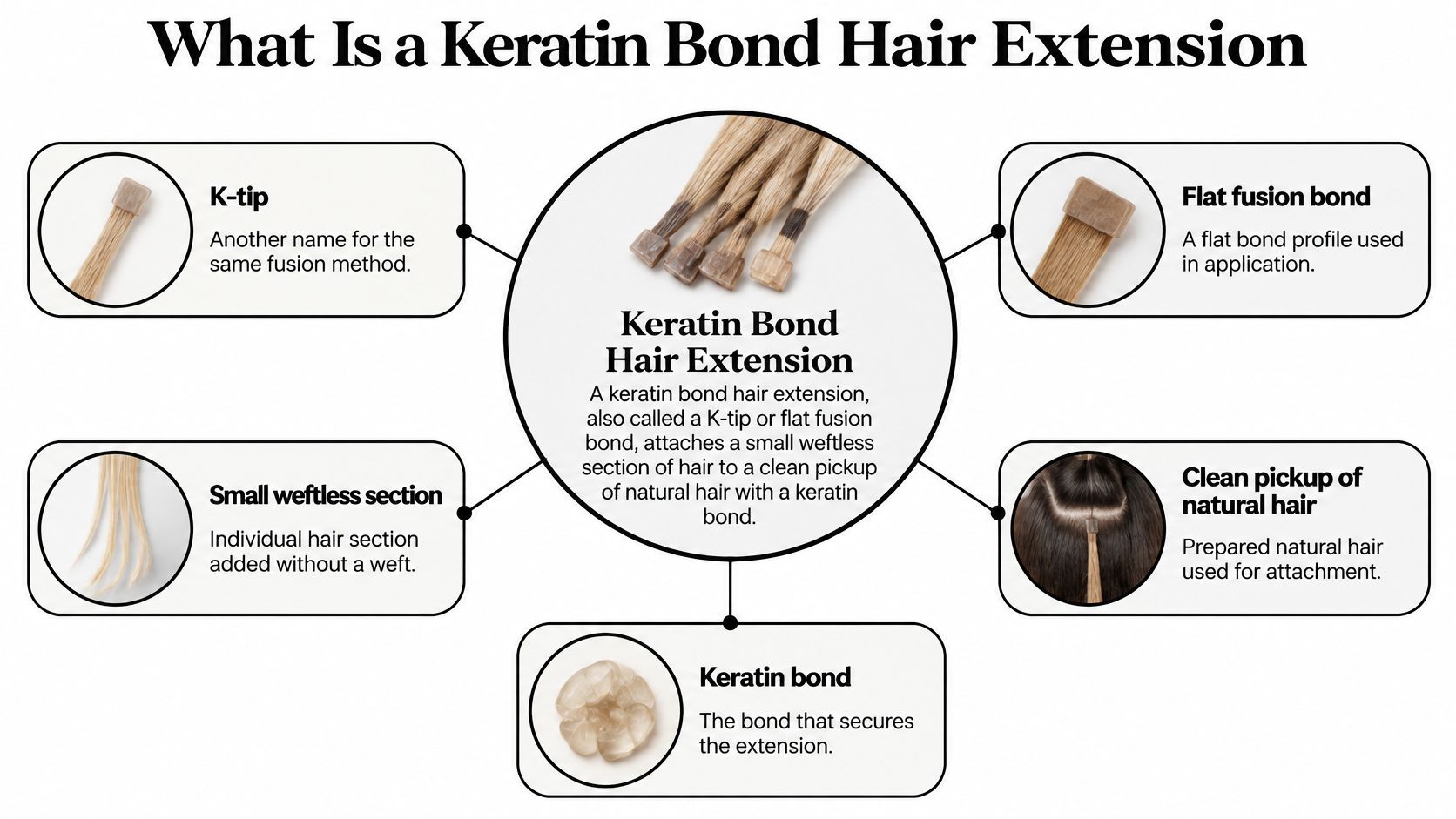
A keratin bond hair extension, also called a K-tip or flat fusion bond, attaches a small, weftless section of extension hair to a clean pickup of natural hair. Heat softens the keratin-based adhesive, which sets around the pickup as it cools. The bond's security and effect on the hair depend on pickup size, placement, heat control, and removal technique.
Fusion is one of several salon extension methods, alongside tape-in, sew-in, clip-in, and microlink. It creates discreet attachment points and can be durable, but installation takes time, and rushed placement or removal can damage hair. Training, a careful consultation, and a documented removal plan all matter.
A keratin-bond installation is different from a keratin smoothing service. The FDA's guidance on formaldehyde in hair-smoothing products explains that some smoothing formulas contain formaldehyde, formalin, or methylene glycol, and that heating can release formaldehyde gas into salon air. The FDA states that exposure above 0.1 ppm can cause serious irritation of the eyes, nose, and lungs, according to its formaldehyde information for hair-smoothing products. OSHA reports that some products labeled formaldehyde-free have tested positive for formaldehyde.
These warnings concern smoothing chemistry, not ordinary prebonded extension tips. Keep smoothing formulas out of a K-tip protocol, and don't treat products as chemically equivalent just because both use “keratin” in their labels. Check the product-specific safety data sheet, ventilation requirements, and PPE guidance before using any heated chemical product.
Ask the supplier about tip ingredients and whether the extension hair has intact cuticles. Check these details during the consultation, then assess how the planned attachment density and strand load will affect the client's hair.
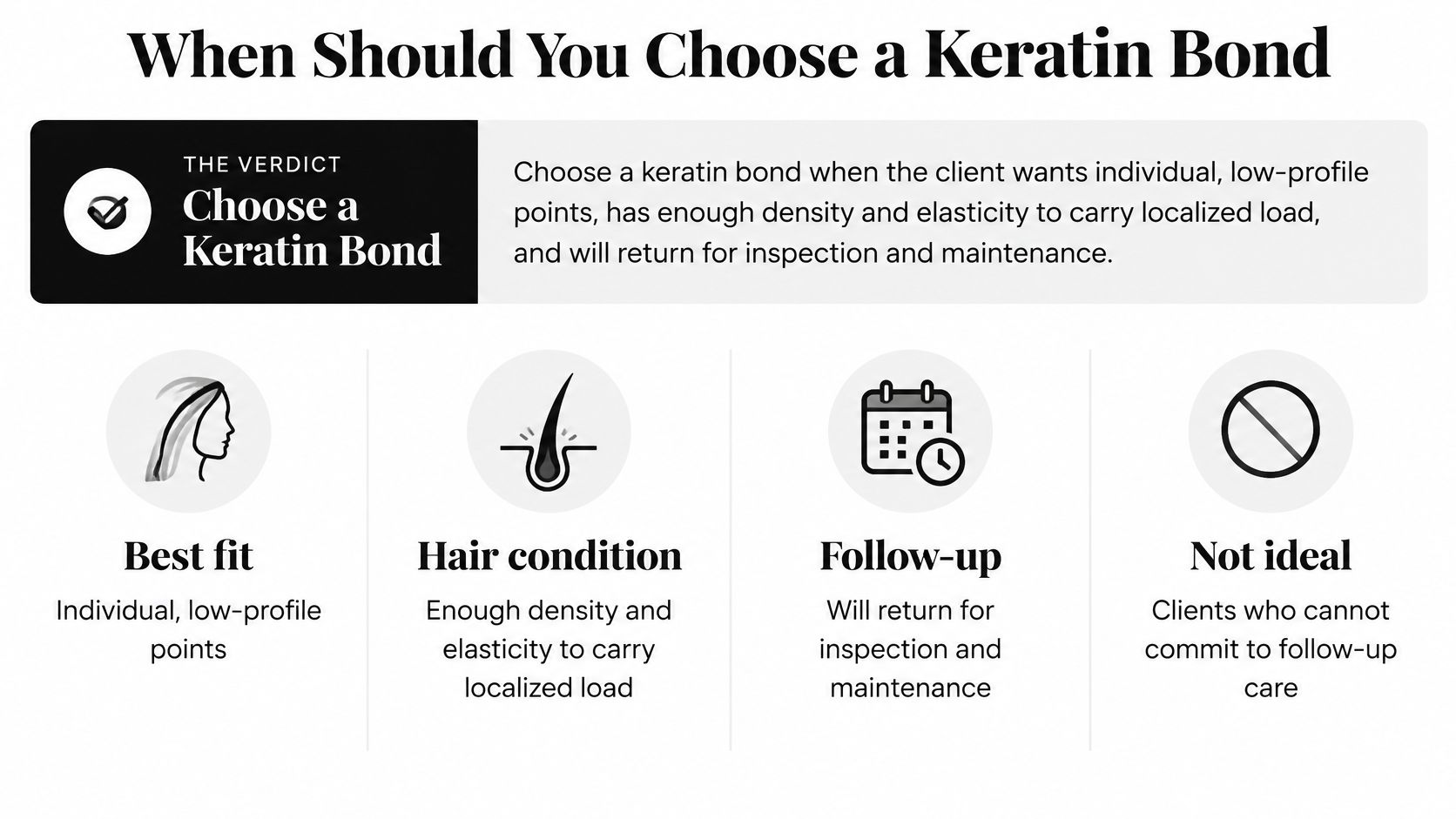
Choose K-tips for individual, low-profile placement when the hair can carry localized weight and the client can return for inspection and maintenance. Choose another method when the hair fails a wet strand check, the hairline cannot tolerate added tension, or the client wants an installation with less upkeep.
Let the hair assessment set the booking. Use this comparison to weigh attachment style against practical trade-offs. Changing methods does not remove traction risk if the alternate plan places a similar load on the hair.
| Method | How it attaches | Fits best when | Main trade-off |
|---|---|---|---|
| Keratin bond / K-tip | Flat keratin tip fused with controlled heat | Discreet points and enough elastic density | Time, heat skill, and removal skill |
| Tape-In | Pre-taped weft sandwiches | Faster install and a client who will protect adhesive | Tape refresh and oil or product slip |
| Tape Weft | Adhesive weft row | Row coverage without individual tipping | Adhesive maintenance and row visibility |
| Volume Weft | Sewn or beaded row | Clients who need coverage and density | Row weight and bead or thread tension |
| Thin Weft | Flatter weft row | A lower-profile row than a Volume Weft | Less coverage per row |
| Microlinks | Cold bead on a section | No-heat individual placement | Bead slip and concentrated link weight |
| Clip-In | Temporary clips | Events and trials | Not a daily wear cycle |
| Bulk | Stylist finishes or tips the hair | Custom color or bond work | More in-salon labor |
Individual placement requires follow-up. A client who cannot commit to return visits is a poor K-tip fit. Tape-In or Tape Weft may suit a faster row plan if the client follows adhesive-care guidance, though both bring upkeep and visibility trade-offs. For a comparison of individual attachment options, see this guide to K-tip versus I-tip extensions.
Stellar Market Research estimates that professional salon application accounts for 71% of keratin-bond extension sales (Stellar Market Research's hair extension market estimates). The same source gives a typical wear period of 8–12 weeks per application, with maintenance potentially extending service life to 12–16 weeks. Treat those figures as market estimates, not a personal schedule or guarantee. Set follow-up timing by inspecting the installation and the natural hair.
The natural hair sets the load each bond can carry. Hair-grade labels such as 6A through 10A aren't technical standards, so assess the fiber's cuticle condition, shedding, combability, and wet resistance instead.
Wet elasticity helps reveal how chemical and thermal processing has affected a strand. In a controlled hair-fiber evaluation, tensile strength measured 3.2 ± 0.7 for virgin hair, 2.8 ± 0.6 after bleaching, and 2.7 ± 0.7 after bleaching and dyeing (the controlled hair-fiber evaluation). The measured reductions were approximately 12.5% after bleaching and 16.6% after bleaching plus dyeing (the controlled hair-fiber evaluation). Use wet response as a screening check alongside density and processing history.
| What you see | Placement choice | Why |
|---|---|---|
| Fine hair or sparse temples and hairline | Use fewer, lighter points, or leave those zones empty | Narrow pickups carrying added mass create continuous pull |
| Medium density with springy wet stretch | Use a balanced pickup matched to the tip | Matching the section to the tip spreads the load |
| Coarse hair | Individual bonds may suit the hair if zones aren't stacked | Diameter alone doesn't determine how much load one area can carry |
| Repeatedly lightened or highly porous hair | Use smaller sections, inspect sooner, or choose another method | Processing can reduce the fiber's tolerance for added weight |
| Poor wet elasticity | Avoid heavy K-tips | Weak wet response signals limited capacity for added load |
| Postpartum shedding | Delay the install or keep the plan very light | Changing density makes the load harder to distribute |
| Active alopecia or scarring patches | Don't install; refer for medical evaluation | Tension at attachment sites can aggravate existing hair loss |
A dermatology review reports a case series of four women who developed multiple patches of alopecia at extension attachment sites (the dermatology review of extension-related traction). The review explains that constant tension can separate the hair shaft from the follicular opening, and that traction alopecia can progress from nonscarring to scarring or permanent loss. Plan placement around strand weight, attachment density, and the client's density, elasticity, and chemical history.
Placement rule: Match each pickup to the tip, distribute the load, and check direction and comfort before finishing the row.
For clients with fine or thin hair, Conde Professional's guide to extension options for fine hair can help frame the method discussion. Compromised hair may still be unsuitable for K-tips.
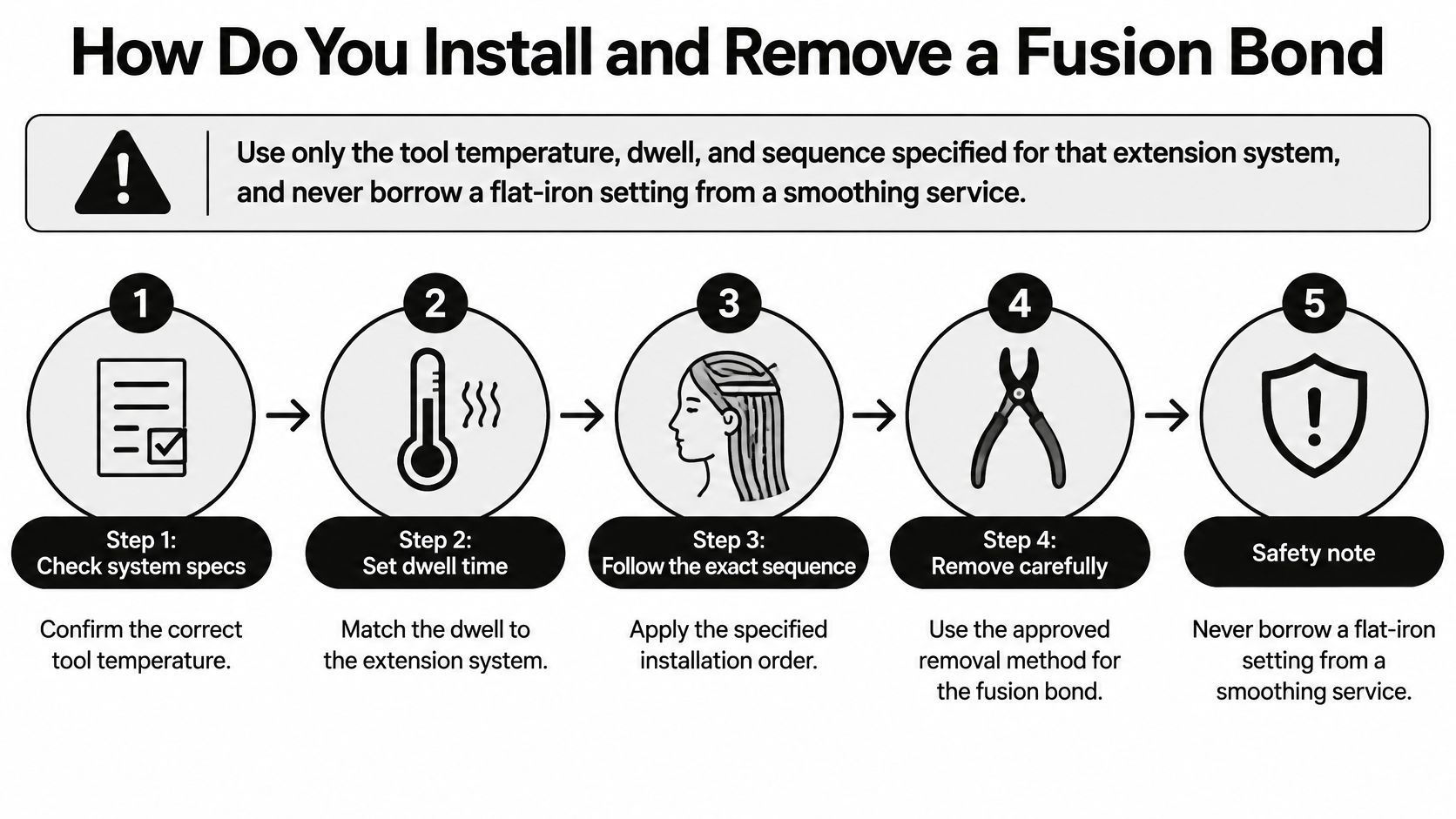
Use only the tool temperature, dwell, and sequence specified for the extension system. Never borrow a flat-iron setting from a smoothing service. Research on thermally treated human hair has found pronounced, nonlinear property changes at high temperatures, especially in bleached hair. Those findings support consistent, limited heat, not an invented K-tip setting (the study of thermally treated human hair).
Keep a heat-stable extension stand at the station to manage strand-by-strand pieces during installation and take-down. For styling, direct heat toward the mid-lengths and ends and leave a buffer around each bond. The OSHA hair-salon guidance discusses heated smoothing products and their exposure risks; its smoothing-service figures aren't K-tip activation specifications. Follow the extension system's verified method instructions instead. Conde Professional's guide to using keratin glue sticks can be consulted for product handling.
Secure bonds do not rule out a scalp reaction. Irritation may come from the bonding formula, heat, friction, cleansing products, or a scalp condition that predates installation.
Stop and reassess if itching intensifies or spreads, or if the client develops burning, redness, swelling, oozing, a rash beyond the attachment points, or discomfort they try to mask with oils or occlusive products. These products can obscure a worsening reaction.
A dermatology reference on scalp contact dermatitis identifies keratin treatments as a common cause of scalp dermatitis and notes that cosmetic scalp procedures, including extensions, can involve irritation or allergic contact reactions. Treat clear stop signals as a reason to end the service and arrange appropriate medical evaluation.
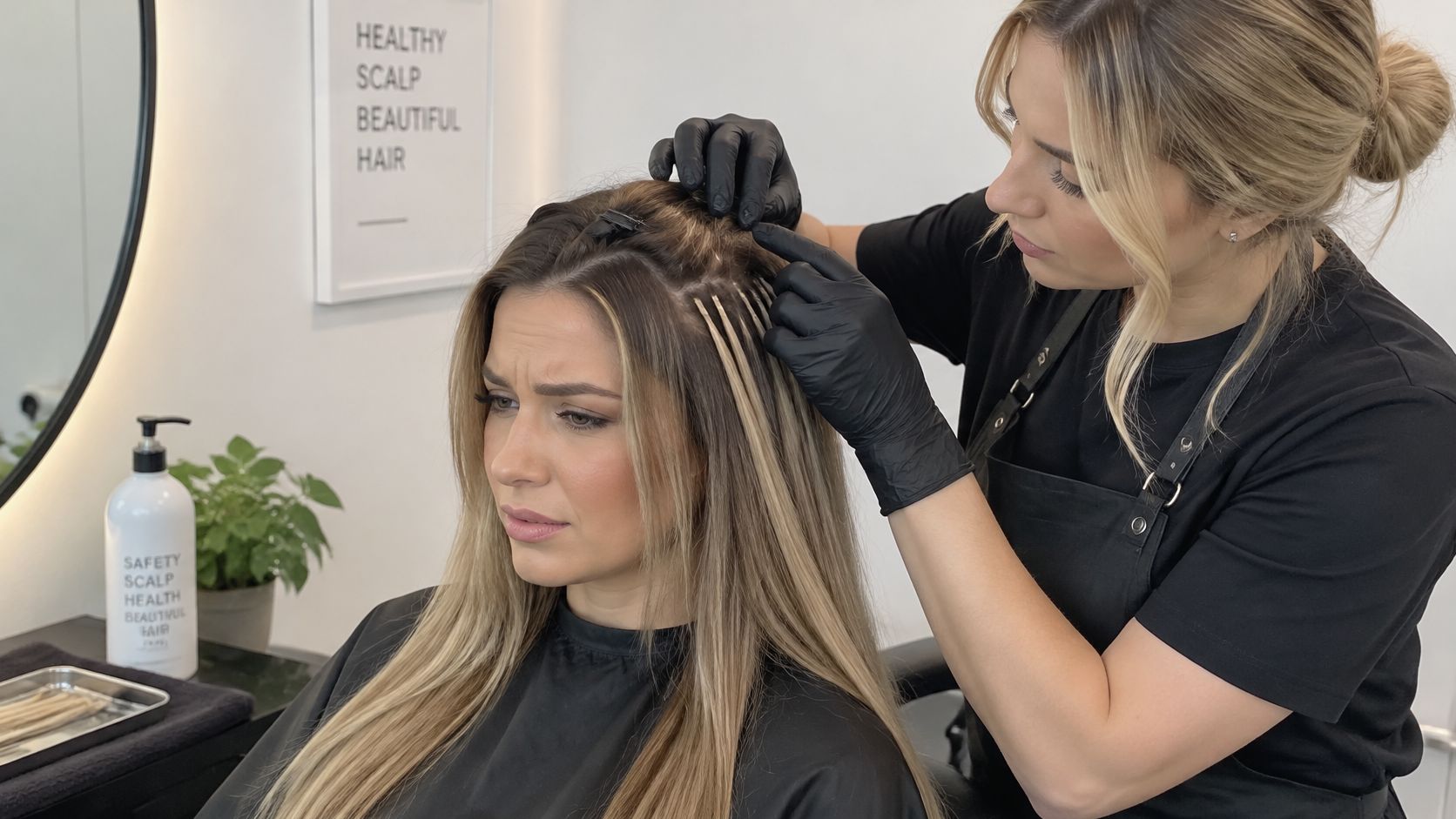
Ask about prior adhesive reactions, reactions to smoothing services, eczema or psoriasis, and recent chemical work. Record relevant scalp history and disclose known bond ingredients when that information is available. Follow the bond maker's patch-test policy and professional guidance. Explain that a negative patch test cannot guarantee tolerance during prolonged wear.
Consent should cover heat, tension, residue, possible irritation, and the need to report symptoms promptly. Schedule an inspection before the client leaves, and give aftercare instructions that do not encourage applying oils or occlusive products to a reaction.
Stop-service rule: If symptoms spread, the scalp oozes or swells, or burning persists, stop the service and arrange appropriate removal and medical evaluation.
If a concerning reaction starts during application, stop immediately. Do not complete the row, apply essential oils as treatment, or switch to another adhesive without understanding the client's reaction history. When it is safe to proceed, remove affected bonds with the appropriate softener. Refer the client to a physician or dermatologist if symptoms spread or they remain uncomfortable.
A consistent removal and referral protocol gives the salon a clear response. For general background on hair structure and the scalp, consult the guide, but use medical evaluation to assess a scalp reaction.
Check the bond format, shade, and supplier terms before you order. Choose specifications you can compare with the approved installation plan. For guidance on professional purchasing, review wholesale human hair extension information.
For example, K-Tip Amber Glow #7/10 Superblend is a flat keratin-tipped option for hot fusion. The catalog lists four variants and shows them in stock. Compare the available options with the approved plan rather than treating the product description as a fit assessment.
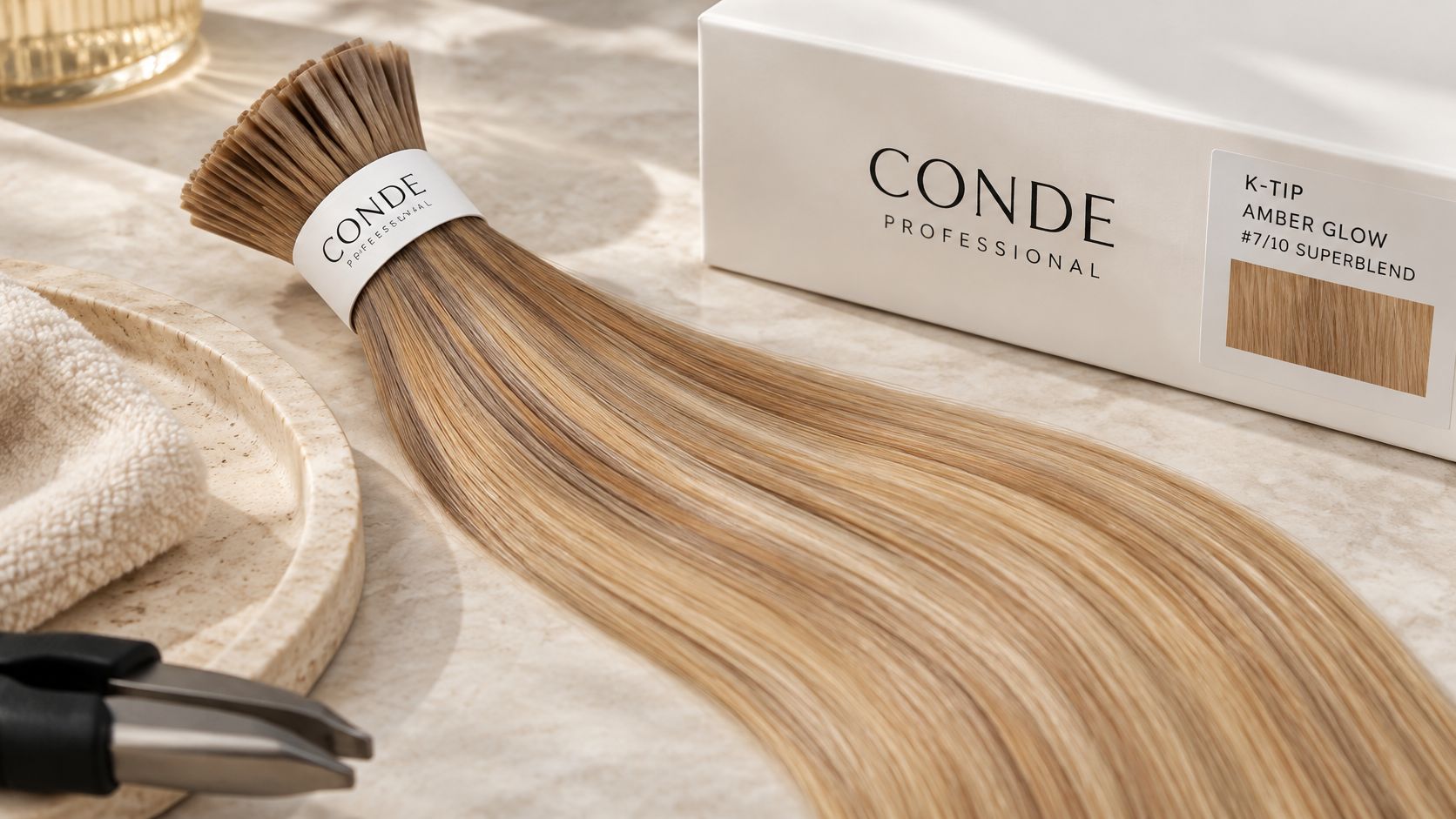
Before ordering, confirm professional purchasing access and ask the supplier to clarify any specification the installation depends on. Don't substitute undocumented gram weights, strand counts, or tensile claims for an assessment of the hair and the system's written instructions.
Book fusion only when the client's hair can carry the planned strand load and attachment density. Use the assessment in Section 3 to decide whether the hair can support K-Tips, and apply the stop-service signs in Section 5 if the scalp reacts.
At the consultation, say: “I'll assess whether your hair can support this attachment method. If it can't, we'll choose another option before booking the install.” Record the client's preferred method, the areas approved for attachments, and any alternative discussed.
If fusion is unsuitable, consider Tape-In, Thin Weft, or a Clip-In trial based on the client's attachment and maintenance preferences. If K-Tips are suitable, order through a professional account and contact Conde Professional by text, phone, or email for shade guidance when the color match is unclear.
Conde Professional offers K-Tips, Tape-In, Tape Weft, Volume Weft, Thin Weft, Clip-In, and Bulk hair for salon professionals. Review the K-Tip options and professional account information before ordering.


